What to Eat Before Exercise: Your Complete Workout Fuel Guide
When it comes to fueling a workout, there’s no shortage of advice online. Should you eat before you exercise? Do you really need sports drinks? And what about pre-workout coffee? Let’s separate fact from fiction and cover everything you need to know in order to fuel your workouts the smart way.
Here’s the one idea I want you to carry through this whole guide: think of your workout like a road trip. A quick spin around the block barely needs any gas. But a long haul—or a scorching-hot day—means you top off the tank before you leave, sip along the way, and refill when you get home. Match your fuel to your workout, and everything else falls into place.
Should you eat before exercising?
The honest answer is: it depends on how long and how hard you’re going.
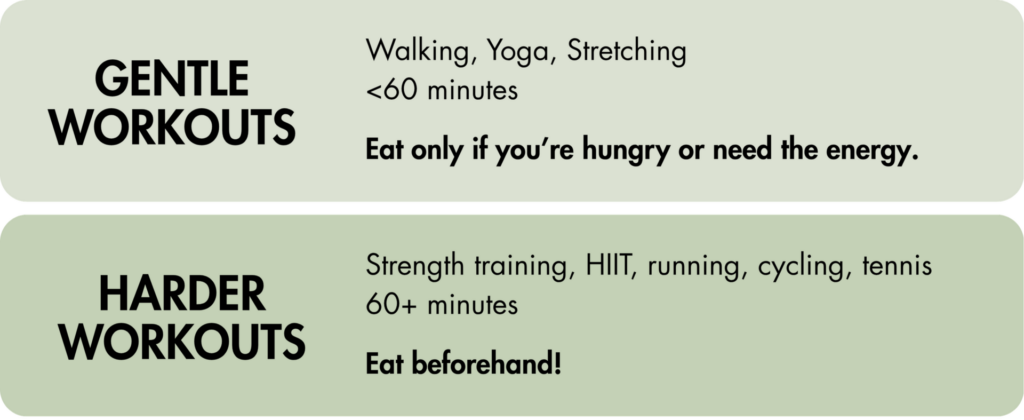
If you’re doing something gentle and under an hour—an easy walk, a stretch session, a gentle yoga flow—and you feel good, you’ve got energy, and you’re not hungry? You do not have to force yourself to eat. Go enjoy it.
But if you’re really working—lifting weights, running, cycling, a HIIT or spin class, a competitive game of pickleball or tennis—or you’re going longer than an hour, you’ll almost always feel stronger and perform better with a little fuel in the tank first.
And I have to address the big buzz around women and “fasted” workouts—exercising on an empty stomach. Researchers are still studying the differences between men and women, but we do not have strong evidence that every woman needs to avoid food. So here’s my advice: listen to your body. If fasted workouts leave you sluggish, lightheaded, or ravenous, have a small snack first and see if you feel better. You are your best judge.
Okay—so what’s the best thing to eat?
Now that you know whether to eat, let’s talk about what to eat. Here’s my one simple rule that makes it foolproof: the closer you are to your workout, the lighter your food load should be.
If you’re eating just 15 to 30 minutes before, you want quick, easy-to-digest carbs—that’s your body’s premium fuel—and you want to keep it low in fat and fiber so it doesn’t sit heavy in your stomach. Think fast energy in, fast energy out to your muscles.
If you’ve got one to three hours, you have time to digest a real, balanced mini-meal—carbs for energy plus a little lean protein to keep you steady. Carbs are the star before exercise; protein is the supporting act.
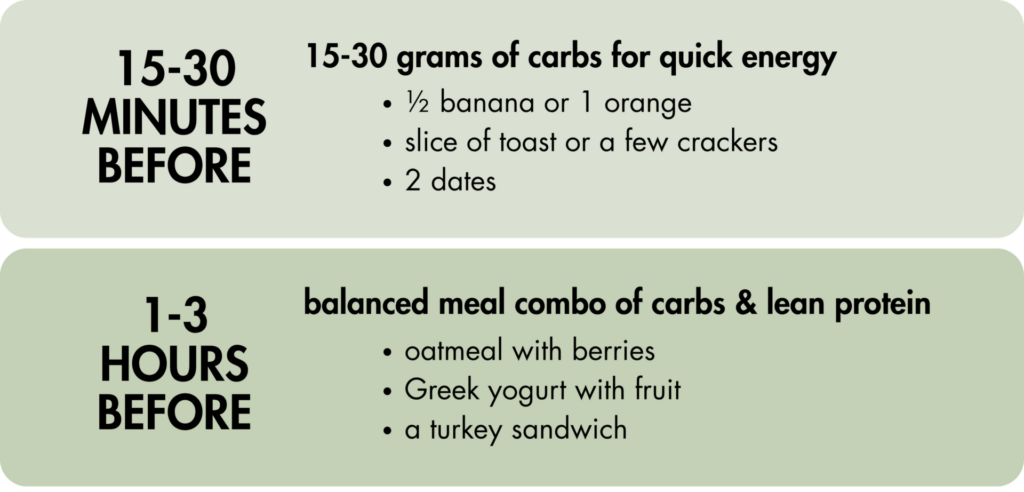
Pre-Workout Fuel: 1-3 hours before exercise
Do you really need sports drinks or electrolytes?
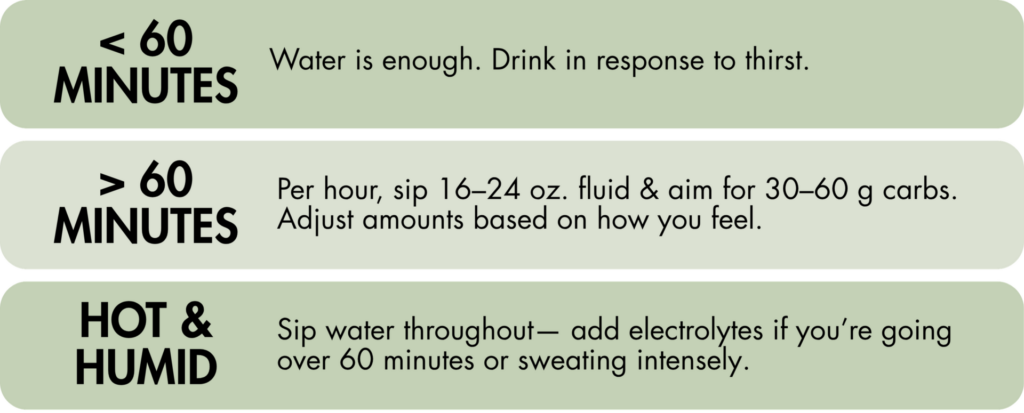
This is where a lot of people spend money and rack up extra sugar and calories they simply don’t need. Here’s the truth: for most workouts under an hour, plain water is all you need.
But remember our road trip. If you’re going farther, or it’s hot and humid, you need to refuel along the way, because you’re sweating out fluid and sodium while burning through your stored carbs. So for anything longer than an hour, a sports drink or carb-rich foods plus electrolytes helps keep your energy up and replaces what you’re losing.
And one myth I really want to bust: more water is not always better. During long endurance workouts, chugging too much plain water can actually dilute the sodium in your blood, and that’s a real risk. The goal isn’t to force fluids; it’s to replace what you’re losing.
Can caffeine actually make my workout better?
Oh, this is a fun one, and the answer is yes! Caffeine is one of the very few workout boosters that has real, strong science behind it. A little bit before you exercise can help you feel more energized and focused, push a little harder, and — my favorite part — it actually makes the effort feel easier. It’s a proven winner for endurance, and it gives your strength and power a nice bump too.
Here’s the sweet spot: a small-to-moderate amount about 30 to 60 minutes before you start, that’s when it kicks in. For most people, that’s just one to two cups of coffee. You do not need a mega-dose or a scary pre-workout powder to get the benefit.
But a few smart rules. More is not better — too much leaves you jittery, racing-hearted, or with an upset stomach. Keep your total caffeine for the day under about 400 milligrams, roughly four cups of coffee, and cut yourself off by early afternoon so it doesn’t steal your sleep, because sleep is where the real recovery happens. And if you’re pregnant or have a medical condition, always check with your doctor.
Caffeinated Beverages
Energizing Bites
What should I eat after I work out?
Post-workout is where the magic happens — this is when your body rebuilds and comes back stronger. I make it easy to remember with my Three R’s: Refuel, Repair, Rehydrate, ideally within 2 hours of finishing (though the earlier, the better).
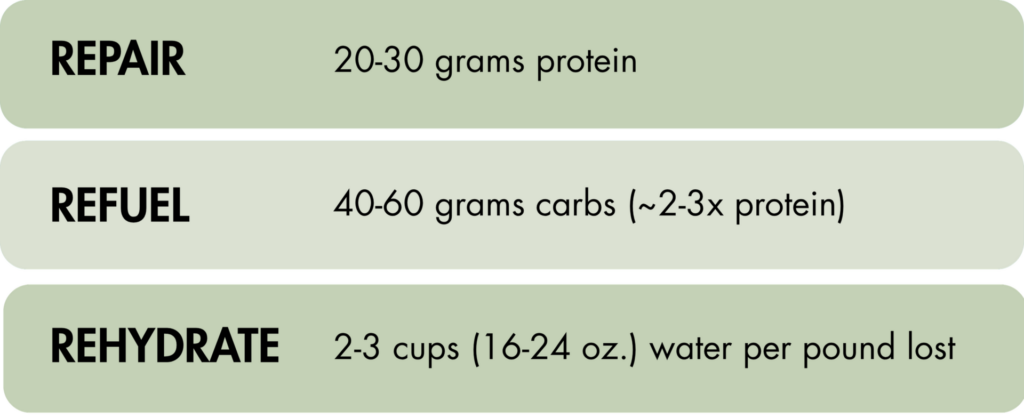
Let’s start with protein, because this is the big one. You want to aim for 20 to 30 grams of protein: that’s about a cup of Greek yogurt or cottage cheese, a palm-size piece of chicken, fish, or meat, three eggs, or a scoop of protein powder blended into a smoothie. Any quality protein works — dairy, meat, eggs, or plant-based.
Then pair that protein with carbs to restock your energy, roughly two to three times the protein, so about 40 to 60 grams after a harder or longer session. If it was seriously hard, you’ll need more carbs for recovery.
And for water, here’s my favorite pro move: hop on the scale before and after a sweaty workout, and drink about 2 to 3 cups (16–24 oz) for every pound you lost. That weight loss corresponds to water loss, so it’s a terrific way to measure how much you should aim to drink in the hour that follows.
You don’t need anything fancy here. Water and simple, everyday foods work beautifully.
Easy recovery meals
- Protein smoothie
- Cottage cheese with berries
- Eggs and whole-grain toast
- Grilled chicken wrap
- Salmon with sweet potato and veggies
Fueling smart doesn’t have to be complicated. Think of it like your own personal road trip: match the fuel to the distance, listen to what your body’s telling you, and use food and water to help you get stronger, not just get through it.
Post-Workout Recipes: within 2 hours of exercise