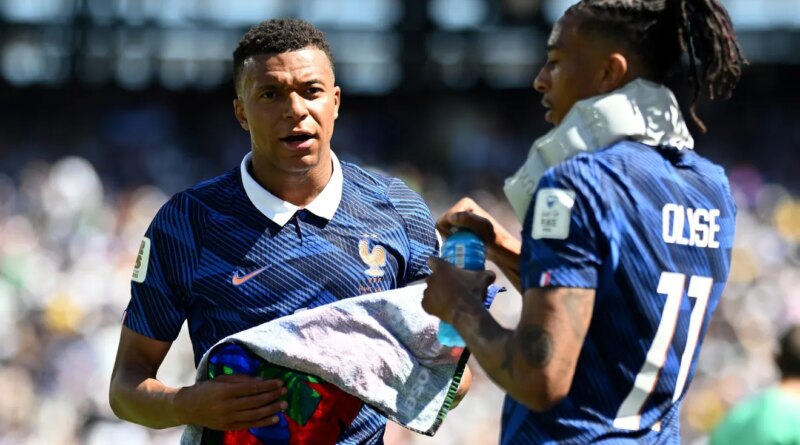
World Cup: Here’s Why New Hydration Breaks Are Getting A Mixed Reception
Topline
The 2026 World Cup has sparked a divide with the inclusion of hydration breaks at this year’s games, with players, coaches and observers expressing mixed feelings about how the breaks disrupt the competitive flow of matches and interrupt games with advertisements.
Kylian Mbappe #10 of France looks on during a hydration break in the FIFA World Cup 2026 Group I match between France and Senegal.
Photo by Hannah Peters – FIFA/FIFA via Getty Images
Key Facts
Following the sweltering 2025 FIFA Club World Cup in the U.S. last year, FIFA introduced the three-minute hydration breaks, which take place midway through the two halves of each game and are taken regardless of weather or temperature conditions at this year’s World Cup.
The rule divides games into a total of three breaks, or four quarters, a significant difference from the singular 15-minute break taken in the middle of typical 90-minute matches.
Virgil van Dijk, star defender for the Netherlands, jabbed at commercials airing during the hydration breaks and said it’s “not great,” for neutral fans watching on TV and that the breaks would be useful for hot conditions but, “I think you have to look at it in every game, separately, in my opinion.”
Emma Hayes, the head coach of the U.S. women’s national team, characterized the hydration breaks as “momentum breaks,” acknowledging their usefulness for teams on the backfoot and noting, “It’s a shame… but it seems like it could be something that could be here for good,” according to ESPN.
U.S. men’s national team head coach Mauricio Pochettino told reporters he does not like the water breaks, adding, “I only like it when the conditions are extreme, but when the conditions are good, it is unnecessary.”
Hydration Breaks And Advertisements
Fox, one of the U.S. broadcasters covering the World Cup, shows advertisements during the breaks while streaming platform Peacock, which shows Telemundo’s Spanish-language broadcasts, does not show full-screen commercial breaks. A commercial break taken by Fox during the World Cup’s opening game went over the allotted hydration break time by 40 seconds, though FIFA has decided it will not punish the broadcaster for missing gametime. Fans on social media have raised concerns the hydration breaks were being used by networks to capitalize on advertising revenue.
Contra
Germany head coach Julian Nagelsmann told reporters after his team’s 7-1 rout of Curaçao that the water break helped “to simply reiterate what we had already adjusted on the board,” referring to Germany’s adjustments to Curaçao’s unorthodox formation. Alexei Lalas, former American soccer player and Fox Sports commentator, said Monday he has “no problem” with the hydration breaks, acknowledging it “changes how you play/coach/watch” but that it is a win-win for players and advertisers. “There will be a generation whose version of the beautiful game includes quarters,” he added.
Tangent
The removal or censorship of sponsored products and stadiums at the World Cup has caught the attention of viewers and media. FIFA’s clean stadium policy removes all non-approved branding from host venues, resulting in food and drink logos being covered and stadiums being renamed. In a press box at Santa Clara, California’s Levi’s Stadium, which has been renamed to “San Francisco Bay Area Stadium” under FIFA’s rules, condiment bottles were taped over to cover their respective brands. Levi’s Stadium leaned into the temporary renaming of its venue, saying in a social media post“Welcoming the world to the beautiful [redacted] stadium!”
Key Background
The 2025 FIFA Club World Cup hosted in the U.S. was the catalyst for the hydration breaks at this year’s World Cup. During the 2025 competition, temperatures in host cities reached as high as 100 degrees Fahrenheit. Atlético Madrid player Marcos Llorente told reporters“My toes were sore, even my toenails were hurting,” though he said there was “no excuse” because the weather was “the same for everyone.” Temperatures at some of this year’s matchups have reached high 80s and low 90s in states like New Jersey, Philadelphia and Texas. FIFA has not yet confirmed if it will make the hydration breaks a permanent rule for future competitions.
Further Reading
Mauricio Pochettino and World Cup coaches cleared to use laptops during water breaks (The Athletic)