What Can We Learn from Prophet Musa’s Leadership? – Muslim and Quran

Last updated on October 2nd, 2026 at 01:32 pm
Prophet Musa عَلَيْهِ ٱلسَّلَامُ is one of Islam’s most respected prophets. According to most scholars, he lived 120 years, though a few also report his age as 160 years. Most classical historians hold that he lived 120 years. He is among the Prophets mentioned by name in the Quran. In fact, he is the most frequently mentioned Prophet in the Quran, for as many as 136 times in 34 different Surahs.
Prophet Musa عَلَيْهِ ٱلسَّلَامُ was elevated to the Prophethood by age 40, according to classical historical accounts. This means his Prophetic mission stretched over 80 years, which is quite remarkable in itself. Before being assigned Prophethood, he spent most of his early life in the royal family of Egypt. He lived in Pharaoh’s palace for around 30 years, then spent the next 10 years in Madyan working for two sisters, and later married one of them. They were the daughters of a righteous man who was, according to some historians, the Prophet Shuaib عَلَيْهِ ٱلسَّلَامُ. Thereafter, he was blessed with Prophethood by Allah سُبْحَانَهُۥ وَتَعَالَىٰ, which lasted for 80 years; quite a long period.
His mission as a Prophet is marked by deep-rooted faith in Allah سُبْحَانَهُۥ وَتَعَالَىٰ, service to his nation, patience in hardships, moral values, courage to face difficult situations, and accountability. For modern life, his early and Prophetic life provides profound lessons for generations across history. His life teaches lessons about faith, courage, patience, justice, meaningful communication skills, responsibility, and determination. He is often remembered as one of the most determined and courageous Prophets, who spent an untiring time in his prophetic mission. Allah assigned him the task of preaching the Divine Message to the most powerful and tyrannical ruler of his era, Pharaoh. He also led the Children of Israel, helped them escape oppression, and guided them toward obedience to Allah سُبْحَانَهُۥ وَتَعَالَىٰ.
Prophet Musa’s Leadership Qualities
His Prophetic mission is marked by extraordinary leadership qualities that offer profound lessons for the contemporary world, even after thousands of years. Some of his leadership qualities that left a profound impact in history and are still more than relevant in the modern era are summarized here:
1. Unwavering Trust in Allah سُبْحَانَهُۥ وَتَعَالَىٰ – The Foundation of Leadership
The leadership ability of Prophet Musa عَلَيْهِ ٱلسَّلَامُ is deeply rooted in complete and unwavering trust in Allah سُبْحَانَهُۥ وَتَعَالَىٰ. He showed his firm belief in Allah سُبْحَانَهُۥ وَتَعَالَىٰ in some of the most testing times of his Prophethood. When he led his nation, the Children of Israel, out of the Kingdom of Pharaoh, they were trapped at the last leg of their journey between the sea and Pharaoh’s army. This was the most terrifying situation for Prophet Musa عَلَيْهِ ٱلسَّلَامُ and his people. The Children of Israel were so frightened of this situation that they said We are trapped, but Prophet Musa عَلَيْهِ ٱلسَّلَامُ showed firmness in his belief and trust in Allah سُبْحَانَهُۥ وَتَعَالَىٰ. The situation and response of Prophet Musa عَلَيْهِ ٱلسَّلَامُ are recorded in the 61st and 62nd verses of Surah Ash-Shu’ara:
Translation
- And when the groups came face to face, the companions of Moses cried out: “We are overtaken!”
- Moses said: “Certainly not. My Lord is with me; He will direct me.”
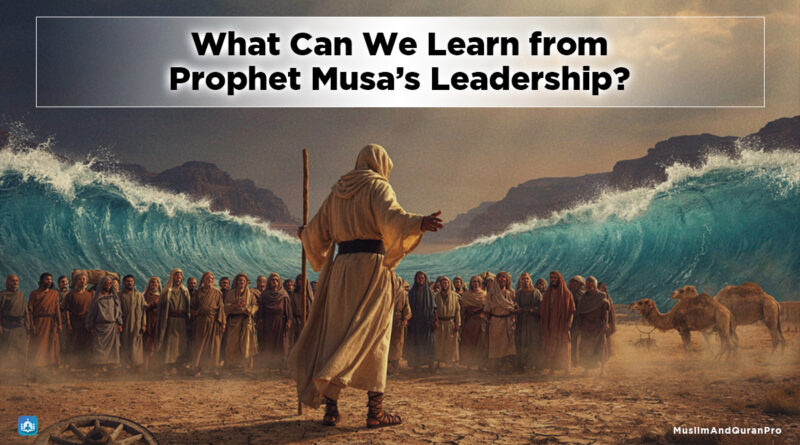
What happened next is one of the most amazing incidents in human history. On the Command of Allah سُبْحَانَهُۥ وَتَعَالَىٰ, Prophet Musa عَلَيْهِ ٱلسَّلَامُ struck the sea with his staff, and the sea was parted, giving way for his people to go out of the kingdom of Pharaoh. This is mentioned in the 63rd verse of Surah Ash-Shu’ara.
Translation – Then We revealed to Moses, (commanding him): “Strike the sea with your rod.” Thereupon the sea split up, and then each became like the mass of a huge mount.
This is the biggest lesson for us, as learned from the life and leadership of Prophet Musa عَلَيْهِ ٱلسَّلَامُ. Complete faith in Allah سُبْحَانَهُۥ وَتَعَالَىٰ is the basic requirement of successful leadership. What Prophet Musa عَلَيْهِ ٱلسَّلَامُ did in that difficult and terrifying situation was not a simple blind faith; he was facing a situation that was apparently impossible, but he trusted and relied on Allah سُبْحَانَهُۥ وَتَعَالَىٰ and saved his nation. The lesson for us is that we should remain firm in our belief and trust in Allah سُبْحَانَهُۥ وَتَعَالَىٰ, continue making practical efforts, and leave the outcome to Allah’s سُبْحَانَهُۥ وَتَعَالَىٰ Will.
2. When Facing Difficulty in Communicating – Seek Allah’s سُبْحَانَهُۥ وَتَعَالَىٰ Help
When Prophet Musa عَلَيْهِ ٱلسَّلَامُ was entrusted with the important task of preaching the Divine Message to Pharaoh, he realized he might not be able to communicate effectively with Pharaoh. There may have been several reasons for this thought, but the important thing is that he did not hesitate to acknowledge his shortcomings and immediately turned to Allah سُبْحَانَهُۥ وَتَعَالَىٰ, seeking His help. He requested the company of an aide, in the shape of his brother Haroon. Allah سُبْحَانَهُۥ وَتَعَالَىٰ accepted his request and allowed him to take along with him his brother Haroon. The verses 25 to 30 of Surah Ta-Ha narrate this as follows:
Translation
- Moses said: “Lord! Open my breast for me;
- and ease my task for me,
- and loosen the knot from my tongue
- so that they may understand my speech;
- and appoint for me, from my household, someone who will help me bear my burden –
- Aaron, my brother.
The next two verses of this Surah (31 to 32) clarify the reason behind Prophet Musa’s عَلَيْهِ ٱلسَّلَامُ request.
- Strengthen me through him
- and let him share my task
So, his request was accepted, and he accomplished the mission successfully. The lesson for us is that true leadership lies in recognizing your weaknesses. Once realized, one must not feel shy about asking for the assistance of a competent colleague. Leadership does not mean that you know everything; your job is to manage the available resources to accomplish a task successfully. The essence of leadership is recognizing your strengths and weaknesses and sharing the burden with those who have the required ability.
3. Leader Must Have the Courage to Raise Voice Against Injustice But Decently
Pharaoh was the most powerful ruler of his time, but he became extremely oppressive toward the Children of Israel (Bani Israel). When Prophet Musa عَلَيْهِ ٱلسَّلَامُ was entrusted with the task of talking to him, he was also commanded by Allah سُبْحَانَهُۥ وَتَعَالَىٰ to remain gentle. Accordingly, he did it gracefully, with the assistance of his brother Haroon. Despite Pharaoh’s tyrannical attitude, he did not use abusive language or become harsh with Pharaoh. Yet he did not remain silent in the face of Pharaoh’s injustice. The 43rd and 44th verses of Surah Ta-Ha narrate it as follows:
Translation
- Go both of you to Pharaoh, for he has transgressed all bounds,
- and speak to him gently, perhaps he may take heed or fear (Allah).”
The lesson from this part of Prophet Musa’s mission is that a leader must not remain silent in the face of injustice, but must also show courage and wisdom in such situations.
4. Leader Needs to Admit Their Mistakes
Prophet Musa’s عَلَيْهِ ٱلسَّلَامُ life is full of fearful and difficult circumstances, which compelled him to make a serious mistake. He accidentally killed a person in an encounter but instantly admitted his mistake before Allah سُبْحَانَهُۥ وَتَعَالَىٰ, as narrated in the 16th verse of Surah Al-Qasas. As a result, he had to leave Egypt in haste.
Translation – Then he prayed: “My Lord! I have indeed inflicted wrong on myself, so do forgive me,” wherefore Allah forgave him for He is Ever Forgiving, Most Merciful.
Confessing his mistake, Prophet Musa عَلَيْهِ ٱلسَّلَامُ established an example for generations to come. Mistakes can happen in everyone’s life, but strong leadership means accepting them and taking responsibility for the outcome. Admitting your mistake does not weaken your authority; in fact, it earns your team’s trust in your leadership.
5. Prophet Musa عَلَيْهِ ٱلسَّلَامُ and Pharaoh – Comparison of Leadership
Prophet Musa عَلَيْهِ ٱلسَّلَامُ led his nation, the Children of Israel, with justice, humility, and compassion. He freed his people from Pharaoh’s oppression and guided them to worship Allah سُبْحَانَهُۥ وَتَعَالَىٰ. In contrast, Pharaoh ruled his nation through power. He did injustice in his kingdom, especially with the Children of Israel. His leadership model was to use power to dominate people and divide them to maintain his authority.
The Quran rejects Pharaoh’s leadership style, as narrated in the 39th and 40th verses of Surah Al-Qasas.
Translation
- And he and his hosts waxed arrogant in the land without any right, believing that they will never have to return to Us!
- Eventually We seized him and his hosts, and We flung them into the sea. So do see the end of the wrongdoers!
The lesson from Prophet Musa’s عَلَيْهِ ٱلسَّلَامُ leadership is that power should not be used to control people, but to serve them.
6. Delegate Responsibility to Your Team
When Prophet Musa عَلَيْهِ ٱلسَّلَامُ went to Mount Sinai (also remembered as Jabal at-Tur in Islam) to have a direct talk with Allah سُبْحَانَهُۥ وَتَعَالَىٰ, he appointed his brother Haroon as his deputy to look after his nation. It was a journey, initially for thirty days, but extended to forty days, as commanded by Allah سُبْحَانَهُۥ وَتَعَالَىٰ. As a leader of his nation, he did not leave his people without leadership during his journey to Mount Sinai. He delegated his authority to his deputy so his nation would not be left without guidance. The 142nd verse of Surah Al-A’raf narrates this event as follows:
Translation – And We appointed for Moses thirty nights, to which We added ten, whereby the term of forty nights set by his Lord was fulfilled. And Moses said to Aaron, his brother: ‘Take my place among my people, act righteously, and do not follow the path of those who create mischief.’
So, the lesson in this part of his life is that a leader should always delegate powers to his team, with clear guidance, to continue the affairs as usual. Sharing power with the team distributes the workload and improves your projects.
7. Leadership Requires Patience
The life and Prophetic mission of Prophet Musa عَلَيْهِ ٱلسَّلَامُ was a journey of continuous struggle. He faced extremely difficult circumstances throughout his life, before and during his Prophethood. He faced resistance and opposition from the most powerful ruler, Pharaoh. He faced disobedience from his nation, who consistently complained about various issues. He faced many hardships, but he never lost patience; instead, he remained calm and patient, with complete trust in Allah سُبْحَانَهُۥ وَتَعَالَىٰ. His patience brought positive results throughout his mission.
The lesson from his story is to remain patient, whatever the circumstances. Always focus on your goals with patience; do not panic and never lose hope, just like Prophet Musa عَلَيْهِ ٱلسَّلَامُ, when he and his nation were trapped between the army of Pharaoh and the sea. He showed complete trust in Allah سُبْحَانَهُۥ وَتَعَالَىٰ, without becoming impatient and panicking. The result was amazing: he successfully led his people out of Pharaoh’s tyrannical regime.
8. Leadership Requires Moral Courage
Prophet Musa عَلَيْهِ ٱلسَّلَامُ faced Pharaoh with courage, despite knowing how powerful a ruler he was. This was possible only because of the strong moral values he possessed. He had the moral support in the shape of Allah’s سُبْحَانَهُۥ وَتَعَالَىٰ help and command, which provided him with the much-needed courage while facing Pharaoh.
9. Leadership Needs Strength And Trustworthiness
A woman acknowledged the leadership qualities of Prophet Musa عَلَيْهِ ٱلسَّلَامُ when he worked for a family in Madyan, serving two sisters. One of them spoke to their father and mentioned the qualities of Prophet Musa عَلَيْهِ ٱلسَّلَامُ, as narrated in the 26th verse of Surah Al-Qasas.
Translation – One of the two women said: “Father, employ this man in your service. The best whom you might employ is he who is strong and trustworthy.”
So, strength and trustworthiness are the basic qualities that make a person a good leader.
10. Leader Must Not Follow Corrupt Practices
When Prophet Musa عَلَيْهِ ٱلسَّلَامُ appointed his brother Haroon as his deputy, during his absence, he advised him to serve the Children of Israel with two major objectives: to follow the right path and not follow the way of corrupters. His instructions to Haroon are mentioned in the 142nd verse of Surah Al-A’raf.
The lesson for us is that leaders should not be dishonest and must not follow the way of oppression, betrayal, and injustice. Islam urges Muslims to achieve righteous objectives with righteous means.
Conclusion
The lessons learned from the leadership of Prophet Musa عَلَيْهِ ٱلسَّلَامُ are many, which can be summarized as follows:
- Have complete faith in Allah سُبْحَانَهُۥ وَتَعَالَىٰeven during the most difficult and terrifying moments.
- Communication matters a lot. Communicate with your team in clear, understandable, and workable words.
- Build a strong team for your projects; share responsibilities with competent people.
- Take a firm stance against injustice.
- Remain humble.
- Confess your mistakes.
- Delegate powers to capable members of your team.
- Never lose patience and hope.
- Always remember that leadership is an Amanah (trust).
FAQs
What were the major leadership qualities of Prophet Musa عَلَيْهِ ٱلسَّلَامُ?
The main leadership qualities of Prophet Musa عَلَيْهِ ٱلسَّلَامُ include unwavering faith in Allah سُبْحَانَهُۥ وَتَعَالَىٰ, courage, patience, humility, accountability, justice, communication skills, and perseverance.
What does Prophet Musa’s عَلَيْهِ ٱلسَّلَامُ story tell us about courage?
Prophet Musa عَلَيْهِ ٱلسَّلَامُ taught us that courage means standing firm in truth, fearlessly against opposition. This quality was exhibited by him when he faced Pharaoh and preached the Divine Message.
How did Prophet Musa عَلَيْهِ ٱلسَّلَامُ exhibit Tawakkul?
The best example of his Tawakkul was the incident when he, along with his people, was trapped between the sea and the army of Pharaoh. His people were worried, but he was not. He said Allah سُبْحَانَهُۥ وَتَعَالَىٰ is indeed with me, and He will guide me out of this terrifying situation (the 62nd verse of Surah Ash-Shu’ara).
What mistake was made by Prophet Musa عَلَيْهِ ٱلسَّلَامُ?
He accidentally killed a person when he encountered him in Egypt. As a result, he was compelled to leave Egypt and went to Madyan, where he lived for ten years.
What did Prophet Musa عَلَيْهِ ٱلسَّلَامُ teach us about delegation of powers?
Prophet Musa عَلَيْهِ ٱلسَّلَامُ appointed his brother Haroon as his deputy to take care of the Children of Israel when he was leaving for Mount Sinai to have a direct conversation with Allah سُبْحَانَهُۥ وَتَعَالَىٰ, with clear instructions to his brother to follow the way of righteous people and avoid corruption.