The Prophet as Witness: How European Painters Enlisted Muhammad in Defense of the Immaculate Conception
The doctrine and the problem
The Immaculate Conception is the Catholic teaching that Mary was preserved from original sin from the first moment of her existence. It is often confused with the Virgin Birth, which concerns Jesus. The Immaculate Conception concerns Mary herself, and it was one of the most contested questions in medieval theology. It had no clear scriptural text behind it, and the great theologians of the thirteenth century were divided over whether it could be true at all. The Church would not define it as dogma until 1854. For roughly six centuries, then, its defenders were arguing for a doctrine they could not settle by appeal to an official ruling, and they went looking for support wherever they could find it.
Some of them found it in an unlikely place: the Islamic tradition. From the late Middle Ages into the eighteenth century, Franciscan preachers and the painters who worked for them put the Prophet Muhammad into altarpieces as a witness for the purity of Mary and her son. The dilemma is obvious. These same preachers called him “perfidious” and his religion a lie. Yet they quoted him as an authority when it suited the argument, and they painted him on church walls beside the Doctors of the Church. This article looks at how that happened, what he was made to say, and why the practice eventually drew the censor’s brush.
The scene being painted
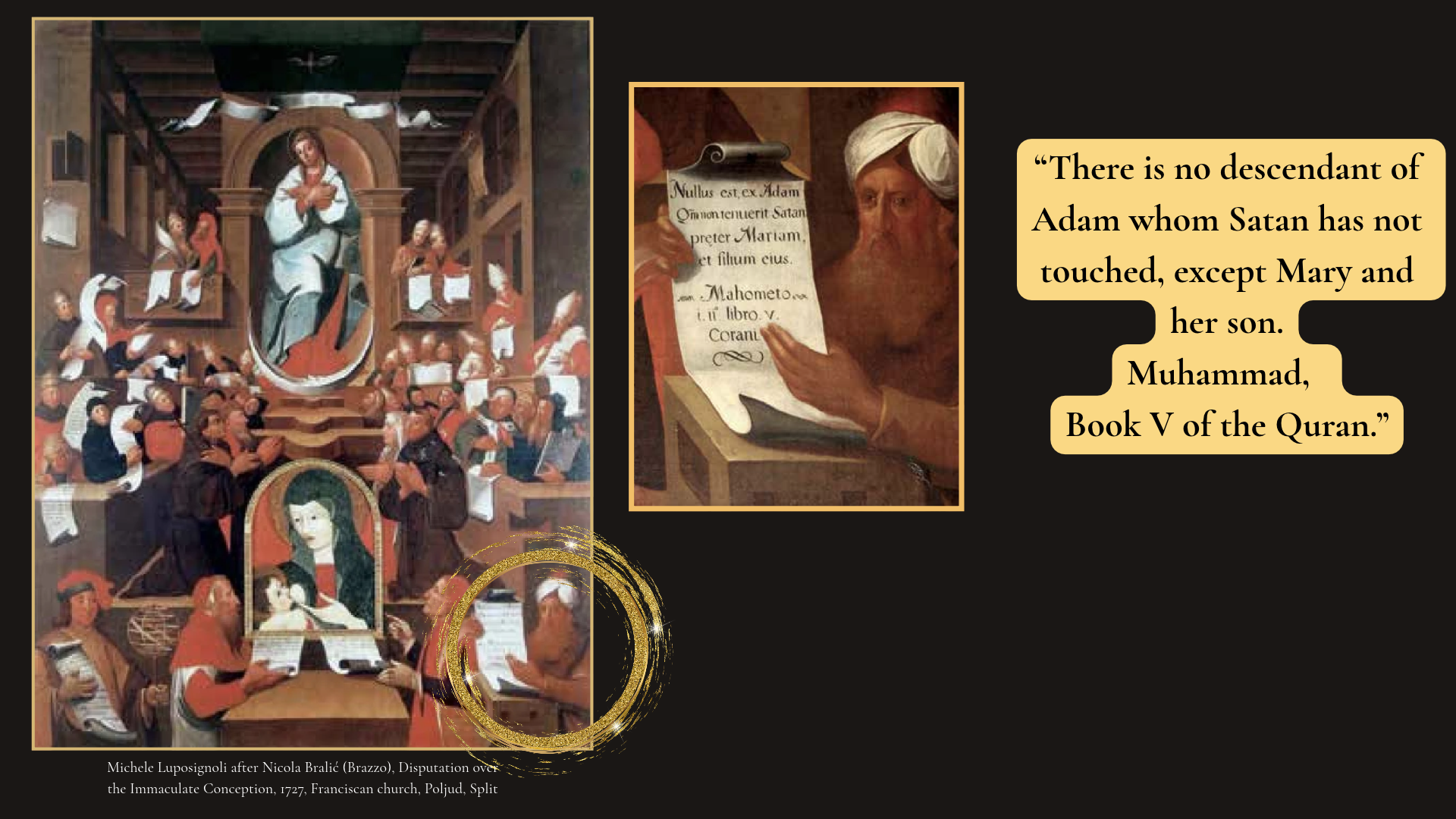
The images in question belong to a type called the Disputation over the Immaculate Conception. Mary stands or sits at the top of the composition, usually in a niche or on a crescent, and below her a crowd of Church Fathers, popes, bishops, and saints argue her case. Many hold scrolls or open books, and the texts on those scrolls are the point of the picture. Each figure is, in effect, a witness giving testimony. The painting works as a trial in which the evidence has been gathered and placed in the hands of the speakers.
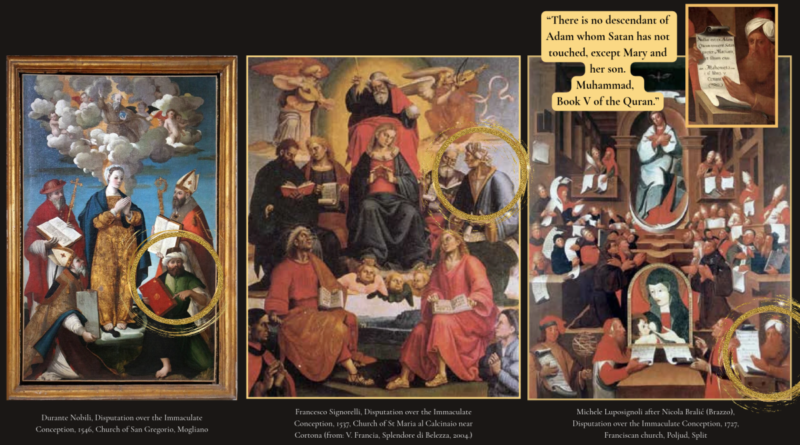
The clearest example on the eastern Adriatic is the altarpiece in the Franciscan church at Poljud, in Split. The surviving canvas was painted in 1727 by Michele Luposignoli, who states in an inscription that he copied an original made in 1518 by Nikola Bralić. Thirty-nine figures surround the Virgin. In the lower corners, two of them stand apart from the rest. The one on the left is the ninth-century astrologer Albumasar, holding an armillary sphere. The one on the right is a bearded man in a white turban, holding a scroll that names Muhammad as its source.
What the scroll says
The scroll reads, in Latin, that no one descended from Adam escapes the touch of Satan except Mary and her son, and it credits the saying to Muhammad, in the second book of “the Quran.” The attribution is wrong in a way that tells us a good deal. The saying is not from the Quran. It is a hadith, a report of the Prophet’s words, narrated by Abu Huraira and preserved in the collections of al-Bukhari and Muslim. In al-Bukhari’s wording, every child of Adam is touched by Satan at birth, which is why newborns cry out, with the exception of Mary and her child. Muslim commentators generally connect the report to the Quranic account in the third sura, where the mother of Mary asks God to protect her daughter and her descendants from Satan.
The painters did not need to know any of this. The saying had already reached Latin Christendom and been passed along by preachers. The Franciscan Marquard von Lindau used it in the fourteenth century, in a treatise that circulated well beyond his order, and he was unusual in distinguishing the Quran from the traditions about Muhammad. A sermon of 1430 attributed to the Franciscan Francesco da Rimini then made the argument that gave the quotation its force. It tells the faithful to listen to the words of “that perfidious Muhammad,” who honors the conception of the Virgin and her son in his own book, and then reasons from the lesser to the greater: if unbelievers preserve the Virgin from every stain, how much more must believers preserve and praise her. The preacher adds that he had seen the life of Muhammad and his law at Paris. A similar quotation appears in a sermon of 1485 by Pietro Arrivabene da Canneto. Because these preachers cited “the Alcoran” rather than the hadith, the error was baked into the tradition, and it ended up on the scroll at Poljud.
The argument deserves a plain statement. It is an argument from an adversary’s admission. Christians did not think Muhammad was a prophet, so they were not claiming his authority. They were saying that even the enemy of the faith concedes the point, and that Christians who deny it are therefore worse than infidels. It was rhetoric aimed at the doubters inside the Church.
A weaker case than the preachers claimed
The use of the hadith was also a stretch, and anyone who knew the Islamic source could see it. The report concerns Satan’s touch at birth, not the moment of conception, and it says the same thing about Jesus that it says about Mary. It does not teach that Mary was conceived without sin, which actually goes against the Quran (35:45). The medieval writers read it through their own categories and found what they needed. This is the common pattern with borrowed testimony: the borrower hears an echo of his own doctrine, and the source has no say in the matter.
The Poljud figure was not alone
Scholars long treated the Poljud Muhammad as a rarity, one of very few figural images of the Prophet in European church art. Ivana Čapeta Rakić and Giuseppe Capriotti show that he belongs to a small family of such figures in Italy, though the evidence for each is uneven.
The strongest parallel is the Disputation altarpiece by Signorelli in Santa Maria al Calcinaio near Cortona, painted in the 1520s. Among the male figures flanking the Virgin sits one in a blue tunic and a turban-like headdress, and his scroll carries an inscription whose fragments match the hadith: no one among the sons of Adam, except Mary and her son. Earlier scholars had read the scroll as a reference to Sirach 24:14 and taken the figure for an Old Testament prophet, but Réjane Gay-Canton showed that the text fits the hadith instead. Where a scroll survives, the scroll settles the question, and in this case it points to Muhammad.
Other cases rest on less. In the Marche, the painter Vincenzo Pagani made two large panels in 1530 that served as organ doors in the cathedral of Fermo. They are lost, but an eighteenth-century friar described one of them as containing Muhammad, seated on the floor with a Quran in his hands. In 1546 Durante Nobili signed an Immaculate Conception for San Gregorio in Mogliano, and in its lower corner stands a turbaned man pointing at a book. The art historian Vincenzo Francia identified him as the prophet Isaiah. Čapeta Rakić and Capriotti suspect Muhammad, and they note that Nobili may have had Pagani’s lost doors as a model, but the picture has no inscription and the identification remains a guess. A third Nobili altarpiece, from 1549, shows the Church Father Origen in a cap that later viewers took for oriental headgear, and that was enough to have him counted as Muhammad.
The turban explains most of these confusions. From the Middle Ages onward, Europeans treated it as a sign of the unbeliever and the Muslim, even on figures whose dress was otherwise invented. A turbaned man in a Disputation could be Muhammad, or a Jewish prophet, or a saint in exotic costume, and the viewer’s eye supplied the identification.
The skeptical turn
The tolerance did not last. In 1633 Luigi Primo Gentile painted a Triumph of the Immaculate for Santa Maria di Monserrato in Rome. There Muhammad appears on the ground, in a lowly position, beside the other heretics Pelagius and Martin Luther. He had changed from a reluctant witness to a defeated opponent. In 1771 the Inquisitor’s vicar at Montegiorgio ordered that the figures taken for Muhammad in the two paintings at San Francesco in Massa Fermana be removed. The friars’ chronicle records that Pagani’s panel was struck out, and that the figure in the main altarpiece was repainted as the aged Simeon, the old man of Luke’s Gospel who held the infant Jesus in the Temple and said that his eyes had seen salvation (Luke 2:25-32, RSV).
This case gives the clearest sign that attitudes had shifted. Whatever the earlier preachers had intended, by the late eighteenth century a Muslim figure in the company of the Doctors of the Church looked like a scandal and had to be corrected.
Why Split kept him
Čapeta Rakić and Capriotti end their study with a contrast. In 1727, the same period in which the inquisitor was erasing Muhammad in the Marche, the Franciscans of Split were commissioning a copy of a painting that kept him, and in a favorable role as an announcer of the Virgin’s purity. On the Marche coast, which belonged to the Papal States, Our Lady of the Rosary was being painted with chained Ottoman slaves at the Virgin’s feet. The authors suggest the difference follows politics. Venice, which ruled Dalmatia, had after the Peace of Passarowitz in 1718 worked to build diplomatic and commercial agreements with the Ottoman Empire, while the Papal States still saw the Ottomans as a danger on their own shores.
That explanation is a hypothesis, and the authors present it as one. A local legend at Poljud adds a further, human detail: it says the church and convent were spared from plunder and arson at the end of the sixteenth century because Ottoman soldiers recognized their Prophet in the painting. Whether or not anyone believed it, the legend shows how the image could be read from the other side.
What the pictures show
Taken together, these paintings show a Christian argument built on a Muslim sentence that its speaker never meant for that purpose. The painters and preachers did not honor Muhammad. They used him, and they placed him in the picture on the condition that he said what they needed. When that condition stopped being enough, and the political climate hardened, he was repainted, demoted, or removed. The Immaculate Conception itself needed none of this support in the end, since it was proclaimed in 1854 on the authority of the Church alone. What remains is a record of how far a medieval controversy would reach for a witness, and how readily an image of the enemy could be made to serve the argument at hand.
This article draws on Ivana Čapeta Rakić and Giuseppe Capriotti, “Two Marian Iconographic Themes in the Face of Islam on the Adriatic Coast in the Early Modern Period,” IKON 10 (2017), pp. 169-186.