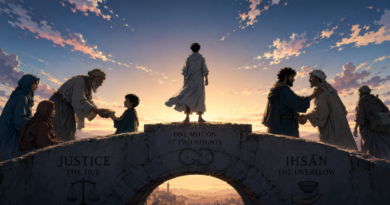
The Loan God Asks For
There is something peculiar about the way the Quran describes charity. It calls it a loan, and it makes God the borrower.
[2:245] Who would lend GOD a loan of righteousness, to have it repaid to them multiplied manifold? GOD is the One who provides and withholds, and to Him you will be returned.
مَّن ذَا ٱلَّذِى يُقْرِضُ ٱللَّهَ قَرْضًا حَسَنًا فَيُضَٰعِفَهُۥ لَهُۥٓ أَضْعَافًا كَثِيرَةً وَٱللَّهُ يَقْبِضُ وَيَبْسطُ وَإِلَيْهِ تُرْجَعُونَ
Read that slowly. The One who owns the heavens and the earth, who provides for every creature that crawls and every seed that splits, who could fill the mouth of every hungry child with a single word, is asking to borrow righteousness from you and me. The Owner of everything positions Himself as debtor to the very people He gave everything to. This is not a translation quirk. The Arabic is deliberate: qarḍan ḥasanan, a loan of goodness, and the verb is yuqriḍ, to lend. God is not asking for tribute. He is opening a ledger and inviting you to become His creditor.
Once you sit with the strangeness of that image, a whole theology of suffering opens up behind it. Because a loan typically requires a lack. You cannot lend to someone who has everything. And so the question hiding inside the offer is this: why would God build a world with lack in it at all?
The objection that sounds like piety
The Quran anticipates the sharpest possible answer to that question, and it puts the answer in the mouths of those who reject faith.
[36:47] When they are told, “Give from GOD’s provisions to you,” those who disbelieve say to those who believe, “Why should we give to those whom GOD could feed, if He so willed? You are really far astray.”
Notice how airtight the objection is on its own terms. It is not the argument of a crude materialist. It is a theological argument. It takes God’s omnipotence as its premise and reasons flawlessly from it. If God wanted this man fed, God would feed him. God has not fed him. Therefore, God does not will him fed. Therefore, feeding him is meddling with the divine decree—an act of pointless, even arrogant, charity. You are really far astray. The disbelievers here have God’s power exactly right and have understood absolutely nothing.
This is the deep misreading of the world, and it is worth naming precisely because it can be misconstrued as reverence. The person who makes it thinks he is deferring to God. In truth, he has turned the world into a machine that runs itself, a closed system of causes in which every outcome is already the outcome God intended, so that human hands are ornamental at best and impertinent at worst. He has taken the one truth he grasps—that God could—and used it to bury the truth he refuses—that God chose not to, and chose not to for a reason that concerns him.
The lack is the design
The reason is not hidden. The Quran states it plainly, and it states it as intention, not accident.
[43:32] Are they the ones who assign your Lord’s mercy? We have assigned their shares in this life, raising some of them above others in ranks, in order to let them serve one another. The mercy from your Lord is far better than any material they may hoard.
In order to let them serve one another. The disparity is not a flaw in the distribution that a more competent deity would have ironed out. The disparity is the point. The gap between the one who has and the one who needs is the space carved out for service to exist—and service is a thing that cannot exist in any other kind of world.
The same note sounds again where the Quran speaks of rank and provision:
[6:165] He is the One who made you inheritors of the earth, and He raised some of you above others in rank, in order to test you in accordance with what He has given you.
[16:71] GOD has provided for some of you more than others. Those who are given plenty would never give their properties to their subordinates to the extent of making them equal partners. Would they thus disregard GOD’s blessings?
The world is not a place where everyone starts level and misfortune knocks some down. It is a place engineered from the outset with unequal shares, and the inequality is loaded with purpose. It is a test surface. It is the terrain on which the soul is asked to reveal what it is made of. Take away the terrain and you take away the test, and with it every possibility of passing.
What a frictionless world would cost?
Imagine the world the disbelievers of 36:47 seem to think God should have made—the one where God feeds everyone directly, where no one ever wants for anything, where provision falls from the sky into every open hand without a human hand in between. It sounds, at first, like mercy. It is worth asking what it would actually be.
It would be a world with no generosity in it. Not stingy—incapable. You cannot be generous where nothing is needed. It would be a world with no justice, because justice is the setting-right of a wrong, and in a world of automatic plenty there is nothing to set right. No compassion, because compassion is a response to another’s lack, and there would be no lack to respond to. No sacrifice, no patience, no courage, no mercy. Every virtue that makes a human being worth admiring is a virtue that only takes shape against a backdrop of difficulty. Erase the difficulty, and you have not perfected the human being. You have erased him. You are left with well-fed objects in a frictionless paradise, and not a single soul that has ever chosen anything.
This is why the Quran treats hardship not as evidence against a good God but as the instrument of a good God. The world was not meant to be easy. It was meant to be legible—a place where the difference between a generous heart and a grasping one can actually show up, because the conditions exist for it to show up.
[2:155] We will surely test you through some fear, hunger, and loss of money, lives, and crops. Give good news to the steadfast.
[90:10] Did we not show him the two paths?
[90:11] He should choose the difficult path.
[90:12] Which one is the difficult path?
[90:13] The freeing of slaves.
[90:14] Feeding, during the time of hardship.
[90:15] Orphans who are related.
[90:16] Or the poor who is in need.
[90:17] And being one of those who believe, and exhorting one another to be steadfast, and exhorting one another to be kind.
The steep path is steep on purpose. A road with no incline leads nowhere worth reaching.
The loan is for the lender
Here is where the loan metaphor turns and shows its real face. Return to the disbelievers’ premise, because it is true: God could feed them. God is not short of resources and does not need your donation to balance His books.
[35:15] O people, you are the ones who need GOD, while GOD is in no need for anyone, the Most Praiseworthy.
The poor man’s sustenance is already guaranteed by the One who guarantees the sustenance of every living thing. If it does not reach him through your hand, it will reach him through another, or through no hand at all. So when God frames your giving as a loan to Him, He is telling you plainly that He does not require the capital. The transaction is not for His benefit. It is for yours. The loan is a device by which God lets you invest in your own transformation and then, with staggering courtesy, agrees to pay you back for it.
[64:17] If you lend GOD a loan of righteousness, He will multiply the reward for you manifold, and forgive you. GOD is Appreciative, Clement.
[2:261] The example of those who spend their monies in the cause of GOD is that of a grain that produces seven spikes, with a hundred grains in each spike. GOD multiplies this manifold for whomever He wills. GOD is Bounteous, Knower.
The word the Quran uses for the alms that purify—Zakat—carries within it the sense of purification and growth. The wealth that sits and swells and is loved too much becomes a kind of poison in the soul that holds it. Giving it away is not primarily a subsidy to the poor. It is a purge for the rich. The poor man receives bread; the giver receives a cleaner heart, a soul with less rot in it, a self that has practiced letting go. The suffering of the world, met with an open hand, becomes the medicine of the one who meets it. That is the exchange the disbelievers of 36:47 could not see. They saw a pointless handout to someone God could have fed. They missed that the handout was never really about the man being fed. It was the ladder placed in front of the man doing the feeding, and they walked past it, congratulating themselves on their theology.
The two ways to read a hard life
Because everything turns on how you read the world, the Quran is unusually direct about the two readings available and about which one is the mistake.
[89:15-20] When the human being is tested by his Lord, through blessings and joy, he says, “My Lord is generous towards me.” But if He tests him through reduction in provisions, he says, “My Lord is humiliating me!” Wrong! It is you who mistreat the orphan. And you do not advocate charity towards the poor. And you consume the inheritance of helpless orphans. And you love money excessively.
Look at what the misreader does. He treats his wealth as a verdict—proof that God favors him—and he treats his poverty, or another’s poverty, as a verdict too—proof of disgrace. He reads the distribution of provision as a scoreboard of divine approval. And the Quran interrupts him mid-sentence: Wrong. Wealth was never a certificate of worth, and want was never a mark of shame. Both are the test. The rich man who reads his riches as honor has failed the test in the very act of misreading it, and you can hear his failure in what he does downstream—the neglected orphan, the un-championed poor, the hoarded inheritance, the love of money that has grown into the shape of his whole life.
This is what it means to fail to understand the world. It is not an intellectual failure only. It is the practical failure that follows from mistaking a test for a reward, from treating the gaps God left open as facts to be accepted rather than doors to be walked through. The one who understands the world sees his surplus for what it is: not a trophy, but a loan he has been invited to extend, held in trust for the moment it is asked back through the hand of someone in need.
Setting the world right
There is a second thing the loan accomplishes, and it is not only private. When provision moves from the one who has too much to the one who has too little, the world itself is mended a little. The calcified gap softens. The ranks that God set “in order to let them serve one another” actually begin to serve. What was designed as a test surface becomes, when the test is passed, a repair. The soul is purified and the society is knit closer in the same motion.
So the shape of the whole thing comes clear. God did not build a world of poverty and hardship because He is indifferent to suffering, and He did not build it because He lacks the power to feed every mouth. He built a world with lack in it because a world without lack is a world without righteousness, and a world without righteousness is not worth building. The hunger of one person is the standing invitation to another. The gap is the doorway. The loan is the mechanism by which a human being turns his brief handful of years and his brief handful of wealth into something that outlasts both—a purified soul, a mended corner of the world, a debt owed to him by God Himself.
The disbelievers looked at all of this and said: Why should we give to those whom GOD could feed? They were standing at the threshold of the single surest investment in existence, and they mistook the threshold for a trap. God could indeed feed them. That was never the question. The question was whether you would—and whether, offered the chance to lend to the Owner of everything, you would recognize the offer for the mercy it is.