The Due & the Overflow: What We Owe God and What We Owe Each Other
The Quran often connects our devotion to God to our treatment of others—parents, neighbors, orphans, the stranger passing through town. Worship opens the sentence, and the doorstep closes it.
The pattern is easy to document. When the command to worship arrives in Sura 4, it does not stand alone for even a full line:
[4:36] You shall worship GOD alone—do not associate anything with Him. You shall regard the parents, the relatives, the orphans, the poor, the related neighbor, the unrelated neighbor, the close associate, the traveling alien, and your servants.
The verse begins in heaven and ends among the people you actually meet—the related neighbor and the unrelated one, the traveling alien with no claim on you but their need. The covenant recalled in 2:83 runs the same connection between worship and regarding others twice. First explicitly, then the second time via the Contact Prayer (Salat) that we give to God, and our Obligatory Charity (Zakat) that we give to others.
[2:83] We made a covenant with the Children of Israel: “You shall not worship except GOD. You shall honor your parents and regard the relatives, the orphans, and the poor. You shall treat the people amicably. You shall observe the Contact Prayers (Salat) and give the obligatory charity (Zakat).” But you turned away, except a few of you, and you became averse.
And in 17:23–25 the command to worship God alone again follows with the command to honor our parents and lower the wings of humility for them.
[17:23] Your Lord has decreed that you shall not worship except Him, and your parents shall be honored. As long as one or both of them live, you shall never say to them, “Uff” (the slightest gesture of annoyance), nor shall you shout at them; you shall treat them amicably. [17:24] And lower for them the wings of humility, and kindness, and say, “My Lord, have mercy on them, for they have raised me from infancy.”
A reader could pass this off as ordinary bundling, the way any moral code files its duties together. The Quran does not permit that reading for long. It presses the connection until it hardens into a test, and the test is merciless:
[107:1–7] Do you know who really rejects the faith (al-din)? That is the one who mistreats the orphans. And does not advocate the feeding of the poor. And woe to those who observe the contact prayers (Salat)—who are totally heedless of their prayers. They only show off. And they forbid charity.
The one condemned here has failed no article of belief that the passage bothers to name. He has failed the orphan. And then the sura turns on the worshippers themselves—the ones at prayer—and files their prayer under the same charge. A prayer performed while the orphan is shoved aside has become a show, and the Quran strips off the fake facade. Whatever religion means in this passage, it cannot survive the separation of the two duties. Pull them apart and what remains only resembles faith from the outside.
So the binding is deliberate, and its stakes reach all the way down. To see why the Quran insists on it, we have to see how differently the two obligations actually work. They run on separate logics and settle in separate currencies.
The Web of Dues
Start with what we owe each other, because the Quran hands us its own word for it. Where Dr. Khalifa renders the command as giving “the due alms,” the underlying Arabic is blunter and more revealing:
[17:26] You shall give the due alms (al-ḥaqq) to the relatives, the needy, the poor, and the traveling alien, but do not be excessive, extravagant.
The word beneath “due alms” is ḥaqq—a due, a right, a rightful claim, the thing that is owed. The verse literally instructs you to give the relative his ḥaqq, what is already his. That is a ledger word more than a warm one. A ḥaqq can be rendered or withheld, paid or defaulted on. The same term governs the deprived person’s stake in the wealth of the comfortable, described in 70:24–25 as a known, fixed portion. Giving the orphan his due settles something that was his to claim before you ever reached into your pocket.
This is the ground floor of human obligation, and it runs on exchange. Dues move in both directions. The claim I hold on you mirrors the claim you would hold on me if our places were swapped, which is why the Quran can set justice as the baseline of every human dealing. Justice is the accurate rendering of what is owed, and it works because the two parties could trade places. Consuming “each others’ money illicitly” (2:188), shorting a debt, taking more than your due, or surrendering less—each tilts the same scale. Justice keeps the web of dues honest, and it assumes equals. A person cannot be cheated unless he was owed something in the first place.
An ethics that stopped here would already be worth having. Render what you owe, claim only what you are owed, keep the scale level. But the Quran refuses to stop here, and the place where it refuses is where the whole argument turns.
The Floor and the Overflow
One verse sets the floor apart from what rises above it. In Dr. Khalifa’s rendering:
[16:90] GOD advocates justice, charity (iḥsān), and regarding the relatives. And He forbids evil, vice, and transgression. He enlightens you, that you may take heed.
The English flattens the very distinction the verse is drawing, so it is worth going to the Arabic. The command is al-ʿadl wa-l-iḥsān—justice and iḥsān. ʿAdl is the due rendered, the scale kept level, the exchange completed. Iḥsān is the excellence that goes past the due: good handed to those with no claim to it and no way to return it. The verse names a floor and then names an ascent that begins where the floor ends.
That ascent behaves in a curious way. As human giving climbs past justice, it starts shedding the very reciprocity that justice depends on. The Quran describes its highest form in words that deliberately close off any return:
[76:8–9] They donate their favorite food to the poor, the orphan, and the captive. “We feed you for the sake of GOD; we expect no reward from you, nor thanks.”
The whole machinery of exchange—I give, you repay, the account clears—is set aside on purpose. Fairness has been left behind for something that no longer keeps accounts at all.
Forgiveness travels the same road:
[42:40] Although the just requital for an injustice is an equivalent retribution, those who pardon and maintain righteousness are rewarded by GOD. He does not love the unjust.
Matching harm for harm is the reciprocal floor, and the Quran permits it. Yet the one who pardons collects nothing from the person he pardoned; his reward is with God instead. A horizontal act of forgiveness has quietly relocated its settlement upward. The same logic drives the counsel elsewhere to repel evil with something better, until “the one who used to be your enemy may become your best friend” (41:34). The overflow reshapes whatever it touches, and it draws its logic from above rather than from the ledger of mutual dues.
So the horizontal reaches across a range rather than sitting at a single point. Justice holds the bottom, the rendering of dues between equals. Grace holds the top, the giving that expects nothing back. And the top of the human range imitates something higher than the human—which the Quran states outright, in the counsel Qaroon received before his wealth undid him:
[28:77] Use the provisions bestowed upon you by GOD to seek the abode of the Hereafter, without neglecting your share in this world. Be charitable, as GOD has been charitable towards you. Do not keep on corrupting the earth. GOD does not love the corruptors.
The instruction sets its pattern inside the sentence: wa-aḥsin kamā aḥsana-llāhu ilayk—be charitable (aḥsin) as God has been charitable (aḥsana) toward you. The verb stands on both sides of the comparison, the same root as the iḥsān of 16:90, so the excellence you extend to others is named as a repetition, in miniature, of the excellence already extended to you.
But the same sentence fixes a limit on the copy, and it is easy to read past: be charitable as God is charitable—without neglecting your share in this world. The overflow is not a license to pour yourself out to nothing. You are told to imitate the manner of divine giving while keeping your own portion, because you are not the one you are imitating. God’s giving costs Him nothing and empties nothing; yours draws on a finite that can be spent to exhaustion. The imitation is real, but it runs inside creaturely limits, and the Quran makes the boundary explicit exactly where it presses generosity hardest:
[2:195] You shall spend in the cause of GOD; do not throw yourselves with your own hands into destruction. You shall be charitable (wa-aḥsinū); GOD loves the charitable (l-muḥ’sinīna).
Spend, and be charitable—the verse closes once again on iḥsān—but do not spend yourself into ruin. Even at its height, then, the overflow keeps a floor beneath it, and that floor is justice, still at work. Your own share is a ḥaqq like any other, a due you hold, and to give yourself away into destruction would be to default on it. This is not self-interest slipping back in; it is the same justice as before, now counting the giver among those it will not see wronged. So the range never collapses into self-erasure: justice holds the bottom, grace rises above it, and grace stays bounded from below by a justice that includes the one doing the giving.
Feeding for the sake of God, pardoning and leaving the account with God—in each the horizontal does knowingly what these verses command, borrowing the manner of the vertical without laying claim to its inexhaustibility. The ceiling of what we owe each other only makes sense once we understand the relation it is copying; the floor of the overflow, once we remember who is doing the copying.
What Remains When Exchange Is Gone
Turn to what we owe God, and ask what kind of due that is.
The logic of exchange breaks down here, and it breaks down of necessity. A debt between humans can be repaid because the parties stand as equals; the account can be closed. Nothing you offer God closes any account. He needs nothing, and there is no station where you could stand and He could stand in yours. The vertical relation lives in the impossibility of exchange. Everything moves downward—mercy, provision, guidance, existence itself—and what rises in answer is acknowledgment rather than repayment: gratitude, humility, the plain recognition that you depend on Him for the ground beneath your feet. The soul does not settle up with God. It turns toward Him.
So the vertical carries a due of its own, one that can never be discharged, only honored. And the Quran names the failure to honor it with the same word it uses for the worst injury between people:
[31:13] O my son, do not set up any idols beside GOD; idolatry is a gross injustice.
The word Dr. Khalifa translates as “injustice” is ẓulm, and its root reaches deeper than the English. Ẓulm is misplacement—putting a thing where it does not belong, a placement in the dark. Wronging another person misplaces his due, handing him less than he is owed or seizing more than is yours. Setting up an idol beside God misplaces God’s due, aiming the reverence owed to the Uncreated at something created, seating among equals the One who sits in no row at all. The same failure surfaces at two heights: a due set down where it does not belong.
That one word, carrying across both spheres, reveals what a two-part picture might otherwise conceal. The horizontal and the vertical rest on a single foundation—the correct placement of what is owed. Justice, followed to its root, turns out to be far more than a rule for human dealings. It is the principle holding up both walls. Wrong the orphan, and you have committed ẓulm. Set a partner beside God, and you have committed ẓulm. One word serves both because one failure underlies both: the refusal to render a due to the one who holds it.
Why the Two Cannot Be Traded
If the spheres share a foundation, why keep them apart? Because their debts are paid in different currencies, and the Quran is firm that neither can be spent on the other’s account.
Ritual buys no exemption from injustice. That is the whole force of the worshipper who prays while shoving the orphan aside: his vertical performance purchases nothing against the horizontal debt. The Quran states the principle outright when it redraws the meaning of righteousness:
[2:177] Righteousness is not turning your faces towards the east or the west. Righteous are those who believe in GOD, the Last Day, the angels, the scripture, and the prophets; and they give the money, cheerfully, to the relatives, the orphans, the needy, the traveling alien, the beggars, and to free the slaves…
The verse takes the most concentrated gesture of vertical devotion, the turning of the body toward the direction of prayer, and declines to let it stand as the measure of a righteous life. The orphan’s due is not settled by which way you face.
The reverse holds just as firmly. Decency toward people does not clear the vertical debt. The Quran marks out a single line no good deed may cross:
[4:48] GOD does not forgive idolatry, but He forgives lesser offenses for whomever He wills. Anyone who sets up idols beside GOD, has forged a horrendous offense.
Every other debt keeps some avenue toward settlement. This one—the misplacement of God’s own due—is the wall that no amount of charity and no lifetime of ordinary kindness can pay down. A generous man who has given God’s place to something else has not balanced that account through his generosity. The currencies do not convert. What is owed above cannot be purchased with what is rendered across.
There is a subtler evasion the Quran also refuses, one that uses a truth about the vertical to cancel a duty on the horizontal:
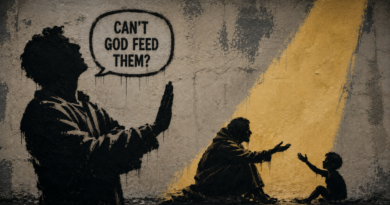
[36:47] When they are told, “Give from GOD’s provisions to you,” those who disbelieve say to those who believe, “Why should we give to those whom GOD could feed, if He so willed? You are really far astray.”
The reasoning wears a pious surface. God is the provider; God could feed the poor directly; therefore their hunger is His arrangement and none of my concern. Every premise is true, and still the conclusion earns the verdict far astray. The evasion turns on a phrase it hurries past—the command was to give from God’s provisions to you. The wealth was already named as His, placed in your hands to move through you toward others. Answering “God could feed them” pockets a gift meant to travel and hides the withholding behind God’s own power. Providence does not excuse the withholding; it convicts it, because what was kept back was never yours to keep.
This refusal—to let either sphere buy off, or excuse away, the other—is a protection. It keeps each from being hollowed out by its neighbor, and there the argument finally comes to rest.
The Mutual Guard
Left standing on its own, either sphere decays in a way the Quran has already diagnosed.
Reverence without justice curdles into exactly the figure the sura mocked at the outset: the man at prayer who mistreats the orphan, forbidding small kindnesses even as he performs the devotion he wants seen. Piety that never descends into how a person treats the powerless amounts to a show, and the Quran files it under the rejection of faith itself. Severed from the horizontal, vertical intensity becomes a way to feel righteous while acting unjustly—perhaps the most dangerous position a religious person can occupy, since it dresses in the very garment of the thing it has betrayed.
Justice without reverence decays along a different line, into self-sufficiency. The human being, the Quran observes, transgresses the moment he counts himself self-sufficient (96:6–7). The one who renders every due, cheats no one, keeps a clean ledger and owes no man, can slide into believing he authored his own standing. This was the posture of Qaroon, who looked at a fortune he had been given and said he had attained it through his own knowledge and skill (28:78): the mind so fluent in the horizontal ledger that it forgets the entire game arrived as a gift. Justice without reverence is honest and blind together, exact about what it owes across, oblivious to what it owes above, settled in the quiet conviction that it owes nothing to anyone.
Each sphere guards the other. Reverence holds human power humble, reminding it that everything in its hands was received and none of it repaid, that a person stands as a debtor long before he stands as a benefactor. Justice holds reverence honest, dragging devotion off the prayer-mat and into the street, where it faces the orphan and the neighbor and the traveling alien and either proves itself or stands exposed. The Quran binds the two for the sake of this mutual guarding. Take away either wall and the structure loses far more than a room; it decays into a forgery—hollow piety on the one hand, self-satisfied fairness on the other.
One Motion at Two Heights
Step back, and the shape settles into something simple.
The vertical relation is what remains once exchange is gone: sheer descent from a source that cannot be repaid, answered by a gratitude that never pretends to repay it. Grace comes down, and reverence rises, with no floor of exchange beneath them because none is possible.
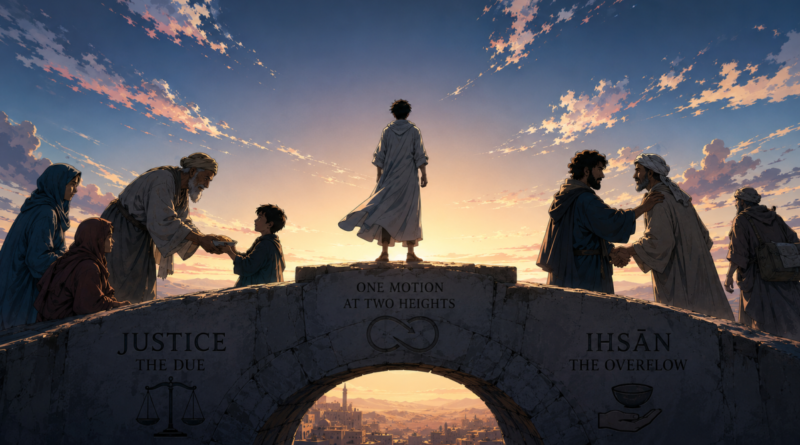
The horizontal relation opens as exchange—the honest rendering of dues between equals, justice holding the scale level. But the Quran never lets it settle there. It commands the overflow, the iḥsān above the ʿadl, and in the overflow the human being stops keeping accounts and starts giving the way he has been given to. Feed for the sake of God and want nothing back. Pardon, and let God keep the reckoning. Answer evil with something better and watch an enemy soften into a friend. The horizontal has climbed until it touches the vertical’s own way of giving—giving with no eye to return, because that is exactly how everything in your hands first came to you.
The two spheres turn out to be one motion caught at two heights. What descends on you from a source you can never repay is meant to travel across you toward those who can never repay you. The reverence owed above and the grace extended around are a single gesture, met at different points along its arc. You receive without earning; you release without charging. Gratitude that has nowhere to rise but upward turns and finds somewhere to move outward. This is why worship and the orphan keep arriving in the same verse—one current, and dammed at either end, it stops flowing altogether.
Which leaves a principle open to anyone, inside the faith or outside it. A human life carries two kinds of debt. One can be repaid, and justice is the discipline of repaying it. The other can never be repaid, and reverence is the honesty of admitting as much. The Quran’s deepest instruction folds them together: what you cannot repay upward, you pass forward. A gift received from beyond your reach does not settle into gratitude and stay there. It moves, and it moves outward, toward whoever stands within your reach and cannot pay you back. Grace received becomes grace given. That is the whole architecture, and neither of its walls will stand alone.