Moses Did Not Receive the Torah (Quran vs. Hadith)
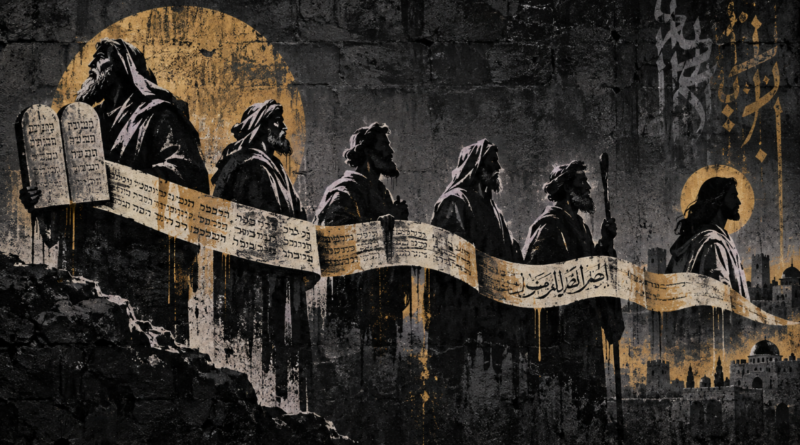
Ask most people—Muslim or otherwise—what book God gave Moses, and the answer comes back instantly: the Torah. It is treated as settled. Yet when you actually search the Quran for that claim, it is not there. The Quran never says the Torah (al-Tawrat, التوراة) was handed to Moses. What Moses received is named with different words. Moreover, the Quran consistently presents the Torah as the scripture of the prophets of Israel as a body—from Moses down to Jesus.
This is a small point with large consequences, because the Hadith says the opposite, and does so explicitly.
What Moses Actually Received
When the Quran describes the revelation given to Moses, it uses precise terms—and Torah is never one of them.
He is given the Statute Book (al-Furqan, الفرقان), and notably not alone:
[21:48] We gave Moses and Aaron the Statute Book, a beacon, and a reminder for the righteous.
[2:53] Recall that we gave Moses scripture and the statute book, that you may be guided.
He is given the tablets (al-alwah):
[7:145] We wrote for him on the tablets all kinds of enlightenments and details of everything…
Across the Quran the pattern holds: Moses receives the scripture (al-kitab), the criterion (al-furqan), the tablets, the guidance (see also 6:154, 17:2, 25:35, 28:43). The word Torah is absent from every one of these verses. And in 21:48 the same revelation is given to Moses and Aaron together—which already sits awkwardly with the idea of a single book personally delivered to Moses.
How the Quran Uses the Word “Torah”
Now look at where al-Tawrat does appear. It is never in the moment of Moses receiving a book. It is always a standing body of scripture that the prophets of Israel carried and judged by:
[5:44] We have sent down the Torah, containing guidance and light. Ruling in accordance with it were the Jewish prophets, as well as the rabbis and the priests…
Read that carefully. The Torah is what the prophets—plural—ruled by. A single book handed to one man would not naturally be described as the corpus that a whole line of prophets governed with.
The Torah is something later generations are told to consult as an existing reference:
[3:93] …before the Torah was sent down. Say, “Bring the Torah and read it, if you are truthful.”
And it is something Jesus, at the far end of the Israelite line, is both taught and confirms:
[5:46] Subsequent to them, we sent Jesus, the son of Mary, confirming the previous scripture, the Torah.
[5:110] …I taught you the scripture, wisdom, the Torah, and the Gospel.
Put together, the Quran’s own usage points to al-Tawrat as the accumulated revelation of the prophets of Israel from Moses to Jesus—not a lone volume dropped into one prophet’s hands. The traditional reading simply treats “the scripture given to Moses” and “the Torah” as the same thing. But the Quran keeps the words distinct, and the distinction is deliberate enough to survive across eighteen occurrences.
Where the Hadith Departs
The Hadith literature does not preserve this distinction. In the well-known encounter between Adam and Moses, the text has Adam say to Moses:
Narrated Abu Huraira: Allah’s Messenger (ﷺ) said, “Adam and Moses met, and Moses said to Adam “You are the one who made people miserable and turned them out of Paradise.” Adam said to him, “You are the one whom Allah selected for His message and whom He selected for Himself and upon whom He revealed the Torah.” Moses said, ‘Yes.’ Adam said, “Did you find that written in my fate before my creation?’ Moses said, ‘Yes.’ So Adam overcame Moses with this argument.”
حَدَّثَنَا الصَّلْتُ بْنُ مُحَمَّدٍ، حَدَّثَنَا مَهْدِيُّ بْنُ مَيْمُونٍ، حَدَّثَنَا مُحَمَّدُ بْنُ سِيرِينَ، عَنْ أَبِي هُرَيْرَةَ، عَنْ رَسُولِ اللَّهِ صلى الله عليه وسلم قَالَ ” الْتَقَى آدَمُ وَمُوسَى، فَقَالَ مُوسَى لآدَمَ أَنْتَ الَّذِي أَشْقَيْتَ النَّاسَ وَأَخْرَجْتَهُمْ مِنَ الْجَنَّةِ قَالَ لَهُ آدَمُ أَنْتَالَّذِي اصْطَفَاكَ اللَّهُ بِرِسَالَتِهِ، وَاصْطَفَاكَ لِنَفْسِهِ وَأَنْزَلَ عَلَيْكَ التَّوْرَاةَ قَالَ نَعَمْ. قَالَ فَوَجَدْتَهَا كُتِبَ عَلَىَّ قَبْلَ أَنْ يَخْلُقَنِي قَالَ نَعَمْ. فَحَجَّ آدَمُ مُوسَى ”. الْيَمُّ الْبَحْرُ.
Sahih al-Bukhari 4736
https://sunnah.com/bukhari:4736Here the Torah is stated, in plain words, to have been revealed to Moses—the exact claim the Quran never makes. The same narration recurs elsewhere in the collections (e.g. Bukhari 3409, 6614, 7515; Muslim 2652), so this is not a stray copyist’s slip; it reflects a settled assumption in the tradition. On this specific point the Hadith and the Quran do not agree. The Quran gives Moses the Furqan and the tablets; the Hadith gives him the Torah.
The Broad “Torah” Is Not Unique to the Quran
One might assume that using Torah for a wider body of scripture is a peculiarly Quranic move. It is not. The same broad usage appears in Jewish and early Christian sources.
The clearest example is Jesus himself. Defending his words to his opponents, he says:
“Is it not written in your Law, ‘I said, you are gods’?” (John 10:34)
The line he calls “your Law”—nomos, the Greek for Torah—is not from the five books of Moses at all. It is Psalm 82:6. Jesus is treating the Psalms as part of “the Law.” He does the same again in John 15:25, quoting a Psalm as “their Law,” and Paul follows the pattern in 1 Corinthians 14:21, introducing a line from Isaiah with “In the Law it is written.”
This reflects a known Jewish convention. As classical commentators note on John 10:34, “the law includes not only the Pentateuch, but all the books of the Old Testament,” and the rabbinic sources repeatedly use Torah to encompass the Prophets and the Writings, not merely the Five Books. Therefore, the Torah as used in the Quran and by Jesus in the Gospels would be more akin to the Tanak, which is the Hebrew acronym for the canonical collection of Jewish sacred scriptures, which Christians commonly refer to as the Old Testament.
Conclusion
The Quran’s language is careful and consistent. Moses is given the Furqan (Book of Law), the scripture, the tablets. The Torah is the revelation of the prophets of Israel taken as a whole—present with them, ruled by them, taught to Jesus, and confirmed by him. The Hadith’s claim that the Torah was revealed to Moses is a later flattening of this picture, and it is contradicted by the Quran’s own wording. And the wider sense of “Torah”—scripture beyond the five books—is exactly how Jesus and the Jewish tradition already used the term. On this question, the Quran is not the outlier. The Hadith is.