Made to Be Killed: How the Crusades Turned Murder into Atonement
In the theology that launched the Crusades, the Muslim was not, first of all, an enemy to be defeated or a rival to be converted. He was something stranger and more useful than that. He was raw material for another man’s salvation. The preachers who summoned Europe to holy war taught that a Christian could wash the sins off his soul by killing—and that the people he killed had been placed in the world by God for precisely that purpose. Murder became a kind of sacrament. The infidel became its instrument.
That is a heavy charge, so it is worth building slowly, out of the words of the men who actually made it. You need no background in medieval history to follow the argument. You only need to watch a single idea change shape over about fifty years.
Beginning in 1095, waves of European Christians marched east to take the region around Jerusalem—the land where Jesus had lived and died—out of Muslim hands. They understood these campaigns as holy wars, sanctioned by God and led, at least in spirit, by the Pope. The fighting stretched across two centuries and left a long trail of massacre on every side. But the part that matters here is not the battles. It is the sales pitch: the theological argument used to persuade hundreds of thousands of ordinary men to leave their homes, cross a continent, and kill strangers they had never met.
The bargain: killing that counted as penance
Medieval Christianity ran on a problem, and the problem was sin. A believer who sinned owed a debt, and he paid it down through acts of penance—prayer, fasting, pilgrimage, charity, self-denial. Fail to pay, and you faced punishment in the next life. This was the anxious spiritual arithmetic that governed every serious Christian, and it weighed heaviest on the knightly class, whose whole trade was violence and who therefore accumulated the most to answer for.
When Pope Urban II preached the First Crusade at Clermont in 1095, he offered these men a way out of the arithmetic. Anyone who marched to liberate Jerusalem, he declared, could count that campaign in place of all penance. The expedition would wipe the ledger clean. This is remembered as the first plenary indulgence—a total spiritual amnesty—and it was wildly effective. In plain terms, Urban was offering a clean slate to men who had spent their lives filling it with blood. Both Urban and, a generation later, Bernard put the pitch bluntly: stop butchering and robbing one another at home, and turn the same swords eastward instead. Killing Muslims in the East would atone for all the killing and licentiousness these men had already inflicted on their fellow Christians in Europe—the very degeneracy that stained them was recast as the fuel for their redemption.
Notice the reversal at the center of the offer. Killing was ordinarily a sin—the sixth commandment says so plainly. Urban turned the act inside out. Kill in this war, aimed at these people, and you would not deepen your debt of sin. You would erase it. Warfare, the very thing that had damned the knight, was rebranded as the thing that could redeem him.
Bernard and the invention of “malicide”
A generation later, the most influential churchman in Europe pushed the logic further. Bernard of Clairvaux, a Cistercian abbot, wrote a short treatise for the newly founded Knights Templar—the order of warrior-monks—called In Praise of the New Knighthood. Bernard had a contradiction to resolve. How could a monk, sworn to Christ, also be a killer? A commandment stood in the way, and centuries of Christian discomfort with bloodshed stood behind it.
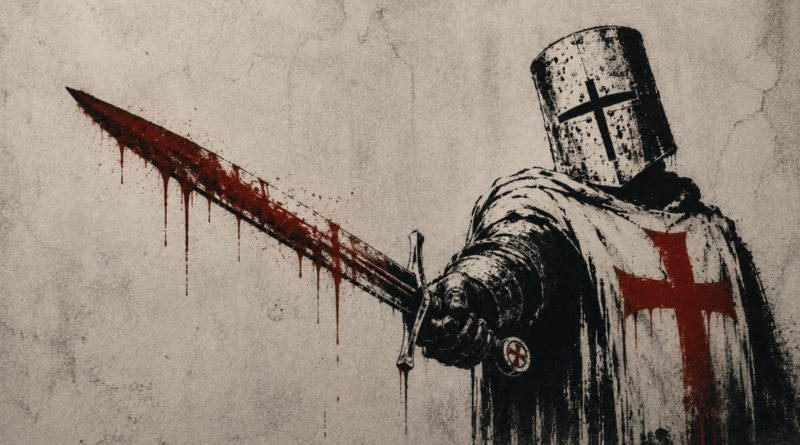
Bernard’s solution was to redefine the act. When one of these knights killed an enemy of the faith, Bernard argued, he was not committing homicide—the killing of a man. He coined a new word for what the knight was really doing: malicide, the killing of evil itself. The soldier who ran a Muslim through was therefore not a murderer at all. He was Christ’s avenger, a minister of God, a destroyer of wickedness wearing a human face. And then Bernard wrote the sentence that should stop any reader cold: “The Christian glories in the death of the pagan, because Christ is glorified.”
The death of the Muslim is not framed as a grim necessity of war, something to be regretted even when required. It is presented as a positive good, an occasion for rejoicing, because the corpse itself brings glory to God. The killing does not merely fail to be a sin. It becomes an act of worship.
The Muslim as a tool made by God
The final move comes when Bernard preaches the Second Crusade, decades after the first. Here the historian Karen Armstrong, in Holy War: The Crusades and Their Impact on Today’s World, traces the theology to its endpoint. Bernard, she observes, preached this crusade as a personal invitation from God to each individual Christian—a private summons, a chance for one soul to save itself by taking up the sword. The believer marching to the Holy Land was answering a call meant for him alone.
And the Muslims, in this scheme? Armstrong’s reading is that they stop being enemies in any ordinary sense and become something colder. They are recast as tools—used and created by God—so that Christians might save their souls. Even the Muslim military victories that had made a new crusade “necessary” were, on Bernard’s telling, permitted by God on purpose, staged so that Christians would be given the occasion to earn salvation through holy war. The whole drama of world history is quietly re-centered on the individual Christian soul, and everyone else is reduced to a supporting role in it.
This is the hinge of the entire argument, so it is worth following the logic exactly where it leads. If the Muslim exists in order that the Christian may be purified by fighting him, then the Muslim’s function—his reason for being present in the story at all—is to be killed. His life carries no standing of its own. It is not an end. It is the ink in which another man’s clean slate gets written.
Murder as atonement
Now assemble the pieces. Atonement, in Christian terms, is the reconciling of the sinner with God, the paying-down or wiping-out of the debt that sin creates. The ordinary believer atoned through prayer, fasting, pilgrimage, and charity. The crusade preachers added one more item to that list of holy acts: the killing of a human being. And they smuggled it past the conscience by renaming it—malicide, not homicide; ministry, not murder; the destruction of evil, not the death of a person.
So picture the sinner the system was designed for. He arrives with a soul stained by exactly the kind of violence that being a medieval knight demanded of him. He is offered a cure. And the cure is more violence—only now aimed at an approved target. He kills, and in killing he is cleansed. The blood on his hands, which used to condemn him, now saves him. That is atonement by murder in its plainest form, and its victims are people whose entire assigned purpose, within this theology, was to supply the occasion for it. They were, quite literally, made to be killed.
There is no way to soften this once the words of the propagators are laid side by side. Urban made the killing count as penance. Bernard made it glorious and renamed it so the conscience would not flinch. Armstrong’s Bernard then took the last step, turning the enemy into an object manufactured by God for the killer’s spiritual benefit. Strip away the vocabulary and what remains is a machine for laundering murder into holiness.
Why this still matters
Armstrong did not subtitle her book The Crusades and Their Impact on Today’s World by accident. The particular vocabulary of malicide belongs to the twelfth century, but the structure underneath it did not stay there. The machinery starts up again whenever a whole people is redefined as an instrument in someone else’s cosmic drama—not human beings with their own lives and ends, but props in a story about our purity, our security, our destiny. The names change. The moves do not: first you deny that the other is fully a person, and then you discover, conveniently, that killing him is not really killing.
That is the quiet obscenity at the heart of the holy war, and it is worth stating without any hedging. The Crusaders’ god did not demand blood because the enemy was dangerous. He demanded it because the killer needed cleansing. The theology turned the murdered into a means and the murderer into a saint—and it called the whole transaction love of God.
Related Articles: