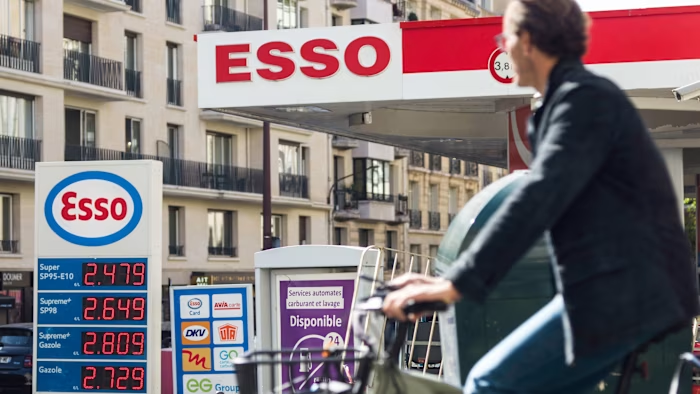
European diesel prices climb over prospect of US export ban
The price of diesel in Europe climbed on Wednesday, as the continent reacted to the “catastrophic” prospect of being cut off by the US, its biggest supplier.
European benchmark diesel futures jumped as much as 7 per cent higher to $1,528 a tonne in morning trading in London, equivalent to more than $200 a barrel, even as crude prices were little changed, after US President Donald Trump said he had told his administration “let’s not send out the diesel”.
They later fell back to $1,494 a tonne as US energy secretary Chris Wright expressed scepticism about the merits of a full ban despite the president’s earlier comments.
“The blunt tool of banning diesel exports definitely doesn’t work,” Wright said at an event in New York according to Reuters.
The Trump administration is evaluating a range of policy tools to tackle diesel prices after weeks of political pressure in the US to curb its fuel exports as domestic diesel prices climbed to a record $6.54 a gallon.
Trump’s comments marked a dramatic reversal from the White House’s pledge in April that the US would be a “critical lifeline”, selling “reliable abundant energy” to the world during the disruption caused by the Iran conflict, and a U-turn from statements just a few days ago denying that a diesel export ban was being considered.
US refineries have worked overtime this year to supply vast quantities of diesel to Latin America and Europe, earning billions of dollars of extra revenue in the process. Europe imported 506,000 barrels a day of US diesel in August, according to data company Kpler.
Cutting off the flow might ease the pressure on US prices, but would send diesel prices sharply higher everywhere else. “It would be quite catastrophic,” said Eugene Lindell, head of refined products analysis at consultancy FGE NexantECA, who said global prices could rise to $350 a barrel.
“Europe will try to replace [US supply] by bidding up the price, but Latin America is also going to be bidding for the same barrels. It is the lifeblood of their economies, so the likes of Brazil cannot afford not to have it,” he said.
Since many US refineries have signed long-term supply contracts with overseas buyers, it would also cause legal chaos, he added.
Lindell said he thought the US would not proceed with a full ban, which would be too disruptive, but said if the Trump administration did put one in place, he hoped other governments and the International Energy Agency would quickly organise further releases of diesel from strategic reserves in order to calm markets.
Losing US diesel shipments would not result in shortages at filling stations, said Benedict George, head of European refined products at Argus Media, because the continent only relied on imports for 20 per cent of its diesel needs. But he said prices would rise sharply because they were “very responsive to the availability of imports”.

He noted that because the US had released so much crude oil during the Iran conflict, European refineries had been able to run at full capacity and the continent had not needed to dip into its strategic diesel reserves. “Europe has not been physically short, it has not run out, and it is remarkable how little of its reserves it has used so far,” he said.
US oil executives have lobbied strongly against a ban on fuel exports, warning the Trump administration that such an attempt to isolate US consumers from global prices would have severe knock-on consequences. Higher international diesel prices would increase the cost of many of the US’s imports, adding further to inflation, for example.
A report by the American Petroleum Institute published on Tuesday said a ban on diesel exports would wreak havoc in the US and overseas by removing the single largest source of the fuel from global markets.
“Of the 8mn barrels of diesel traded globally by sea each day, the US supplies about 1.5mn of them — about 20%,” the API said. “Removing that much fuel from the global market would exacerbate the very global refining crisis that is increasing prices here in the US.”
US refineries produce substantially more diesel than the domestic market consumes, and any attempt to shut in exports would “swamp” local markets, said Lindell.
Some parts of the US, such as the west coast and New England, depend heavily on imported diesel from Asia or Canada, and prices in these regions would initially rise sharply together with global prices until supply chains could be rerouted to send them US diesel.
Eventually, US refineries would have to scale back their production of diesel, which would also see them produce less petrol and jet fuel, potentially raising prices for these other fuels. “In the end, a diesel export ban causes pump prices to rise,” wrote Garrett Golding, who previously analysed the impact of an oil export ban for the Federal Reserve Bank of Dallas on social media platform X.
S&P Global estimated that a diesel export ban could eventually force US refiners to cut production by almost 2mn b/d, or 12 per cent. Petrol prices could rise by 25 cents a gallon.
The intervention would crash confidence in the stock of energy companies, said Dan Pickering, at Pickering Energy Partners, and would also undermine Wright and Doug Burgum, the interior secretary, who have both insisted for weeks that such a move is not on the table. It would also work against President Trump’s ambition for the US to build more refinery capacity.
TD Cowen analysts said a more limited export quota could achieve some of the administration’s objectives with less disruption. They suggested that since the US imports about 180,000 b/d of diesel, Washington could reduce exports by roughly 200,000 b/d to “insulate US diesel from global diesel”. They added that limiting exports to prewar levels would allow reserves of diesel to accumulate and reduce pressure on prices.