Keir Starmer feels MPs’ fury as Peter Mandelson fallout widens
Unlock the Editor’s Digest for free
Roula Khalaf, Editor of the FT, selects her favourite stories in this weekly newsletter.
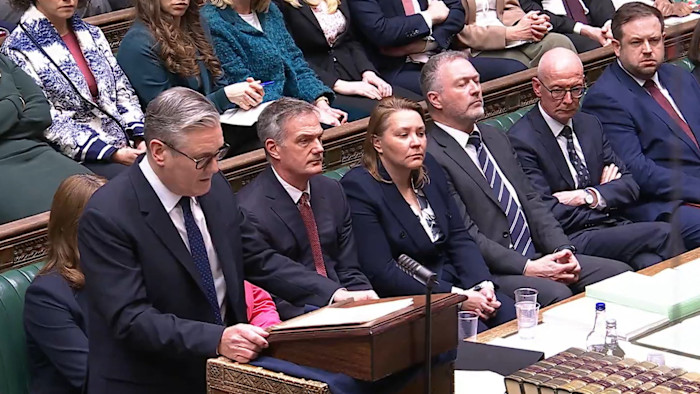
As Sir Keir Starmer delivered his statement on the Peter Mandelson affair on Monday — a statement long on excuses, process and timelines — Labour MPs sat in glum silence. More than two hours of parliamentary debate exposed their leader’s weakness.
Sir Ed Davey, Liberal Democrat leader, summed up the views of many MPs across party lines: “He blames his officials. He says he has no idea. He gives every impression of a prime minister in office but not in power.”
Starmer stood before a sceptical chamber to defend Mandelson’s appointment as his US ambassador, despite the New Labour veteran’s chequered history.
The scandal has so far claimed the jobs of Starmer’s chief of staff, director of communications and the top official in the Foreign Office. Now it has left the prime minister himself in grave jeopardy.
The release of thousands of pages of more documents — due in the coming weeks — could claim yet more scalps.
In the House of Commons, a beleaguered Starmer insisted that he had been kept “deliberately” and repeatedly in the dark by the Foreign Office over the fact Mandelson had failed security vetting by Cabinet Office officials.
MPs are not allowed to make accusations of dishonesty in parliamentary debate, but this did not prevent a barrage of withering questions towards Starmer.
Two MPs were thrown out of the chamber for directly accusing the prime minister of lying: Reform UK MP Lee Anderson and Zarah Sultana, a former Labour MP who is now in “Your Party”.

Sultana had accused Starmer of being a “barefaced liar” who “appointed Mandelson because he owes his job to him”.
Starmer’s opponents have not been able to disprove his argument that he did not find out about the vetting fail until Tuesday last week, despite some claims of him having “lied”.
But the prime minister is battling a growing perception that he lacks judgment. Some of his own MPs asked why he had ignored red flags about Mandelson.
Mandelson was sacked from cabinet twice by Tony Blair, cultivated business interests in Russia and China, and maintained a close friendship with notorious paedophile Jeffrey Epstein — all of which was public knowledge in late 2024 when he got the job.
Emily Thornberry, Labour chair of the foreign affairs select committee, said Starmer’s team had wanted to give Mandelson the job at the expense of “second order” security considerations.
Many MPs raised questions about why Starmer ignored advice from his then-cabinet secretary in November 2024 that the new US ambassador, if a political appointment, should undergo national security vetting before any formal confirmation.
Starmer’s defence was that the fact that security officials had advised against granting clearance to Mandelson “could and should have been shared with me” before the peer took up the ambassador role.
Kemi Badenoch, the Conservative leader of the opposition, accused Starmer of a breach of the ministerial code for failing to correct the record in parliament last Wednesday, the day after discovering that Mandelson had failed the vetting.
Starmer argued that he had needed time to find out who had given Mandelson clearance in order to give MPs the full picture.
Badenoch also asked Starmer if he had been aware that Mandelson was a director of Sistemaa Kremlin-adjacent conglomerate that has a defence subsidiary, until 2016 — two years after Moscow’s invasion of Crimea. It was a question that the prime minister seemed to sidestep.
Stephen Flynn, leader of the Scottish National Party at Westminster, accused the prime minister of “proactively ignoring the victims of Jeffrey Epstein” when he chose to select Mandelson as US ambassador.

“I’m interested in his judgment. Does he believe himself to be gullible, incompetent or both?” he said.
The Mandelson scandal has threatened to drag down a Labour administration that was already struggling in the polls. Starmer’s personal ratings have been close to a record low.
With potentially disastrous local elections barely two weeks away, many Labour MPs are discussing whether it would be possible to oust Starmer afterwards, and when, and who would be an acceptable replacement.
Dissident MPs’ problem is that they cannot agree on a successor: figures such as Andy Burnham, Angela Rayner, Wes Streeting and Ed Miliband all pose different challenges.
Nor can they decide the best moment to strike. Some want to hold off and others are keen to act after local elections on May 7.
Party veterans say Labour is famously bad at defenestrating leaders, in contrast to the perpetually regicidal Conservatives. Attempts to bring down former leaders Gordon Brown and Jeremy Corbyn both failed.
“Just because it isn’t obvious who the next leader should be doesn’t mean that you won’t see a collective moment of panic after we get obliterated in the May elections,” said one Labour MP. “It was Boris Johnson who once said ‘when the herd moves, it moves’, and for once I agree with him.”