
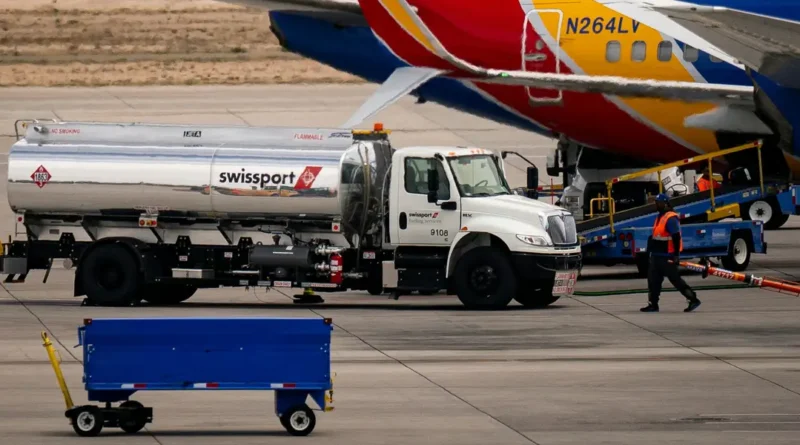
This is how much airlines pay to fuel planes as oil tops $100 a barrel, and what that means for airfare
Filling a Boeing 747 now costs more than a quarter million dollars as oil tops $100 a barrel — driving up already high fares during the peak summer travel season.
Fuel is already airlines’ largest expense after labor, and the recent price surge means filling passenger jetliners now costs nearly twice as much as it did earlier this year. Travelers are already starting to see the impact, with ticket prices climbing by hundreds of dollars.
As the Spirit collapse showedairlines’ profit margins are strained by the unexpected jump in fuel prices. Before the US and Israel launched the war against Iran, in late February, the average cost to fill up an Airbus or Boeing long-haul widebody was about $114,000. That’s since jumped to roughly $180,000.
The fuel costs put upward pressure on airlines to raise ticket prices, but the extent to which they do may depend on the degree to which airlines have locked in fuel costs via hedging strategies, an industry analyst said.
An analysis by Business Insider, using aircraft specifications and the average jet fuel price per gallon across major US cities, found that all classes of aircraft are seeing substantial spikes in the cost to fill up their tanks.
Among the cheapest regional jets — a 50-seat Embraer E145 — costs about $6,800 to fill. Fueling a 600-seat Airbus A380 costs roughly $340,000.
Popular narrowbody planes like the Airbus A320neo and the Boeing 737 — which typically seat roughly 150 to 200 passengers — cost between $23,000 and $46,000 to fill. Jets with extra fuel tanks, like the A321XLR and the 737 Max 9, sit at the high end of that range.
Smaller regional aircraft now cost up to $17,000 to fuel; before the war, that figure was about $10,000.
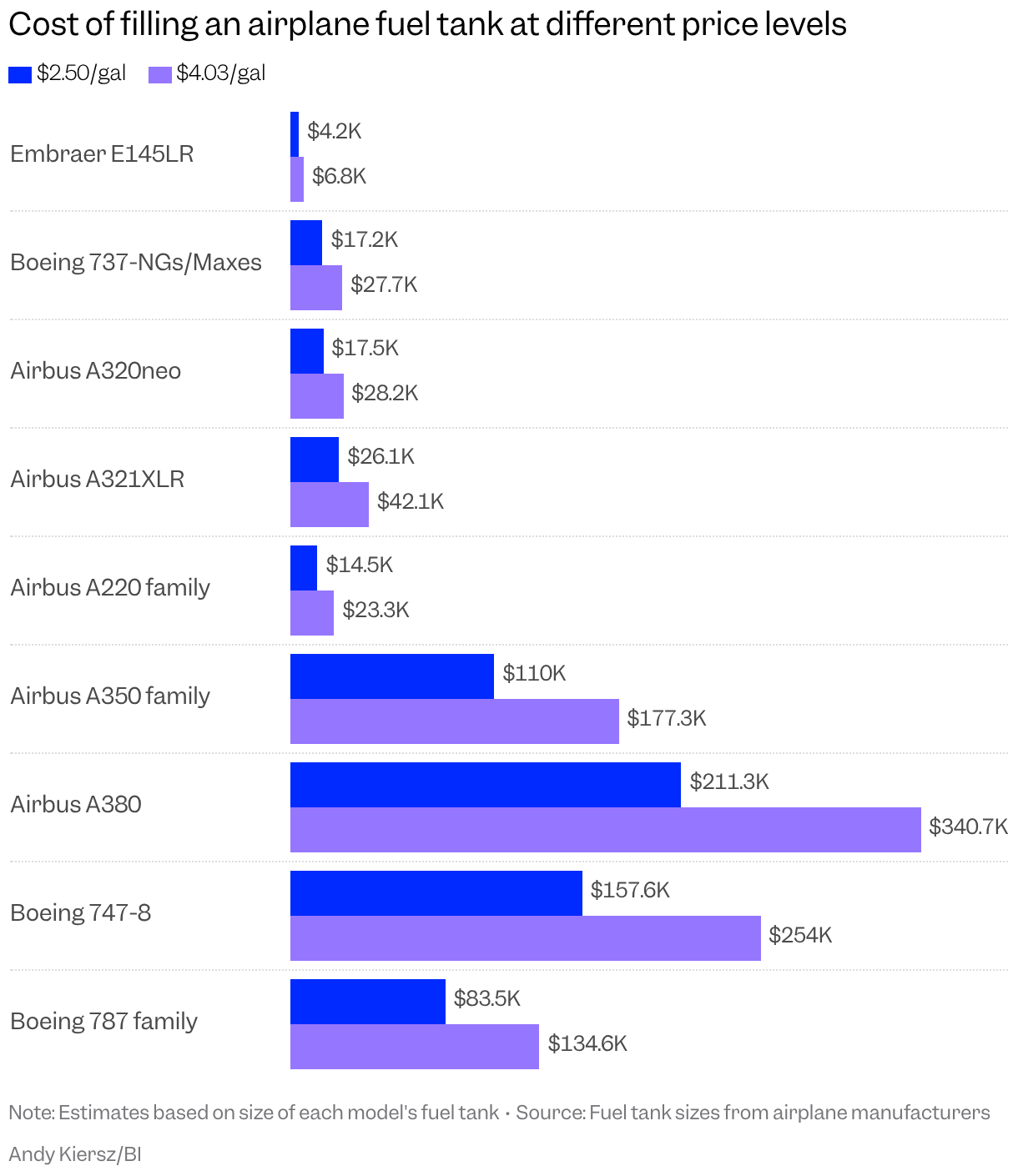
These figures assume a plane is filled to the brim with fuel. In reality, aside from certain ultra-long-haul flightscommercial aircraft rarely depart with full tanks because fuel is heavy, and carrying more than necessary is inefficient.
Actual fuel loads vary significantly depending on route length, payload, weather, reserve requirements, and airline seat configuration.
Airlines are facing the possibility that these high prices may be the new normal for months. In a note shared with Business Insider on Monday, JPMorgan analysts said oil is likely to “remain in the low $100s” per barrel through the end of the year amid the war in Iran, averaging $97 for 2026.
That’s a 40% jump from the 2025 average of about $69 per barrel; as of Tuesday afternoon, the price is about $107 a barrel. Jet fuel averaged $4.03 per gallon on Monday in the US, according to the industry trade group Airlines for America.
Jet fuel is an aviation-grade kerosene refined from crude oil and is highly volatile to supply disruptions — such as the choking of the Strait of Hormuz, through which roughly 20% of the world’s oil had passed prior to the Iran war.
Flyers foot the bill
Airlines have few ways to offset soaring fuel costs, and higher ticket prices are among the most immediate impacts, colliding with peak summer travel demand in full swing.
Data from the travel booking platform Kayak shows that average fares on domestic and international flights have jumped by $90 and $199, respectively, year over year. In 2025, international fares rose about $180 between January and May as peak season approached; during the same period this year, fares jumped $430.
Domestic fares in 2025 were actually $5 cheaper in May than in January, per Kayak. This year, they are nearly $100 more.
Fuel is stored primarily in the wings of most commercial aircraft. Al Drago/Getty Images
Commodity Economics & Finance professor Michael Tamvakis at City St. George’s, University of London, told Business Insider that travelers could see some relief if airlines lean on fuel hedging strategies — contracts that lock in fuel prices ahead of time to protect against sudden spikes — and if higher fares begin to weaken demand. European carriers commonly hedge fuel; US carriers largely do not.
“If airline customers anticipate fare surges, they may be less willing to book air travel, hence reducing demand and making airlines keep prices competitive,” Tamvakis said.
Major US airlines, including Delta, American, and United, each reported spending roughly $330 million to $340 million more on fuel in the first quarter.
Southwest said its fuel costs were up $164 million. During its April earnings call, the company’s CEO, Bob Jordan, gave a blunt reality: “Fuel prices are much higher, and if that is sustained, it will require higher ticket prices to offset that increase in fuel.”
Airlines are pinching pennies across the operation
Beyond raising prices, airlines are scrambling to manage the sudden spike in fuel costs with a set of other familiar tactics — most of which ultimately hit customers.
Airlines like Delta, United, British Airways, and the Dutch flag carrier KLM have cut unprofitable routesJapan Airlines and Virgin Atlantic have introduced fuel surcharges, and all major US carriers have raised checked-bag fees.
In the European Union, regulators have stepped in on the passenger side.
On Thursday, they clarified that under EU261 — rules requiring airlines to compensate travelers up to roughly $700 for certain cancellations and long delays — rising jet fuel prices are generally considered within an airline’s control and part of the cost of doing business, meaning carriers can still be required to pay compensation.
European airlines that cancel flights or cause major delays because of maintenance or IT issues are generally required to compensate passengers. Illustration by Tejas Sandhu/SOPA Images/LightRocket via Getty Images
However, it doesn’t protect travelers flying to and from Europe on US airlines, which operate under different, less generous rules. EU261 also doesn’t shield passengers from a true fuel shortage outside an airline’s control — an increasingly realistic concern as jet fuel markets tighten globally.
While US and European officials insist supplies should remain stable through the summer, low inventories and refinery constraints could still leave airlines and airports vulnerable.
The JP Morgan analysts said summer travel demand is surging while global oil inventories are shrinking so quickly that supplies could become critically tight by August. In other words, flight prices could soar even higher late this summer.
“Jet fuel prices may come down early, in anticipation of a peace deal, or a bit later once the supply chain is full with refined products moving uninterrupted to their destinations,” Tamvakis said.