
Western air forces have used centralized headquarters for decades. A top NATO commander said this easy era is over.
The West’s long-enjoyed luxury of having large command centers can’t continue, even though it will make work more difficult, a top NATO commander told Business Insider.
The West has, for decades, operated out of large air operations centers, Air Chief Marshal Sir John Stringer, NATO’s Deputy Supreme Allied Commander Europe, told BI. “If we’re honest, a lot of it still looks like it did towards the last decade, two decades even with the Cold War.”
But that can’t continue as the number of threats in the air growshe said.”The sense of the big single air operation center, which a lot of people have grown up with over the last sort of 35 years — probably first seen at scale in the Gulf War in 1991 — through to the fixed command and reporting centers, that’s going to have to change,” Stringer said.
There needs to be mobility in command instead, he said. “In fact, mobility, redundancy, and survivability in command and control are essential. Those are not going to become essential. They’re essential now.”
He described it as an area where NATO needs to “play catch-up.”
NATO’s current large air operation centers include the Combined Air Operations Center at Uedem, Germany, which directs and monitors NATO missions with aircraft like Dassault Rafales and F-16 fighter jets and is responsible for all of the alliance’s air policing in northern Europe, including in the Baltic region, where the threat from Russia is the strongest. Another center, in northern Norway, oversees missions across the Baltic Sea and the Nordic region.
Over the last few decades, the Western way of running air wars has focused on a small number of large command-and-control organizations like these that coordinate aircraft sorties, missile strikes, surveillance, air defense operations, and more.
It works extremely well when an adversary doesn’t have the range to target them, but that’s likely not what future wars will look like. China and Russia, for example, have built huge missile arsenals and are leading producers of attack drones, as well as less advanced adversaries like Iran.
The shift will make NATO’s work harder, Stringer said.
“Getting everybody in one place is easy,” he said. “The more distributed it becomes, the more difficult and challenging it is.”
It means there needs to be “essential” investment in modern communication and information systems to coordinate that work, Stringer said: “You’re going to have to do that.”
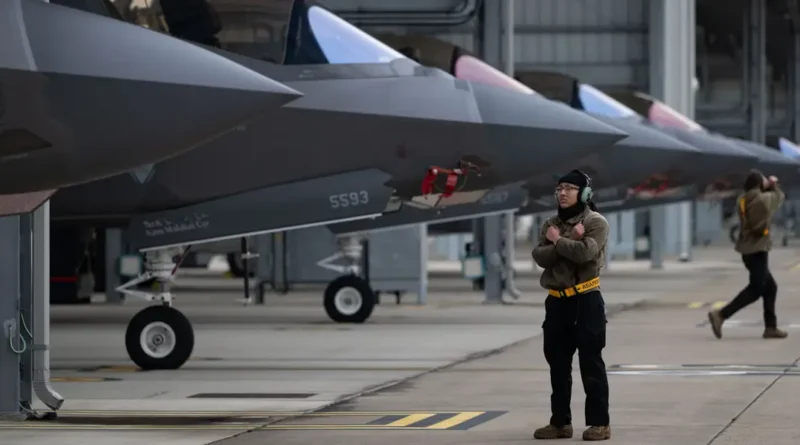
The necessity to disperse command cells echoes a wider strategic shift. Large air bases like RAF Lakenheath in the UK and Ramstein in Germany could become targets for missile and drone barrages, where runway damage could prevent aircraft from taking off and become sitting ducks on the tarmac.
A member of the Combined Air Operations Centre Uedem wears a patch inside a P-8A Poseidon maritime patrol aircraft. Lt. Sara Wedemeyer/US Navy
Despite the drawbacks, communication will need to work in a more networked way, he said, with command-and-control functions spread across multiple sites.
A future mission set, for example, may spread headquarters tasks from mission planning to tactical control across widely separated bases.
That could look like different headquarters and ships, and aircraft, rather than concentrated in a single headquarters or operations center.
It’s something NATO has been testing. When Stringer served as deputy commander of NATO’s Allied Air Command, it started practicing how to distribute its command functions to get “away from one single center,” he said. Stringer is also a former senior officer in the UK’s Royal Air Force, where he flew aircraft including the SEPECAT Jaguar and the Eurofighter Typhoon.
It’s something NATO tests in big exercises, “that’s very much a focus” for many parts of the alliance’s command, Stringer said.
The nature of Ukraine’s fight against Russia’s invasion has sparked a flurry of warnings across the alliance that militaries also need to start dispersing in other ways.
Dispersal and mobility have been key to Ukraine’s survival, from the very start of Russia’s full-scale invasion in February 2022.
It has kept Ukraine’s far smaller air force from being wiped out. A US general said Ukraine lost relatively few of its aircraft on the ground in the first 18 months because “they very seldom will take off and land at the same airfield.” Russia took longer to disperse aircraft, and Ukraine was able to destroy many of them clustered on airfields and at air bases.
It is even finding ways to keep its US-made F-16s on the move, so they don’t need to rely on the advanced airfields that are among Russia’s priority targets.
It’s a lesson many Western officials and analysts say the West needs to adopt — and quickly. Gen. Kevin Schneider, the commander of US Pacific Air Forces, said last year that “the days of operating from secure, fixed bases are over.” He said the threats in the Indo-Pacific region required “a flexible, resilient force that can operate from multiple, dispersed locations under contested conditions.”
Doing that makes the job harder: A large air base has fuel, maintenance, and control facilities, and dispersing makes every step more difficult.
Ukraine also keeps air defense assets, command centers, and key units on the move and concealed.
“This war, especially in terms of the drone war, is like a cat-and-mouse game,” Taras Berezovets, the head of the military cooperation department of Ukraine’s Territorial Defense Forces, said last week.
Many Ukrainian defense manufacturers also spread their production across multiple sites to avoid creating a single target for Russia, even though this makes processes more difficult, and some have told BI that defense companies in Europe should start doing the same.