France faces budget showdown as presidential election looms
Unlock the Editor’s Digest for free
Roula Khalaf, Editor of the FT, selects her favourite stories in this weekly newsletter.
France must resist the temptation to delay difficult spending decisions until after next year’s presidential election, the country’s budget minister has said, as it cannot afford to worsen its wide deficit.
“Repairing France’s public finances is the number one priority,” David Amiel told the FT, likening their current state to a “powder keg” as he prepares the 2027 budget to present to parliament in the autumn.
He called on candidates seeking to succeed President Emmanuel Macron after April’s election to present credible campaign proposals and not pander to voters with “electoralist” spending promises.
The minority government led by Prime Minister Sébastien Lecornu wants to increase spending on defence and protect green initiatives next year while slowing growth in welfare spending.
But amid tepid GDP growth, the government has warned it will not be able to narrow the budget deficit by much this year because of rising interest payments, the economic fallout from the Iran war and higher military spending. Nor will rising unemployment help: it hit 8.3 per cent in the second quarter, the highest level in almost six years.
The government’s current goal is to reach a deficit of 5 per cent of national output by year-end, down only slightly from 5.1 per cent in 2025. France remains far off a promise to reduce the deficit to 3 per cent of GDP by the end of 2029, which would be needed to meet EU rules.
Higher borrowing costs pushed France’s debt interest bill to €34.5bn in the first six months of this year, up 18.8 per cent from the same period in 2025. Amiel said borrowing costs could rise by about €11bn this year compared with last, which would swallow up the equivalent of the justice ministry’s entire budget.
“Everyone knows that the root of our degraded public finances is the explosion of healthcare and pensions spending,” argued Amiel, which is largely an effect of France’s ageing population. “When you look at the increase in spending in the past 50 years, 80 per cent of it is social spending.”

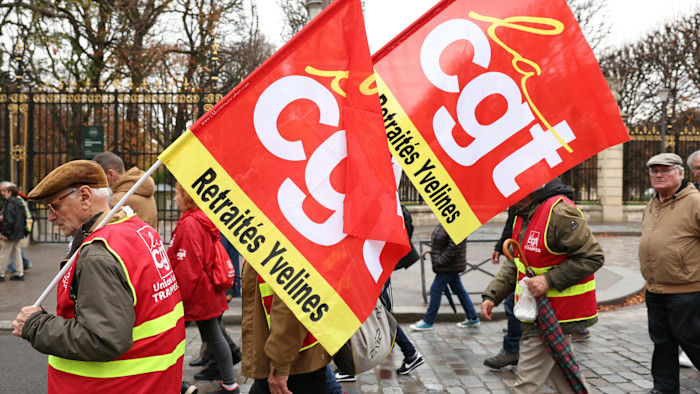
But it will be difficult for the government, which lacks a parliamentary majority and has nine months left under Macron’s term, to deliver broad budget cuts, especially to pensions, a toxic political issue in France.
Pensions, healthcare, unemployment and other social benefits account for 58 per cent of public spending, according to the country’s statistics office Insee, making their reform key to repairing the public finances.
Amiel said parliament must consider freezing automatic inflation-linked increases to pensions and certain benefits since such a move would save billions. In 2025, inflation-adjusted pensions spending rose 2.2 per cent, adding about €6bn to the budget, while in 2026 the rise moderated to 0.9 per cent, adding €2.7bn. But with inflation forecast to rise this year, the government will have a hole to plug in an already tight 2027 budget.
Previous governments tried such freezes but abandoned them after fierce pushback.
In July, the government promised to pass a decree to raise the maximum annual out-of-pocket spending that people pay for medications and doctors’ visits from €50 to €100, doubling the combined cap to €200 a year.

The Socialists, whose votes France’s minority government will again need, would probably oppose social spending cuts. Last year, to pass a budget, Lecornu caved to the left and abandoned Macron’s hard-fought increase to the retirement age by two years to 64. In 2024 and 2025, governments fell during budget showdowns.
Nevertheless, Amiel said the government did not want to pass the buck to the next president. “We prefer to cut spending, and if our successor wants to, they can cancel the measures,” he said.
Concerned about France’s inability to reform, bondholders have demanded a premium compared with other European countries, even to one-time laggard Greece. The spread between the 10-year yield of Germany and France has hovered around 80 basis points recently, the highest since last autumn during the previous budget battle.

A lasting legacy of Macron’s decade in power is the degradation of public finances: borrowings have risen more than a trillion euros while debt-to-GDP has risen to 117 per cent from 98 per cent in 2017.
Macron took out the cheque book to cushion households and businesses through successive crises, including the Covid-19 pandemic and 2022 energy shock, then struggled to scale back the aid. Unfunded tax cuts also played a big role.
With campaigning yet to begin in earnest, presidential candidates in a crowded field have not detailed how they would repair the public finances.
Rightwing hopeful Édouard Philippe has emphasised the need for sacrifices to protect future generations from the weight of the public debt, while far-right leader Marine Le Pen calls for cutting the French contribution to the EU budget and clamping down on immigration. Far-left leader Jean-Luc Mélenchon does not see public debt as a problem, and wants a new wealth tax and higher corporate tax.
“The presidential election is where the various candidates and parties will wage their major cultural and ideological battles,” said Amiel. “In the meantime, parties must act responsibly to cut the deficit, so the next president and parliament have as much freedom of action as possible.”
Data visualisation by Alan Smith and Daniel Jones in London