North Dakota State Dominated FCS. Does That Predict Success In FBS?
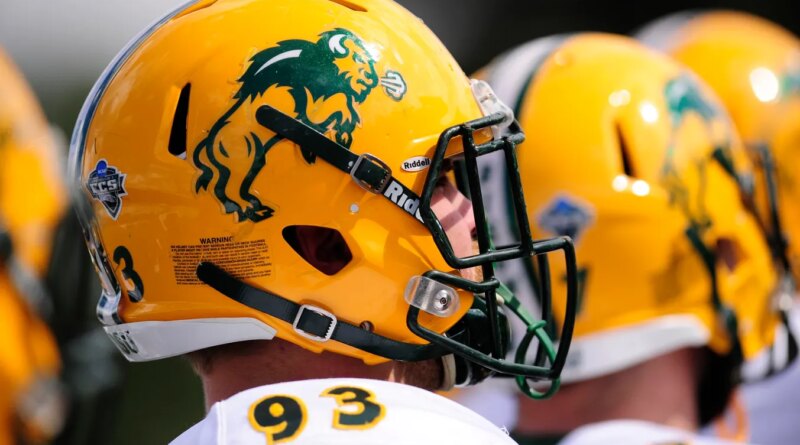
TERRE HAUTE, IN – OCTOBER 07: Jarrod Tuszka (93) defensive end North Dakota State University (NDSU) Bison watches from the sideline in the fourth quarter with a score of 52-0 against the Indiana State University Sycamores in a Missouri Valley Conference (MVC) game Saturday, October 8, 2017, at Memorial Stadium in Terre Haute, Indiana. (Photo by David Allio/Icon Sportswire via Getty Images)
Icon Sportswire via Getty Images
Two programs make their FBS debuts today, and the betting market has very different expectations for them. North Dakota State opens its first FBS season at home against Jacksonville State. Despite being the newcomer, NDSU is a 6.5-point favorite. Sacramento State, which also moves up from FCS this year, opens at Eastern Michigan as a 9.5-point underdog.
That is a 17-point difference between two programs making the same formal jump in competition. Their recent histories in FCS competition help explain why. North Dakota State has spent more than a decade as the standard in FCS football. The Bison finished their 22-year FCS tenure with a 50-5 record in the playoffs, including 10 national championships. They went 12-1 last season before beginning the move to FBS. Sacramento State has also had strong seasons, including a 12-1 run to the FCS quarterfinals in 2022, but its recent results have been less consistent.
Both programs officially begin FBS competition in 2026. North Dakota State joins the Mountain West as a football-only member, while Sacramento State joins the MAC. The question is whether their FCS records tell us much about what comes next.
How Five Year FCS Success Translates To First Year FBS Performance
FRESNO, CA – SEPTEMBER 21: Sacramento State (59) Wyatt Ming (OL) prepares to hike the ball during a college football game between the Sacramento State Hornets and the Fresno State Bulldogs on September 21, 2019, at Bulldog Stadium in Fresno, CA. (Photo by Chris Williams/Icon Sportswire via Getty Images)
Icon Sportswire via Getty Images
To examine whether success at the FCS level carries over immediately to FBS, I first looked at established FCS programs that moved up since 2012 and had at least five seasons of history before playing their first full FBS schedule. Startup programs such as UTSA, Georgia State and Charlotte were excluded because they did not have five comparable FCS seasons.
For each program, I calculated its record over the five seasons immediately preceding its first full FBS season, then compared it with its record during Year 1 in FBS. The NCAA’s realignment history confirms the recent additions to the group, including James Madison, Jacksonville State, Sam Houston, Kennesaw State, Delaware and Missouri State, followed by North Dakota State and Sacramento State in 2026.
Five-year FCS winning percentage versus first-year FBS winning percentage for established programs that moved up since 2012. North Dakota State enters FBS with the strongest five-year record in the group, while Sacramento State sits closer to the middle of the historical range.
Image created by author.
In practical terms, teams that won more in FCS have done slightly better after moving up, on average. Their FCS record alone provides little certainty about how their first FBS season will unfold. The individual programs make that clear. James Madison had won 84.8% of its games over the five seasons before moving to FBS in 2022. The Dukes immediately went 8-3 and finished atop the Sun Belt East in their first season. Georgia Southern and Jacksonville State also transitioned well. Georgia Southern went 9-3 in its first FBS season, while Jacksonville State finished 9-4 in 2023.
AUBURN, AL – SEPTEMBER 12: Wide receiver Ruben Gonzalez #15 of the Jacksonville State Gamecocks catches a pass over defensive back Jonathan Jones #3 of the Auburn Tigers on September 12, 2015 at Jordan-Hare Stadium in Auburn, Alabama. (Photo by Michael Chang/Getty Images)
Getty Images
Other successful FCS programs had a much harder time. Coastal Carolina had won 77.3% of its games during the five-year period before its first FBS season. The Chanticleers went 3-9 in 2017. Sam Houston presents an even stronger counterexample. The Bearkats had won more than 72% of their games during the five-year window and captured an FCS national championship before moving up. They finished 3-9 in their first full FBS season in 2023. Sam Houston’s move also followed an unusual transition period that included the shortened spring 2021 season and a nine-game 2022 schedule.
A simple linear regression confirms the lack of strong predictive power. Five-year performance has a positive relationship with first-year FBS performance, but a weak one. Five-year winning percentage explains only about 5.4% of the variation in first-year FBS winning percentage, with a correlation of 0.23. The regression would place NDSU at roughly a .550 first-year FBS winning percentage and Sacramento State around .440 based on five-year record alone. Given how little variation the model explains, those numbers are better viewed as historical benchmarks than forecasts. Saturday will provide the first data point for both.
Predicting FBS Success From FCS Winning Percentage
A closer look at the historical transitions produced a much stronger signal than the five-year winning percentage alone. Two variables stood out:
- Winning percentage in the program’s final FCS season
- Whether the program reached at least the FCS semifinals during the previous five seasons
A regression using those two factors explains 37.4% of the variation in first-year FBS winning percentage across the historical sample. The model estimates that every additional 10 percentage points of winning percentage in a team’s final FCS season is associated with about 5.2 additional percentage points of first-year FBS winning percentage. Reaching at least an FCS semifinal during the preceding five years adds another 16.7 percentage points, holding final-season performance constant.
A two-variable model using a program’s final FCS-season winning percentage and whether it reached at least the FCS semifinals in the prior five years explains 37.4% of the variation in first-year FBS winning percentage. The model estimates a 71.6% first-year FBS winning percentage for North Dakota State and 37.3% for Sacramento State.
Image created by author.
That model paints a particularly favorable picture for North Dakota State. The Bison finished their final FCS season 12-1, a .923 winning percentage, and easily satisfy the deep-playoff criterion after multiple championship and semifinal appearances over the previous five seasons. The model estimates a 71.6% first-year FBS winning percentage, equivalent to about 8.6 wins over a 12-game schedule.
Sacramento State enters with a different profile. The Hornets finished 2025 at 7-5, a .583 winning percentage, and did not reach an FCS semifinal during the five-year window. Their deepest postseason run was a quarterfinal appearance in 2022. The model estimates a 37.3% first-year FBS winning percentage, equivalent to about 4.5 wins.
BOULDER, CO – AUGUST 29: North Dakota State quarterback Cam Miller (7) in action during the college football game between the North Dakota State Bison and the Colorado Buffaloes on August 29, 2024 at Folsom Field in Boulder, CO. (Photo by Kevin Langley/Icon Sportswire via Getty Images)
Icon Sportswire via Getty Images
The striking part is how closely those estimates line up with the betting market. Current season win totals list North Dakota State at 8.5 wins and Sacramento State at 4.5. A model built entirely from the recent FCS performance of previous programs making the jump arrives at essentially the same numbers. That agreement does not make the regression a substitute for the much broader information incorporated into betting markets. It does suggest that a program’s performance immediately before moving up, combined with evidence of recent postseason success, captures a meaningful amount of its readiness to compete at the FBS level.
What FBS Conferences Should Look For In FCS Expansion Candidates
SACRAMENTO, CALIFORNIA – OCTOBER 22: Robby Hauck #17 of the Montana Grizzlies runs down Asher O’Hara #10 of the Sacramento State Hornets as O’Hara scores in the first possession of overtime during a college football game at Hornet Stadium on October 22, 2022 in Sacramento, California. (Photo by Tommy Martino/University of Montana/Getty Images)
Getty Images
For FBS conferences evaluating potential new members, the key question may be which programs are positioned to compete at a high level immediately. In this small historical sample, the strongest signals were recent winning performance and deep FCS playoff success. North Dakota State checks both boxes, while Sacramento State enters with a more modest profile.