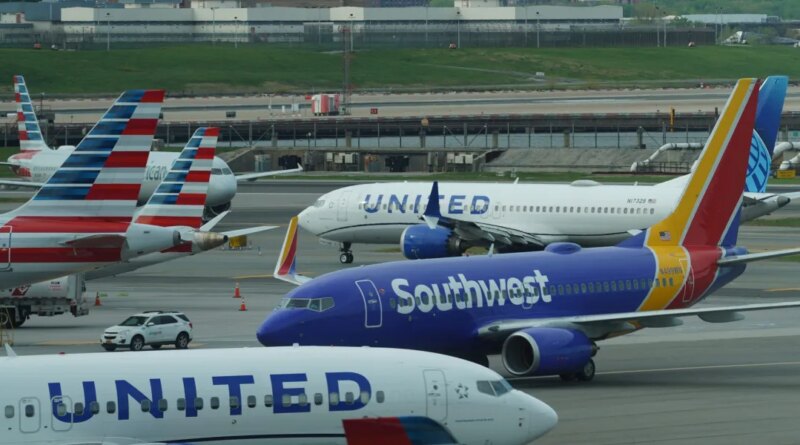
American, United and Southwest are all cutting 'marginal routes' as jet fuel prices spike | Fortune
Bargain plane tickets are already pretty hard to get, and now, they’re only going to get more scarce as airlines scramble to deal with increased fuel costs nearing record highs.
Executives at American Airlines, United Airlines and Southwest Airlines this week said they’re rethinking their least-profitable routes as jet fuel climbs to $4.71 per gallon, more than double the cost a year ago and near a 20-year high.Now, they’re considering cutting some low-performing routes in an effort to cut down on costs.
“You’re just going to want to pull a little capacity out when we see a rise in fuel like we’re seeing right now,” American Airlines CFO Devon May said at Morgan Stanley’s annual Laguna Conference on Sept. 16, adding the fuel spike has added $1 billion to the company’s projected fourth-quarter expenses, prompting it to cut some December flights and plan for less growth next year.
May was far from the only airline executive to sound similar alarms at the conference. He was joined by Southwest CFO Tom Doxey, who said the company began projecting the year it would add 2-3% to flight capacity, but has since cut that projection in half, “because fuel has been higher.”
United CFO Mike Leskinen was also in attendance. He told analysts every airline has its “bell curve of profitability” and some routes make more money than others. As fuel costs rise, maintaining the flights near the bottom of that curve stops making financial sense, which is why United will have fewer flights in December and could make further cuts next year if costs stay high.
“There’s some marginal routes that don’t make sense in a higher fuel environment, so we cut them,” he said. “We’re flying to maximize profitability and free cash generation, so we’ll make those adjustments.”
Leskinen noted 35% of United’s fourth-quarter tickets were already booked—so the airline can’t retroactively hike those prices—but he said there’s room to pass on higher fuel costs to consumers eventually.
“Jet fuel price gets passed through with a lag,” he said. All three carriers (in addition to almost every player in the airline industry) have raised checked bag fees as a way to offset costs.
United and American declined to share the number of flights they cut. A Southwest spokesperson told Fortune its flight schedule adjustments were “very minimal” and do not affect “large scale exits of routes or airports.”
The effects of the jet fuel crisis
It’s bad news for travelers making plans to visit back home. Less routes would mean fewer flight choices to pick from, and could mean fewer convenient times to fly out or having to opt for a layover instead of a nonstop trip.
War in Iran has choked off the global supply of oil, which hit jet fuel particularly hard, sending the price soaring and leaving the airline industry to eat most of the costs. United and American spent about $8.2 billion and $7.8 billion respectively on fuel in the first six months of this year, both up almost 49% from a year earlier, according to their latest filings. Southwest spent nearly $3.6 billion, up about 39%.
Now that airlines are cutting flights, this could also make bargain prices harder to come by for American travelers who are already paying more to fly. Fares are 23.4% higher in August than a year earlier, compared to a 3.4% increase in overall consumer prices, according to the Bureau of Labor Statistics.
Jet fuel costs have also squeezed airlines across the Atlantic Ocean. The Iran fuel shock slammed Europe, which is more dependent on Middle Eastern oil than the U.S., and took a toll on one of its largest budget airlines, Ryanair. The carrier cut its full-year passenger forecast this month from 216 million to 214 million. CEO Michael O’Leary warned oil prices could hike up Ryanair’s famously cheap European flights.