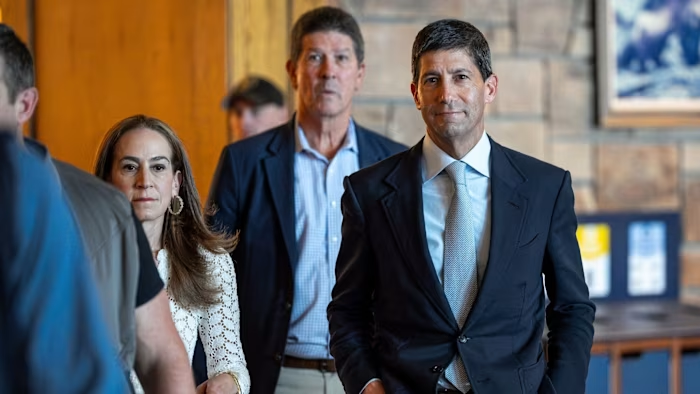
Warsh puts Fed on collision course with Trump ahead of midterms
Kevin Warsh may be about to hand Donald Trump just the thing he does not want: an interest rate rise weeks before November’s crucial midterm elections.
For years, Trump piled pressure on Warsh’s predecessor as Federal Reserve chair, Jay Powell, to lower rates. Since he appointed Warsh earlier this year, the US president has renewed his calls.
But Warsh made it clear in his speech at the Jackson Hole gathering of economists and central bankers on Friday that “concerning” inflation numbers mean “the Fed’s predominant focus right now should be on prices”.
Any rate rise would put Warsh squarely in Trump’s crosshairs, analysts said.
“Warsh has drawn a clear and vivid line in the sand about his goals and intentions, which will put him directly at odds with Trump’s push for lower rates no matter the data or consequences,” said Eswar Prasad, professor at Cornell University, adding that the Fed chair had “made it abundantly and emphatically clear that he intends to put the Fed’s price stability mandate front and centre”.
Warsh faced a dilemma ahead of his first major speech as Federal Reserve chair: assure his critics on Wall Street and within the US central bank that he is serious about bringing inflation under control — or appease Trump and do little to convince markets that interest rate rises are coming.
His address at Jackson Hole made it clear that he had chosen the first course. He prioritised the demands of markets and his fellow rate-setters, both camps that have criticised him in recent weeks for his failure to spell out how he plans to tackle inflation, which has now exceeded the Fed’s 2 per cent goal for more than five years.
“There was a very strong appetite from investors . . . for him to deliver upon the basic principles of central banking,” said Gregory Daco, economist at EY Parthenon. “And that’s what he did.”
In a taste of what was to come, Warsh began the address at the Kansas City Fed’s symposium with a reference to the “hikes” he had taken at the mountain resort with former Fed vice-chair Don Kohn and Ben Bernanke, his boss during his first stint at the US central bank.
After digesting the whole speech, markets ratcheted up their bets on rate rises, with investors now viewing a quarter-point rise in September as likelier than not after the Fed chair warned there was “work to do” if price rises across the world’s biggest economy did not ease soon.
Warsh’s remarks did what he had set out to do, winning praise from analysts and a strong round of applause from those in the room.
But the prospect of rate rises as soon as September may not be greeted as favourably by a president who has spent much of his second term in the White House calling for aggressive cuts.
Powell fell out of favour with Trump soon after his own tenure started in 2018 over the issue of rate cuts. The relationship reached its nadir after the Department of Justice launched a criminal investigation into the then-Fed chair over his handling of a refurbishment of the central bank’s headquarters.
The investigation has since been dropped. But the Trump administration continues to pursue Fed governor Lisa Cook, calling for her to be fired over allegations of mortgage fraud, which she denies.
Just last week Trump said US borrowing costs — at 3.5-3.75 per cent — were “ridiculous”.
Warsh on Friday dismissed that argument, saying that “on balance, I would be hard pressed to describe broad financial conditions as restrictive”.
He also made clear that he was far more concerned about bringing inflation under control than juicing growth in an economy that he said “appears to have strengthened”.
Warsh cited a measure of six-month inflation, which has soared on the back of Trump’s Iran war and voiced fears that, while expectations of future inflation were still well anchored, this could quickly change if the Fed fails to get on top of price pressures.
There is already support among some policymakers for an increase. At the Fed’s July vote, three of the 12 voters on the FOMC backed a quarter-point rate rise.
Warsh supported a hold at that meeting but Robert Sockin, chief US economist at PGIM, said his Jackson Hole speech placed the Fed chair firmly in the hawks’ camp. “[It] reaffirms our view that Warsh is the most hawkish member on the FOMC or, at a minimum, tied for that ranking,” Sockin said.
There was another notable shift evident in Warsh’s remarks on Friday.
After he stepped down as a Fed governor in 2011, he launched frequent attacks on the US central bank which at the time left many of those who were in the crowd at Friday’s symposium disgruntled.
At Jackson Hole he sought to mend bridges with the senior central bankers and economists in the room, saying that it was “a credit to the Fed as an institution — and consistent with the best of the Fed’s traditions — that market prices show confidence that we will deliver price stability”.
“I can assure you, they’re right,” he added.
Some think Warsh, who has closer personal ties with Trump than Powell, will be able to handle any fallout from the White House. Trump has already sought to play down any future rate rises as the result not of the views of the man he picked for the job in January, but a “political” FOMC.
“The administration has framed Warsh’s chairmanship within the context of a potentially hostile FOMC. And that framing gives a little bit more leeway to the chair,” Daco said.
And some think Warsh left enough ambiguity in his remarks that any rise in interest rates — and subsequent ire from the White House — is far from certain.
“He left a lot of room. There’s more data to come,” said Bill English, a professor at Yale.
“I presume [Warsh] intended to send a hawkish signal,” said David Wessel, a senior fellow at the Brookings Institution think-tank. “Declaring independence from Trump, though, means raising rates, not just talking tough.”