France, Britain and Other Countries Say They’ll Send Ships to the Strait of Hormuz
European nations are poised to send ships into the Strait of Hormuz to protect shipping — but not until they are convinced that the new cease-fire between the United States and Iran is working.
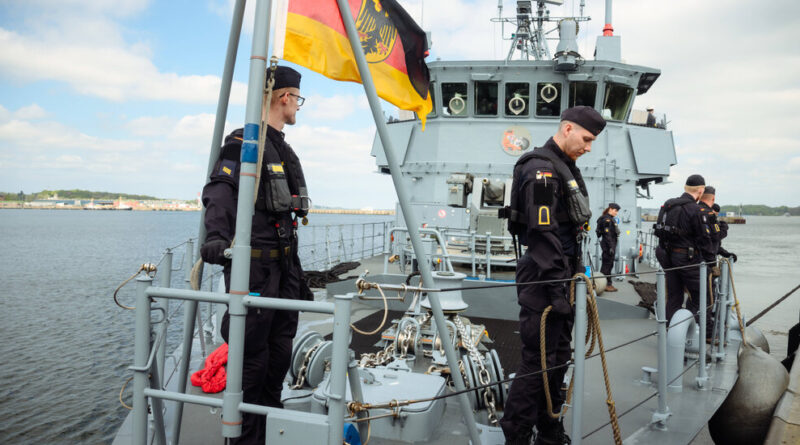
Italian minesweepers are stationed off the coast of Djibouti in East Africa. A German minesweeper and a logistical support ship are in the eastern Mediterranean. France’s nuclear-powered aircraft carrier is a two- or three-day sail from the strait. Britain has sent a destroyer, the Dragon, to the region, to be ready to help secure the strait once shipping resumes.
France and Britain are “ready to act very quickly,” President Emmanuel Macron of France told a radio station Monday morning. He said the two countries and their allies would “do everything” necessary to ensure a resumption of normal shipping of oil and other goods around the world, without fear of attacks or any requirement to pay tolls.
“There are many other straits in the world,” Mr. Macron said. “If we charge a toll every time, what will the consequence be? You’ll drive up prices for the entire world.”
As a Group of 7 meeting began on Monday in France, Europeans said their assets would be sent into the strait only once it was clear the cease-fire agreement would hold, unlike the false starts that led to a resumption of military strikes in recent months. Officials said the memorandum of understanding between the two countries had not been made public for governments to examine.
Already, early signs of disagreement between the United States and Iran emerged on Monday when a spokesman for the Iranian foreign minister challenged President Trump’s claim that the strait would be “permanently” toll-free.
“We are not seeking to levy transit tolls; however, fees will be charged in exchange for the services that are provided,” Esmaeil Baghaei, the spokesman, said in a statement issued by Iran’s state media.
As the G7 leaders assembled in Évian-les-Bains, France, the issue of toll-free passage underscored the anxiety among Europeans about the U.S.-Israeli war in Iran, which most of them opposed. Most of their nations stayed on the sidelines of the three-and-a-half month conflict, enraging Mr. Trump, who accused them of cowardice.
Britain and France instead assembled a coalition of nations that pledged to help ensure a long-lasting peace once the fighting stopped. But the details of what the coalition would do, how much risk it would take, and how long the militaries would stay in the strait have not been publicly stated.
Those questions are becoming more urgent as it appears that the time may have arrived for the Europeans to begin making good on their promises.
In a statement on Monday, Prime Minister Giorgia Meloni of Italy said that her country was “ready, together with our other partners and subject to the necessary parliamentary authorization, to contribute to an international naval presence to support the full reopening of the Strait of Hormuz.”
But in an interview this month, Guido Crosetto, Italy’s defense minister, cautioned that the country would commit troops and equipment only if it was safe.
“No country can enter into the conflict without being sure that their ships — which can’t even defend themselves — won’t be bombed,” Mr. Crosetto said at the time. “Minesweepers aren’t warships. They’re ships which are used for demining. So it must be certain that no one will attack them.”
On Monday, European foreign affairs officials were gathering in Luxembourg, where one topic brought up was Operation Aspides, a European mission started in February 2024 to protect commercial vessels in the Red Sea from attacks by Iranian-backed Houthi militants in Yemen. For months, European Union officials have floated the idea of expanding it to help with the situation in Hormuz once the fighting stopped.
Kaja Kallas, the European Union’s top diplomat, said at a news conference on Monday that the cease-fire announcement by United States and Iran was “a potential breakthrough.” But she said that Operation Aspides would remain focused on the Red Sea and that “the Franco-German coalition then will operate in the Strait of Hormuz.” She said that the two operations “go hand in hand and complement each other.”
Another subject discussed in Brussels — and likely to be on the agenda in France — is the question of the economic sanctions recently reimposed on Iran.
Ursula von der Leyen, the president of the European Union’s executive arm, said at a news conference at the G7 in France that the E.U.’s sanctions on Iran addressed two main issues: human rights violations and weapons of mass destruction.
“The principle of sanctions is that we need real change on the ground before we can think about lifting them,” she said.
Friedrich Merz, the German chancellor, and his government are open to lifting sanctions on Iran as part of the deal, provided Iran complies with terms. But officials stressed that any such relief must be approved by the full European Union.
Germany will wait for the signing of the agreement on Friday to take concrete steps, German officials said on Monday.
Reporting was contributed by Mark Landler from Evian, France; Jim Tankersley from Bern, Switzerland; Jeanna Smialek from Brussels and Motoko Rich from Rome.