Daniel 11 and “Prophecy After the Event”
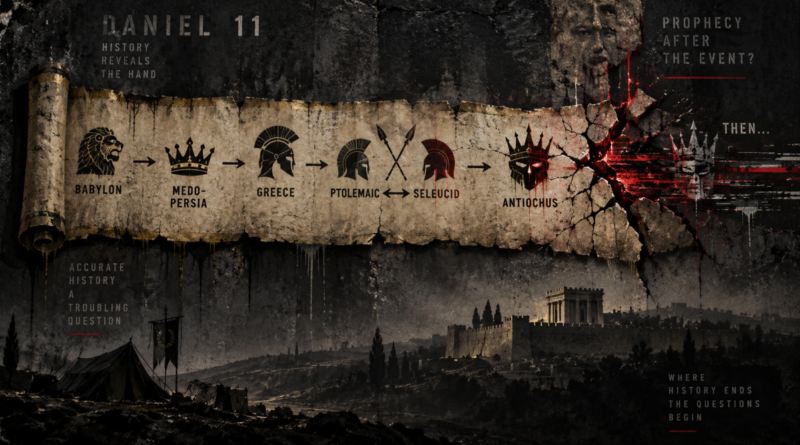
Biblical scholars have a Latin term for a certain kind of writing: vaticinium ex eventu, which simply means “prophecy after the event.” The idea is straightforward. Instead of predicting the future, a writer describes things that have already happened but frames them as if a figure from long ago were foreseeing them. Done well, it reads like uncanny prediction—because the “predictions” are really history written in the past tense’s disguise, looking forward.
Daniel 11 is the most famous test case for this argument. The chapter presents itself as a revelation given to Daniel in the Persian period (sixth century BCE), foretelling centuries of events. What makes it striking is that it gets those events remarkably right—up to a very specific point. Then, critical scholars argue, the accuracy suddenly breaks down. That break is the clue that tells us roughly when the chapter was actually written.
Let’s walk through it in plain terms.
Setting the stage: Persia and Alexander (11:2–4)
The chapter opens with a quick sketch of the Persian kings and then a “mighty king”:
“Then a mighty king shall arise, who shall rule with great dominion and do according to his will. And when he has arisen, his kingdom shall be broken and divided toward the four winds of heaven, but not to his posterity.” (11:3–4)
This matches Alexander the Great, whose empire, after his early death, was carved up among his generals rather than passed to his heirs. So far, a broad historical summary.
The Long Tug-of-War: South vs. North (11:5–20)
The bulk of the chapter then narrates a centuries-long rivalry between two of those successor kingdoms: the “king of the South” (the Ptolemies, who ruled Egypt) and the “king of the North” (the Seleucids, who ruled Syria and the East). Judea sat between them and kept changing hands.
The detail here is what impresses readers. Take the failed marriage alliance:
“After some years they shall make an alliance, and the daughter of the king of the south shall come to the king of the north to make peace; but she shall not retain the strength of her arm… but she shall be given up, and her attendants, her child, and he who got possession of her.” (11:6)
Historians recognize this: a Ptolemaic princess, Berenice, was married to the Seleucid king Antiochus II to seal a treaty. The arrangement collapsed, and Berenice, her child, and her supporters were murdered. The chapter goes on—verse after verse—to track real wars, invasions, and a defeat by an emerging power (Rome), down to a Seleucid king who “sends an exactor of tribute” and then dies quietly rather than in battle (11:20).
Every one of these figures can be matched to a known ruler and event. To critical scholars, that precision is not proof of miracle but a signature of hindsight.
Enter Antiochus IV (11:21–39)
The chapter then narrows its focus onto a single villain:
“In his place shall arise a contemptible person to whom royal majesty has not been given; he shall come in without warning and obtain the kingdom by flatteries.” (11:21)
This is Antiochus IV Epiphanes, the Seleucid king who seized power by maneuvering rather than by right. The following verses describe his campaigns against Egypt, his being forced to back down (the “ships of Kittim” in 11:30 point to Roman intervention), and then his rage turning against the Jews and their religion.
The climax is the desecration of the Jerusalem temple:
“Forces from him shall appear and profane the temple and fortress, and shall take away the continual burnt offering. And they shall set up the abomination that makes desolate.” (11:31)
Historically, this lines up with the crisis of 167 BCE: Antiochus outlawed core Jewish practices, halted the daily temple sacrifices, and had a pagan altar (to Zeus) set up on the temple’s altar. This is the same event 1 Maccabees remembers, and the “abomination that makes desolate” became a byword for that profanation. The chapter also notes the Jewish resistance it provoked:
“The people who know their God shall stand firm and take action.” (11:32)
Up to this point, the correspondence with history is tight and specific.
The Turning Point (11:40–45)
Then something changes. The text moves into what it calls “the time of the end” and describes a fresh round of warfare:
“At the time of the end the king of the south shall attack him; but the king of the north shall rush upon him like a whirlwind… and he shall come into countries and shall overflow and pass through.” (11:40)
It pictures Antiochus sweeping through Egypt, with Libya and Ethiopia in his train, until alarming news pulls him away and he marches out for one last, furious campaign—ending near Jerusalem:
“But tidings from the east and the north shall alarm him, and he shall go forth with great fury to exterminate and utterly destroy many. And he shall pitch his palatial tents between the sea and the glorious holy mountain; yet he shall come to his end, with none to help him.” (11:44–45)
Read plainly, this predicts that Antiochus will die near the holy land—somewhere “between the sea” (the Mediterranean) and “the glorious holy mountain” (Jerusalem / Mount Zion).
Where The Prediction Misses
Here is the problem. That is not what happened.
Antiochus IV did not die in a grand final assault near Jerusalem. He died in 164 BCE far to the east, deep inside his own empire, during a campaign in Persia—reportedly of illness, after a failed attempt to plunder a temple’s treasury. His death had nothing to do with a last stand outside the holy city.
So the pattern looks like this:
- Up to 11:39, the chapter is astonishingly accurate.
- From 11:40 onward, it describes a final campaign and death that never occurred.
For critical scholars, this is the decisive clue. The “history” is accurate precisely because it was written after the events. The “prediction” fails precisely because, at that point, the writer was doing what he claimed all along—actually trying to foretell the future—and got it wrong.
Why Scholars Date it to About 167–164 BCE
Put those two observations together and you can bracket when this section reached its final form:
- It was written after the abomination of 167 BCE, because it describes that event in detail and with strong emotion.
- It was written before Antiochus actually died in 164 BCE, because it predicts a different death that history did not deliver. (It also seems written before the temple was cleansed and rededicated in late 164, the event later celebrated as Hanukkah.)
That narrow window—roughly 167 to 164 BCE—is why most historical-critical scholars place the final form of this material in the years of the Antiochene crisis, rather than in the sixth-century Persian setting the book itself claims.
The Wider Pattern
Daniel 11 is the clearest example, but it is not the only one. Scholars commonly read Daniel 7 (the four beasts and the “little horn”), Daniel 8 (the ram, the goat, and the sanctuary being trampled), and Daniel 9 (the “seventy weeks”) against the very same Antiochene background. Each, on this reading, uses symbolic imagery to speak to Jews living through the persecution of the 160s BCE, offering the assurance that the tyrant’s reign is limited and that God will bring it to an end.
A Fair Word on The Other Side
It should be said that this is a scholarly interpretation, not a unanimous verdict. The traditional view—held across much of Judaism and Christianity for centuries—takes the book at its word: Daniel wrote in the sixth century BCE, and the accuracy of chapter 11 reflects genuine predictive prophecy. Defenders of that position sometimes argue that 11:40–45 refers to events still future, or to a figure other than Antiochus, so that the “failed prediction” objection does not apply.
The historical-critical case does not rest on denying that anyone could predict the future. It rests on a simpler literary observation: a text that is uncannily exact about the past and noticeably wrong about one particular future death is most easily explained as history written forward—right up until the author reached the edge of his own present, and had to guess.