
Medtronic Just Retired 55 Million Shares Without Spending Cash. Is the Stock a Buy? | The Motley Fool
Medtronic (MDT -0.59%) is entering new waters after spinning off its diabetes segment, now called MiniMed (MMED -5.04%). The hope for the medical devices company is that the move will unlock greater margins.
It’s already helped the stock in one way. As part of the deal, Medtronic received approximately 55 million of its own shares in the final results of its oversubscribed split-off and exchange offer for MiniMed. That means Medtronic’s future net income will be distributed across a smaller number of shares, making it easier for the company to increase earnings per share (EPS).
Investors have been a bit dubious about the stock, despite strong financials. It’s down just under 1% so far this year, but over the last three months, it has climbed more than 11%. Here are three reasons why Medtronic might be a buy.
Image source: Getty Images.
It’s about to become a Dividend King
The list of Dividend Kings is a small one. Out of roughly 7,000 stocks on major U.S. exchanges, only 59 have made it to the list by increasing their dividends for 50 or more consecutive years.
MDT Medtronic
$96.54-$0.57 (-0.59%)
NYSE · As of 4:00 PM ET 10/30/26
Companies on that list have survived multiple recessions and market crashes, all while maintaining cash-flow stability and market competitiveness. It’s an elite list that investors pay attention to, and Medtronic has increased its dividend for 49 consecutive years, including a 1.4% increase in 2026. If it raises its dividend in 2027, as expected, the milestone will likely boost stock sales as institutional inflows and fund rebalancing increase.
The company’s trailing cash dividend payout ratio is just under 60%, leaving plenty of room for additional dividend increases.
Strong financials, anticipated growth
In the first quarter of fiscal 2027 — the quarter ended July 31 — Medtronic reported revenue of $9.8 billion, up nearly 14%, year over year. The bump was led by the company’s cardiovascular segment, in which revenue rose by 19% over the same period last year. The company’s two remaining segments, neuroscience and medical surgical, saw revenue rise 14% and 9%, respectively.
EPS rose 15%, year over year, to $1.45. Medtronic had previously forecast yearly organic revenue to increase between 7.25% and 7.75%, and for yearly EPS to rise between 7.4% and 8.5%. However, the guidance was released before the company’s MiniMed spinoff, so those numbers will change.
In fiscal 2026, the healthcare company reported its second great year of growth after a long period of so-so returns. It reported 2026 revenue of $36.4 billion, an 8.4% increase.
The key is a reinvigorated pipeline. The company had more than 50 new FDA approvals and clearances in fiscal 2026, including approvals for its Stealth AXiS computer-assisted surgical system for cranial, ear, nose, and throat, and spine procedures and its Hugo robotic surgery system for urological procedures.
The stock is underpriced
Despite the company’s operational rebound and revenue acceleration, Medtronic stock trades at a discount compared to medtech peers.
It is trading at roughly 16 times forward earnings estimates and 24 times trailing earnings, well below competitors such as Johnson & Johnson (JNJ -0.73%), Edwards Lifesciences (EW -2.57%), Abbott Labs (ABT +1.56%), and Stryker (SYK -6.38%). Medtronic also boasts an earnings yield of 4.2%, again outperforming its closest medtech competitors.
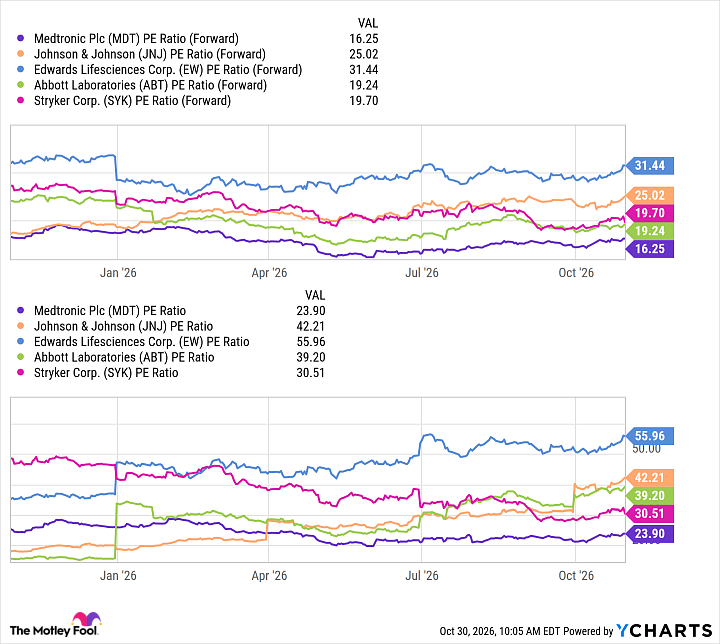
MDT PE Ratio (Forward) data by YCharts