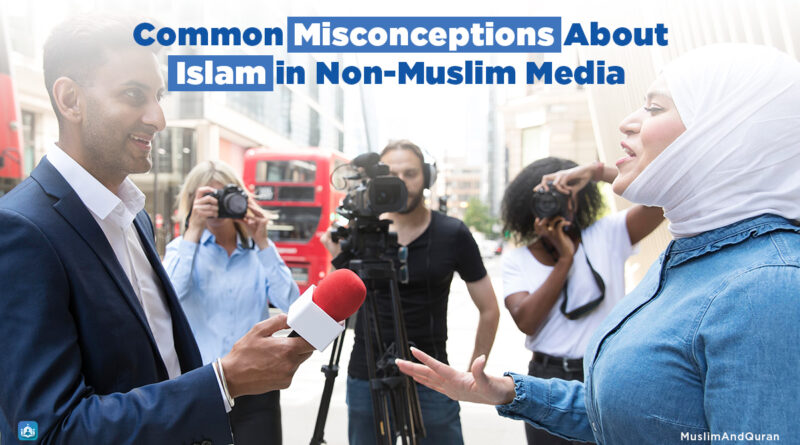
Common Misconceptions About Islam in Non-Muslim Media – Muslim and Quran

Last updated on October 27th, 2026 at 12:45 pm
Muslims firmly believe that Islam is the perfect and ultimate religion, which provides complete guidance for life in this world. It is widely believed in the Muslim world that Islam teaches a complete code of life. By number of followers, Islam is the second largest religion, after Christianity. The total number of Muslims living in different parts of the world is estimated at about 2 billion, which is approximately 25.6% of the world’s population, according to a 2025 Pew Research Center study based on 2020 data. Islam is also known for having one of the most diverse followings in the world, with believers in almost every region, from every nationality and culture.
Although interfaith harmony is included in the basic teachings of Islam, and Muslims generally follow this principle across the world, a bias against Islam does exist, especially in parts of the non-Muslim media. Unfortunately, this trend has become somewhat more serious in the recent past, especially after the introduction of social media platforms. But this bias is not new; it has existed since the inception of Islam, in one way or another. Despite meaningful interfaith dialogue among different religions, the misconceptions about Islam have not ended, perhaps due to the centuries-old mistrust between Islam and other major religions.
Some of the common misconceptions and misunderstandings about Islam, being promoted in non-Muslim media, are summarized here:
1. Misconception That Islam Teaches Terrorism And Violence
There have been multiple misconceptions or misunderstandings about Islam since its inception, but one of the most widespread misconceptions is that Islam promotes terrorism and violence. This misconception has taken a more serious shape in the recent past, just within a span of 3 to 4 decades. Media coverage often links the actions of individuals who carry out terrorist attacks to the whole religion, which presents Islam as a faith that teaches and promotes violence. In fact, Islam forbids aggression and promotes peaceful coexistence across different faiths. It permits fighting only against those who fight, and forbids going beyond that limit, as mentioned in the 190th verse of Surah Al-Baqarah, as follows:
Translation – And fight in the way of Allah with those who fight against you, but do not commit aggression, because Allah does not like aggressors.
Going further, Islam strictly prohibits the killing of innocent people and teaches us to save lives, as mentioned in the 32nd verse of Surah Al-Ma’ida. This verse was first addressed to the Children of Israel, and scholars widely cite it as a principle on the sanctity of human life.
Translation of the relevant part – …. that he who slays a soul unless it be (in punishment) for murder or for spreading mischief on earth shall be as if he had slain all mankind; and he who saves a life shall be as if he had given life to all mankind……..
So, the teachings of Islam are clear: Islam prohibits unjust fighting and killing, and urges its followers to save lives.
2. Misconception That Islam Oppresses Women
Another very common misunderstanding about Islam is that it lacks equal treatment of men and women. It is widely believed in the non-Muslim world, and is promoted in its media, that Islam treats women as inferior to men. Critics cite isolated instances of forced marriages, child marriages, and domestic violence against women as the regular practice, wrongly associating them with Islamic teachings.
The 19th verse of Surah An-Nisa describes the rights and status of women as follows:
Translation – Believers! It is not lawful for you to become heirs to women against their will. It is not lawful that you should put constraint upon them that you may take away anything of what you have given them; (you may not put constraint upon them) unless they are guilty of brazenly immoral conduct. Live with your wives in a good manner. If you dislike them in any manner, it may be that you dislike something in which Allah has placed much good for you.
This verse clearly answers the claim that Islam discriminates against women. In fact, Islam protects the rights and dignity of women, and makes it obligatory for men to treat them with kindness and fairness. Islam also teaches that men and women are equal in dignity and earn the same reward for their faith and good deeds, as mentioned in the 35th verse of Surah Al-Ahzab:
Translation of the relevant part – Indeed, the Muslim men and Muslim women, the believing men and believing women, the obedient men and obedient women … for them Allah has prepared forgiveness and a great reward.
So, the claim that Islam treats women as inferior is baseless, and mistreating women goes against Islamic traditions and values.
3. Misconception That Islam Promotes Hatred Towards Followers Of Other Religions
Parts of the non-Muslim media often portray Muslims as having an inherent sense of hatred and hostility towards the followers of other religions, such as Christians and Jews, or even atheists. It is also claimed that Muslims are hostile toward fellow Muslims who hold different beliefs within Islam. Isolated incidents do not reflect the general behavior of Muslims. Islam teaches respect for people of other faiths and their freedom of belief, as the Quran says, “There shall be no compulsion in [acceptance of] the religion” (Surah Al-Baqarah, 2:256). It urges us to live in complete harmony within a society, irrespective of what religion or faith others may be following. Islam teaches mutual and peaceful coexistence. The 8th verse of Surah Al-Mumtahana provides the basic guideline for interfaith coexistence, as follows:
Translation – Allah does not forbid that you be kind and just to those who did not fight against you on account of religion, nor drove you out of your homes. Surely Allah loves those who are equitable.
Respect for the followers of other religions was personally shown by the Prophet Muhammad صَلَّى ٱللَّٰهُ عَلَيْهِۦ وَسَلَّمَ, as reported in Hadith 1312 of Sahih Al-Bukhari.
Translation – A funeral procession passed in front of the Prophet (ﷺ), and he stood up. When he was told that it was the coffin of a Jew, he said, “Is it not a living being (soul)?”
That’s the spirit of Islam: respect for the followers of other religions. Unfortunately, parts of the media continue to mislead the general audience.
4. Misconception That Jihad In Islam Is A Form Of Terrorism
It is a general misconception among non-Muslims, and is being propagated through non-Muslim media these days, that the concept of Jihad in Islam is a form of terrorism. The fact is that Jihad means striving in the way of Allah سُبْحَانَهُۥ وَتَعَالَىٰ, and this striving covers much more than fighting, as mentioned in the 78th verse of Surah Al-Hajj.
Translation – Strive in the cause of Allah in a manner worthy of that striving.
And the 61st verse of Surah Al-Anfal teaches us as follows:
Translation – If they incline to peace, incline you as well to it, and trust in Allah.
Generally, the term Jihad is used to express one’s physical, spiritual, and financial effort to safeguard the interests of Islam and the Muslim community. While armed fighting against the enemies of Islam is one form of Jihad, non-Muslims often link it to the general behavior of Muslims, alleging that Jihad in Islam promotes terrorism. The fact is that Islam teaches peaceful coexistence within a society and outside it. Most scholars hold that armed jihad can only be declared by a legitimate state authority, and Islam sets strict rules for it, such as forbidding harm to non-combatants. Any such activity by an individual or a group of individuals is against the teachings and spirit of Islam. It should be seen as their personal conduct, instead of relating it to Islam.
5. Misconception That Islam Is Not Compatible With Modern Science
Another common misconception is that Islam is not compatible with modern science, and that Muslims are reluctant to accept new scientific developments. In fact, the Quran repeatedly invites people to observe and reflect on the natural world, as in verses 190 and 191 of Surah Al-Imran:
Translation of the relevant part – Indeed, in the creation of the heavens and the earth and the alternation of the night and the day are signs for those of understanding. Who remember Allah while standing or sitting or [lying] on their sides and give thought to the creation of the heavens and the earth……
The Quran also teaches Muslims to pray for more knowledge: “My Lord, increase me in knowledge” (Surah Ta-Ha, 20:114). This encouragement shaped Islamic history. During the Islamic Golden Age, Muslim scholars made lasting contributions to science. Al-Khwarizmi laid the foundations of algebra, and the word “algorithm” comes from his name. Ibn al-Haytham pioneered the experimental study of light and vision. Ibn Sina’s Canon of Medicine was used as a medical textbook in Europe for centuries. Today, Muslims work in every field of science, medicine, and technology.
Conclusion
Islam is not restricted to a certain era, nation, or language; it is a universal religion, which can be practiced by all future generations. It exists in almost every part of the world. Despite the fact that Islam promotes peaceful living, parts of the non-Muslim media often portray Islam negatively. Over the years, they have created and promoted various misconceptions against Islam and Muslims, mainly linking it with extremism, terrorism, gender inequality, hostility towards other faiths, and rejection of science. Such claims do not reflect the teachings of Islam, and they damage its image. The Islamic teachings categorically discourage such wrong practices. Various Quranic verses and Hadiths prohibit Muslims from such activities, and Muslims in general prefer to live a peaceful life, making this world a peaceful place for everyone.
FAQs
1. Why is Islam often misunderstood in non-Muslim media?
Islam is often misunderstood because some media coverage links the actions of a few individuals to the whole religion, and because many people have limited knowledge of Islamic teachings. As a result, Islam is wrongly associated with terrorism, the oppression of women, and hostility towards other faiths.
2. Does Islam promote violence and terrorism?
No, in fact, Islam prohibits aggression, as taught in the Quran in many verses, such as the 190th verse of Surah Al-Baqarah. It also upholds the sanctity of human life (Surah Al-Ma’ida, 5:32).
3. Does Islam treat women as inferior to men?
No. Islam gives men and women equal dignity and equal reward for their deeds, and it gives honor and respect to women. The 19th verse of Surah An-Nisa provides some of the guiding principles about the status of women in Islam.
4. What is Jihad in Islam?
Jihad refers to striving in the way of Allah سُبْحَانَهُۥ وَتَعَالَىٰ. It includes spiritual and moral striving, while armed struggle is a specific type of Jihad, which, according to most scholars, can only be declared by a legitimate state authority.
5. Are Islamic laws only for punishment?
No, Islamic laws (Sharia) cover all aspects of human life, including worship, moral conduct, family affairs, and justice.