Bond investors brace for ‘volatile’ Federal Reserve transition as Powell stays on
Unlock the Editor’s Digest for free
Roula Khalaf, Editor of the FT, selects her favourite stories in this weekly newsletter.
Bond investors are steeling themselves for a bumpy transition in Federal Reserve chair from Jay Powell to Kevin Warsh that could fuel volatility in the world’s most important financial market.
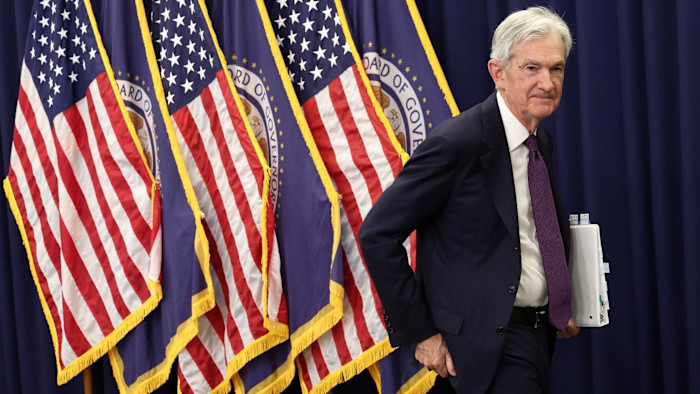
Powell said on Wednesday that he would stay on the Fed’s board of governors as a voting member after stepping down as chair, breaking with 80 years of precedent. Powell said he would remain as a governor — a term that ends in 2028 — at least until the US Department of Justice’s criminal probe into his handling of the central bank’s renovations is fully resolved.
Warsh is expected to take over as chair next month after the Senate banking committee approved his nomination on Wednesday.
While Powell said he would not seek to be a “shadow chair” influencing policy, fund managers warn that his continued presence would muddy the signals the central bank sends to the $30tn US government bond market, which acts as a reference interest rate for the global economy.
“The shadow of Powell could hang over Warsh,” said Mark Dowding, chief investment officer for fixed income at RBC BlueBay Asset Management. “[His] ongoing presence . . . as a governor could add to volatility at a time when there is a divergence of opinions with the [rate-setting Federal Open Market Committee]as currently is the case.”
Powell’s decision, which Treasury secretary Scott Bessent said on X “flies in the face of tradition”, has deepened the open conflict between the Fed and the US government.
President Donald Trump has repeatedly called for the central bank to lower interest rates and his administration has launched multiple legal attacks against the institution and its members, which Powell has previously characterised as a “pretext” for pressuring the bank to loosen policy.
Trump said on Truth Social late on Wednesday: “Jerome ‘Too Late’ Powell wants to stay at the Fed because he can’t get a job anywhere else — Nobody wants him.”
Powell sought to soothe concerns that he would quell Warsh’s influence.
“I plan to keep a low profile as a governor,” he said in his final press conference as Fed chair on Wednesday.
“There is only ever one chair of the Federal Reserve board. When Kevin Warsh is confirmed and sworn, he will be that chair. Once sworn in as board chair, his new colleagues will elect him to chair the FOMC as well.”
But, even before Powell decided to stay on as a governor, investors were worrying that the transition could fuel uncertainty as traders try to digest Warsh’s desire both to significantly shift the Fed’s approach to monetary policy — pursuing a “new inflation framework” while having a dovish view on rates — and to rein in its communication to investors and the public.
Warsh’s divergence on policy and his desire to “pull back” on communication “can add some volatility back into not only interest rate markets but markets in general”, said Bill Campbell, portfolio manager at DoubleLine.
Campbell also pointed to signals from Warsh and Bessent that they would like to redraw the relationship between the Fed and the Treasury. Warsh has previously criticised the Fed for “exercising powers that are the province of the Treasury department”.
With the institution’s independence in the spotlight, Warsh will inherit a board that is increasingly divided over whether the central bank’s next move should be a rate cut.
Three regional Fed presidents at Wednesday’s meeting objected to the majority’s bias towards easing policy, amid a surge in oil prices to their highest level since 2022.
“The dissenters are concerned about a still bigger oil price shock coming on top of prior shocks to inflation, but are also sending a signal to Warsh that they will follow the data regardless of the new chair’s orientation on rates,” said Krishna Guha, vice-chair at Evercore ISI.
Meanwhile, Trump’s latest Fed appointee — governor Stephen Miran — argued that the bank should still be cutting borrowing costs.
Wednesday’s decision marked the first time four officials have dissented since October 1992.
Some bond investors said they took Powell at his word that he would keep a low profile.
“This is just about pushing back on political interference rather than any intention to undermine Warsh,” said John Stopford, head of multi-asset income at Ninety One.
Vishal Khanduja, head of broad markets fixed income at Morgan Stanley Investment Management, said Powell would be viewed as the “flag-bearer of an independent Fed”, which could slow down some of Warsh’s plans to change the central bank.
“It gives one more vote to a member who is not going to be fully aligned with what the president wants to do,” added Khanduja.
Bill English, a former Fed official who is now a Yale professor, said that when Marriner Eccles stayed on as governor in 1948 — the last chair before Powell to do so — it sowed confusion within the US central bank’s ranks.
“The view looking at that period was that it was pretty hard on the institution because it wasn’t entirely clear who was in charge,” English said, though he added that he thought Powell did not want to make the same mistake.
“I think Powell is looking at that and saying ‘That was bad, I don’t want to do that’,” he said. “I think he really will try to be unobtrusive and leave Kevin Warsh to find his way with a committee that’s quite divided.”