
2 TSA experiments follow Trump's push to privatize airport security
The Transportation Security Administration is rethinking airport security after two government shutdowns recently wreaked havoc across the nation.
One new initiative, TSA Gold+, aims to shift day-to-day security operations to private contractors without increasing airport costs.
Another trial, launching in June, will allow some Boston airport passengers to clear security 25 miles away, then ride a bus to the airport for a fee, where they will be dropped off at their gates. It relies on the transport company Landline to keep the bus secure for the often over one-hour drive.
Both initiatives have the same goal: Make airport security less of a headache for everyone and rely more on private companies to do it.
It’s not a new stance from the Trump Administration — privatization of aviation systems has been a campaign promise, with President Donald Trump saying he believes fully privatizing them while maintaining government oversight would save money, improve efficiency, and enhance safety.
The US has been experimenting with privatization for years, primarily through the TSA’s Screening Partnership Program. This uses contracted security officials to screen passengers and baggage at 20 airports, including San Francisco and Kansas City, as well as several smaller regional airports.
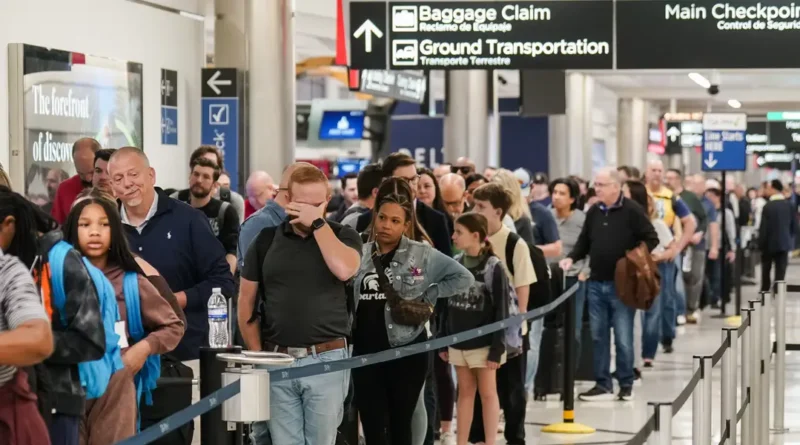
The benefit of this became apparent in late 2025 and early 2026, when thousands of federal TSA officers worked without pay during two government shutdowns after Congress failed to reach funding deals. Staffing thinned as demoralized workers called out or quit, stretching security lines for hours with little to no notice. San Francisco’s private security, by contrast, saw minimal disruptions.
Passengers at Houston Hobby Airport experienced TSA wait times up to three hours during the partial government shutdown. Brett Coomer/Houston Chronicle via Getty Images
With Gold+, officials want to make the Screening Partnership Program a reality nationwide, shifting not just physical screening duties but also equipment to contractors whose budgets don’t rely on Congress.
“The administration wants a larger private influence for airport security,” Sheldon Jacobson, a computer science professor at the University of Illinois Urbana-Champaign who helped regulators develop TSA PreCheck, told Business Insider. “It all sounds good, with TSA setting the standards and airports implementing them. If the lessons learned are widely shared, there can be some benefits.”
However, opponents warn that privatizing airport security could result in the loss of thousands of TSA jobs, lower pay, weakened worker protections, increased turnover, and potentially pressure companies to prioritize profits over safety.
The TSA employs roughly 50,000 security officers who start at about $40,000 annually. The average pay ranges from $60,000 to $75,000, with higher-cost-of-living cities paying more. Experienced TSOs with years on the job and strong performance can advance into analytical and supervisory roles that make six figures.
The Boston bus experiment, limited to Delta and JetBlue passengers for now, takes a different approach to involving private companies in airport operations — and the unusual idea comes with its own risks.
The bus costs $9 per adult, while children 17 and under are free, and it’s available only for Delta and JetBlue flights between 5:30 am and 4 pm. The ride can take 20 minutes to over an hour, depending on traffic. Massachusetts Port Authority
TSA officers still conduct screening, but Landline handles the trip to the airport, with checked bags stored underneath the bus while passengers keep carry-ons and personal items with them. If Gold+ succeeds as officials expect, it could open the door to more remote screening setups paired with private shuttle buses.
Jacobson said privatization can work “so long as the standards for [private] employees are well-defined and the training is rigorous,” but the pilot bus program raises a separate concern: maintaining airport-style security outside the airport itself.
A Landline spokesperson told Business Insider that the company “meets the high security standards set by TSA and DHS.” The TSA said there will be a “multi-layered screening of passengers.”
But Jacobson said there are many uncontrollable factors on that trip to Logan — which will drive on public roads for sometimes more than an hour — pointing to the heightened risks when airport security processes depend on a separate operator outside the TSA-controlled environment.
For instance, if the bus were involved in an accident or someone aboard got sick, that could compromise security and require a rescreening, which could cause travelers to miss their flight.
“I don’t see the motivation in terms of convenience; people still have to park at the remote terminal, clear TSA, and get on a bus,” Jacobson said. “The question is, will this now be a weak spot?”