Andy Burnham Becomes UK Prime Minister: Live Updates
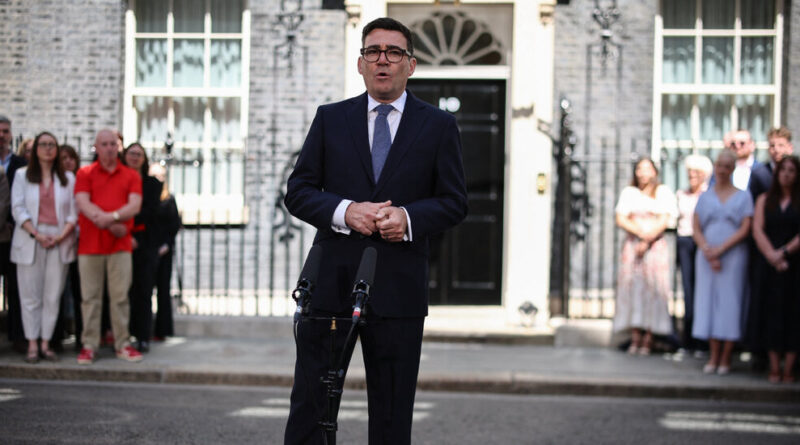
On Monday, when Andy Burnham officially became the new prime minister of Britain, meeting with King Charles before entering the doors of 10 Downing Street, he did something he has rarely done in the last decade. He put on a tie.
For most politicians that would have been a matter of course. Duh! Obviously you wear a tie when you take the job as leader of the country. But for Burnham, who has largely abandoned the tie since leaving Westminster in 2017 and becoming the mayor of Greater Manchester, it was both a symbol of his new post, with all the tradition and demands for compromise it involved, and a reminder of his willingness to discard precisely those niceties. In his hands, a tie is never just a tie. It’s a tactic.
Indeed, few male politicians have used their wardrobe as part of their political arsenal quite as strategically as Burnham. As he returns at age 56 in triumph to the job he first vied for in 2010he does so as a new-look prime minister. One whose change of clothes in his decade in the north has come to represent, as much as anything he says, what he promises is a change in what power looks like.
Out with the Jaeger and the Armani suits bought on sale and in with the T-shirt and unstructured jacket, the zip-ups, the jeans. In with the navy and black. In, sometimes, with the embarrassing athletic choices, like the short running shorts that exposed an awkward (but recognizable) attempt at fitness and the Everton jersey that touted his off-duty fandom. In with the smart casual dad look: a little dorky, a little hipster wannabe, never too polished. In with relatability.
It is a look, after all, shared by numerous middle-aged men who vote. Kenny Farquharson, a London Times columnist who writes a Substack newsletter called The Jaggy Thistleexplained that he started thinking about what the politician wore after looking in the mirror and realizing, “I look like Andy Burnham.”
Farquharson christened the style Andycore. It may have been a joke, but it was a telling one. And while having a vibe named after you is not quite the same as becoming synonymous with an actual garment, like the Mao jacket, the Modi kurta, the Madiba shirt and the Eisenhower jacket, it is close. And it suggests that Burnham may be one of those politicians so skilled at the semiotics of silent communication that he ends up giving his name to a style.
Certainly Burnham’s look has become part of his signature — and his sell. You can trace its origins all the way back to his second failed leadership campaign in 2015, when he told GQ he didn’t think George Osborne, then the chancellor of the Exchequer, would become leader of the Conservative Party because “he looks scheming and tactical, and I think that’s quite unappealing.”
Little wonder that with what British Vogue called his “friendly features, a memoji-like swoosh of dark hair, long eyelashes framed by Harry Potter-style spectacles and a permanent stress frown,” Burnham decided to present a different option. When he ran for mayor, his clothes offered a message to his new constituency that he had shed his parliamentary pretensions with his tailoring. This was a new, unbuttoned Andy who understood voters’ concerns because he understood their taste.
“Because we’re such a class-obsessed society,” Farquharson said in a phone call, “the way you dress carries great signifiers.” Class differences are coded in clothes, whether anyone is consciously processing them or not.
When Burnham left Parliament, he told The Guardian that he remembered “slowly realizing, ‘I don’t have to do this anymore.’ What I would have worn to the match at weekends, I just started wearing. It was an evolution, and I’m not going back.”
Case in point: the zip-up navy Harrington jacket Burnham bought on sale from the former House of Fraser department store and liked to wear to watch his favorite soccer team on the weekends. As it happened, he also wore it in 2020 during a speech in which he denounced the Covid-19 restrictions imposed by the Tory government. The speech became so famous that Burnham was crowned “King of the North,” and the proletariat-coded jacket ended up in the People’s History Museum in Manchester.
At this point his style has become a kind of shorthand for what his leadership represents, good or bad. “Is Andy Burnham more than just a smart-casual Sir Keir Starmer?” went a headline in The Economist. The New Statesman put Burnham on the cover after the election for Makerfield M.P. sent him back to Parliament and positioned him for the leadership. The illustration depicted him on a horse as a conquering hero in bluejeans, a black polo and Adidas sneakers, javelin in hand. (This despite the fact that he actually wore dark jeans, a white zip-up polo and brown sneakers to celebrate his victory.)
Dressing like a regular guy is not exactly a new tactic in politics, though it has backfired as often as it has succeeded. David Cameron, a former prime minister, once held a no-ties Group of 8 meeting that was widely mocked for its pretend casualness. By contrast, the workingman cred of Senator John Fetterman in the United States is reflected in his workingman clothes.
But what’s striking about Burnham is how he has used his wardrobe to occupy a greater and greater middle ground. He’s so upfront about it that it’s practically a rhetorical device.
Consider his riposte to the attempt by Kemi Badenochthe leader of the Conservative Party, to use his clothes against him by calling him “a pair of eyelashes and a black T-shirt.” Burnham simply posted a video of himself on X batting his eyelashes, looking down at his shirt and observing, “It’s dark blue, actually.”
Later, when he made a speech laying out his ideas about devolution of powers in Britain, he did so in Manchester in his trademark uniform of dark T-shirt, relaxed jacket and jeans, joking he had to get “special permission” from the folks in Westminster to wear what they called his “Manchester clothes.” Then he made fun of his running shorts and reminded everyone that his jacket was in a glass case in the People’s History Museum, a place that commemorates how “ordinary people have fought to change that status quo.”
Ordinary people, in other words, like him. Even though, of course, there is nothing ordinary about becoming prime minister.
And therein lies the rub. The expectations of his new position most likely dictate more formal dress. The House of Commons has a dress code — “Members should dress in businesslike attire” — albeit one that includes the caveat that “this need not include a tie.” Yet if Burnham abandons Andycore, he could be seen as waffling, an accusation already being lobbed at him by his detractors.
Perhaps there is a clue to the approach he will take in the suit he wore to be sworn in upon his return to Parliament. A three-button number that spoke more stylistically to the mythology of Carnaby Street than Savile Row, it stood out: clearly similar yet different from all the other suits around him. Which is presumably how Burnham would like voters to think about him, too.