USS Ronald Reagan Nearing Return To Service As Navy Faces Carrier Shortage
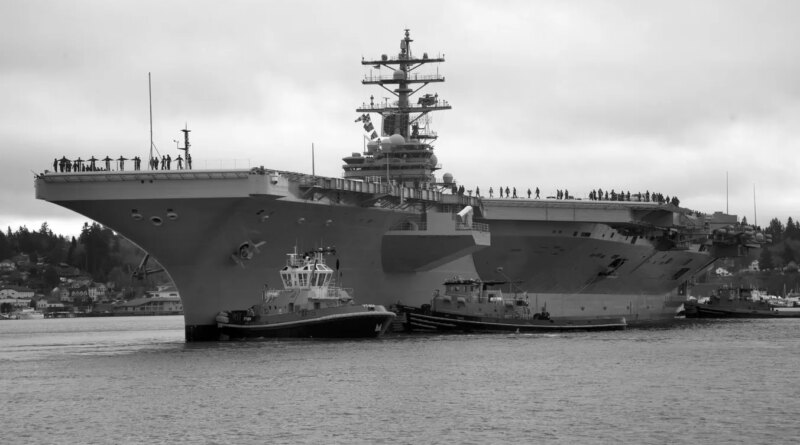
Aircraft carrier USS Ronald Reagan (CVN 76) departs from Bremerton, Washington for San Diego following over a year of maintenance, 2013. Image courtesy Scott A. McCall/US Navy. (Photo via Smith Collection/Gado/Getty Images).
Getty Images
There are currently just three United States Navy nuclear-powered aircraft carriers actively operating at sea, with two deployed to the Middle East and another in the Western Pacific. A fourth could head out to sea in the coming weeks, but the U.S. Navy remains stretched thin and will likely continue to extend deployments of each warship.
Two other carriers – one on the West Coast and another on the East Coast – aren’t likely to begin their respective patrols until later in the fall, but one other aircraft carrier is close to returning to service, and could be set to resume operations in early 2027.
Stars and Stripes first reported that the Naval Base Kitsap-Bremerton, Wash.-based USS Ronald Reagan (CVN-76) is on track to complete its Drydocking Planned Incremental Availability by the end of August. That work is being conducted at the Puget Sound Naval Shipyard & Intermediate Maintenance Facility, the specialized industrial shipyard located within the Bremerton portion of Naval Base Kitsap.
The U.S. Navy’s ninth Nimitz-class carrier, USS Ronald Reagan, is named for America’s 40th president. CVN-76 had served as the service’s only forward-deployed flattop until early 2024, and spent much of that summer conducting a “hull swap” with USS George Washington (CVN-73) in San Diego, before arriving at her new home port of Naval Base Kitsap, Bremerton, Washington, on August 13, 2024.
Carrier Maintenance On The West Coast
CVN-76 is the latest aircraft carrier to be serviced at PSNS & IMF, the only facility on the West Coast able to conduct such maintenance on the massive vessels.
The supercarrier began its DPIA in March 2025, as a scheduled maintenance period where large warships are placed into a dry dock. During the past year and a half, the USS Ronald Reagan has undergone intensive structural repairs, hull preservation and technological upgrades. Much of this work can only be done while out of the water, as it focuses on parts of the ship that are normally submerged, including the propeller shafts, rudders and underwater hull plating. In addition, the warship is receiving upgrades to its combat systems, electronic suites, catapult mechanisms and living quarters.
The DPIA is a more intensive maintenance than a Planned Incremental Availability, which can be completed while the ship remains afloat in the water.
Even as PSNS & IMF is the only facility on the West Coast that can handle this level of work, it isn’t capable of handling the same level of work on the newer Gerald R. Ford-class carriers. As current plans call for the second carrier of the new class, the future USS John F. Kennedy (CVN-79), to be homeported at Naval Base Kitsap, the U.S. Navy is likely to move forward with an upgrade of the facility to support the maintenance of the vessels in the Pacific Northwest.
Last month, the U.S. Navy issued a Sources Sought notice for a multi-mission dry dock, with the contract being worth up to $30 billion.
“The Multi-Mission Dry Dock is a fully pressure-relieved dry dock capable of accommodating shipyard repair services for the newest Ford-class aircraft carrier, Nimitz-class carriers, and other surface and subsurface ships served by PSNS & IMF,” the notice explained.
It would be a mammoth undertaking to upgrade the current Dry Dock 3, which will include installation of new infrastructure, including electrical substations and utility tunnels, and finally a dock caisson. The U.S. Navy may not have a choice; however, an alternative option will be to send the Ford-class flattops back to Norfolk, Virginia.
Where Are The Other Carriers?
The Nimitz-class supercarriers USS Abraham Lincoln (CVN-72) and USS George H.W. Bush (CVN-77) remain in the Arabian Sea, supporting U.S. military operations in the Middle East, and are ready to launch combat sorties against Iran should that be ordered.
The forward-deployed USS George Washington is now operating in the Indo-Pacific, after conducting a port visit to Da Nang, Vietnam, last month. The Yokosuka, Japan-based flattop began its 2026 patrol in May.
A fourth carrier, the San Diego-based USS Theodore Roosevelt (CVN-71), is in port after leading last month’s Rim of the Pacific international military exercises near Hawaii, and is set to begin its 2026 deployment in September.
The USS Dwight D. Eisenhower (CVN-69), the U.S. Navy’s second oldest nuclear-powered aircraft carrier, completed its PIA this spring, and has been undergoing preparations and certifications for a deployment later this year from Naval Station Norfolk.
The San Diego-based USS Carl Vinson (CVN-70) is also preparing for its next deployment.
However, by the time CVN-69 and CVN-70 finally head out to sea, USS Abraham Lincoln will likely be back in port after having departed from Naval Station North Island, San Diego, in late November 2025, and USS George H.W. Bush will also have spent much of the year deployed, having departed from Norfolk this past March.