Allies Converge on Iran as Funeral Ceremonies for Supreme Leader Begin
Iran’s government began a week of events on Friday to mourn and bury its slain supreme leader, Ayatollah Ali Khamenei, with visits by foreign leaders to the site in Tehran where his body is lying in state.
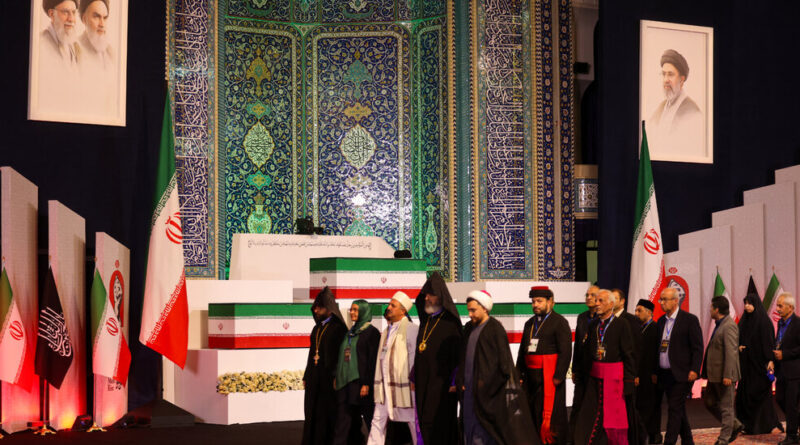
Images published by Iranian state media showed Iranian and foreign officials, militia members and religious leaders walking to and standing before the casket of Ayatollah Khamenei, who was killed on Feb. 28 at the outset of U.S.-Israeli strikes on Iran. Some visitors bowed solemnly, prayed or cried.
The events on Friday set the stage for an elaborate series of ceremonies, which will continue on Saturday with a public viewing of Ayatollah Khomeini’s casket. After a procession in Tehran on Monday, his body will be taken to holy Shiite cities in Iraq before he is buried in his hometown, Mashhad, in Iran.
The casket, draped in the Iranian flag, was topped by a black turban and a black-and-white checked scarf like one he often wore, which in Iran is associated with the country’s Basij militia force. The black turban signifies that he was a cleric descended from the Prophet Muhammad.
Friday’s ceremony took place in Tehran’s Grand Mosalla, a large prayer complex where Ayatollah Khamenei gave many important addresses during his reign. State news reports said his casket was surrounded by those of family members who were killed along with him.
While Iran’s government is seeking to portray Ayatollah Khamenei as a beloved and respected leader of global stature, many Iranians may view the expensive, dayslong funeral with discontent or anger.
Over 37 years of authoritarian rule, Ayatollah Khamenei harshly repressed dissent and allowed economic mismanagement and corruption to fester in Iran.
The long delays to his burial, more than four months after his killing, reflect the extraordinary circumstances Iran has faced this year: bombardment by the United States and Israel, with uncertainty over whether the government could ensure a secure event.
Dmitri A. Medvedev, a former president of Russia and the deputy chairman of its Security Council, is expected to attend Friday’s ceremony, the Kremlin spokesman, Dmitri S. Peskov, said Thursday. Russia has given support to Iran during its war with Israel and the United States, and Iran has supplied drones to Russia that it has used to attack Ukraine.
China is sending a senior Chinese lawmaker, He Wei, who is a vice chairman of its top legislature. Iran is increasingly looking to China as a critical economic partner, and the country has been the primary purchaser of Iranian oil over the last several years.
Leaders of Shiite communities abroad are also in attendance, including from Pakistan. During the six days of public ceremonies that are expected to follow, Iran’s government is seeking to emphasize Ayatollah Khamenei’s role as a Shiite spiritual leader with devoted followings throughout the Muslim world.
Members of several Iranian-aligned militias in Iraq also attended on Friday, including Kataib Hezbollahaccording to images published by Iranian state media. The group has attacked U.S. targets in Iraq in recent months. The images also showed family members of slain leaders of the Lebanese militant group Hezbollah, which is backed by Iran.
Iraq’s president, Nizar Amedi, and the country’s speaker of Parliament, Haibat al-Halbousi, were also in attendance for the funeral ceremonies. The arrival of Iraqi officials comes at an awkward moment for Iraq’s new government, as it is under increasing pressure to loosen its ties to Iran.
Ayatollah Khamenei’s funeral has also brought together adversaries, if not outright enemies, who are otherwise engaged in deadly conflicts in the region.
The president of Iraq’s Kurdistan Region, Nechirvan Barzani, met with Iranian officials on Friday, according to Iranian state media. His government hosts Iran’s exiled Kurdish militias, who remain in an undeclared shadow war with Iran’s Islamic Revolutionary Guards Corps.
From Afghanistan, one of the Taliban’s most senior figures, Mullah Abdul Ghani Baradar, and its foreign minister, Amir Khan Muttaqi, were set to attend the funeral.
And on Friday, Ahmad Massoud, the son of Ahmad Shah Massoud, a commander who fought the Taliban in the 1990s, could be seen paying his respects. Mr. Massoud now leads one of the main opposition groups to Taliban rule from abroad.
Also scheduled to attend the funeral was Prime Minister Shehbaz Sharif of Pakistan. His country has been embroiled in a conflict with Afghanistan that has left hundreds dead since late February as Pakistani officials accuse the Taliban of supporting militant groups that have killed thousands of security personnel in Pakistan in recent years.
Pakistan and Iran’s relations have been marred by tensions in recent years, but the war with the United States and Israel, and Pakistan’s role as a mediator to end the conflict, has brought their leaderships closer.
The killing of Ayatollah Khamenei rattled many among Pakistan’s estimated 35 million Shiites, a minority often targeted by militant violence.
Elian Peltier, Erika Solomon, Paul Sonne and Li You contributed reporting.