
Christopher Nolan's 'The Odyssey' changed Odysseus into a hero. It was a mistake.
Warning: Spoilers ahead for “The Odyssey.”
“Tell me about a complicated man,” begins Emily Wilson’s translation of “The Odyssey.”
The man in question, of course, is Odysseus — and “complicated” should be the key word here. “The Odyssey” tells the story of a mythological king who spends two decades killing, pillaging, cheating, and swindling his way to survival. That’s what makes his journey so treacherous, so compelling, and his homecoming so very bittersweet. Contradiction is human; it stands the test of time.
And yet, despite director Christopher Nolan citing Wilson’s translation as an inspiration — and the “complicated man” line specifically — Nolan’s “The Odyssey” flattens Odysseus into a righteous, predictable hero with the reassuring face of a Hollywood sweetheart. Sigh.
Now, let me clarify: I’m not a book-to-movie adaptation snob, especially not when it comes to an ancient text spun from myth and folklore. Many scholars believe the epic poem we know as Homer’s was actually composed by multiple people and reshaped over time; it would be weird if Nolan didn’t take artistic liberties or update the story for modern audiences. That’s how “The Odyssey” was created in the first place.
But if a filmmaker is going to omit or subvert huge chunks of the source material, those changes should serve a greater purpose. They should make the story more interesting, more legible, or more thematically effective. Some of Nolan’s biggest changes to Odysseus do the opposite.
Director Christopher Nolan with Matt Damon and Zendaya on the set of “The Odyssey.” Melinda Sue Gordon/Universal Pictures
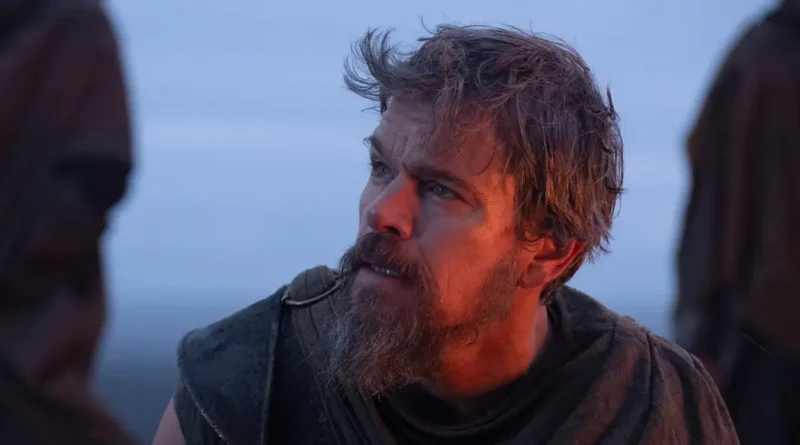
Casting Matt Damon as Odysseus was the first hint that Nolan’s title character may not be quite the antihero depicted in the source material. Though Damon has played complicated characters before — a CIA assassin, a rat for the Boston mob, a psychopathic con artist — at its core, Damon’s status as a movie star is rooted in his perceived wholesomeness. He plays Odysseus as an honorable, salt-of-the-earth warrior, the kind of guy who plucks his bow while hunting to give his prey a fair chance.
Damon’s performance embodies the character’s noblest roles — king, husband, war hero — while shunning his dark side.
‘Wily Odysseus, the lord of lies’
Odysseus’ dark streak makes him more interesting, but it’s also a driving force in the poem’s plot. Why does it take an experienced seafarer 10 years to make it home after the Trojan War, you may ask? A few strokes of bad luck, of course, and divine intervention plays a role — but mostly, Odysseus is a scalawag who causes as many problems as he solves.
Odysseus spends years satisfying his appetites and whims at the expense of his crew and his waiting family back in Ithaca. He has a sexual relationship with the sea nymph Circe, which turns a brief stop for supplies into a yearlong sidequest, and with the goddess Calypso. When he first washes up on the shore of the latter’s island, he’s hardly desperate to leave her lush paradise. True, after seven years with her, he wants to go home because Calypso “no longer pleased him,” but that also means at one point, she did.
Odysseus is smart, but his ego makes him short-sighted. He famously can’t help but take credit for his cunning escape from the Cyclops. He taunts the monster, telling him precisely who to blame for his humiliation — “Odysseus, the city-sacker, Laertes’ son, who lives in Ithaca” — and thus brings the vengeance of Cyclops’ father, the sea god Poseidon, crashing down on himself and his crew.
Nolan includes none of these unflattering details. The hero’s selfish edges are buffed until a smoother, sturdier figure remains. In the movie, Odysseus never cheats on his wife, at least not consciously. He only spends so much time with Calypso because she feeds him memory-erasing lotus flowers. While he does offend Poseidon by shooting the Cyclops with an arrow, it’s framed as an impulsive lapse in judgment, not an indictment of his hubris and deception.
Without Odysseus’ dark side causing him to make pivotal, repeated mistakes, he mostly comes across as an unlucky guy trapped in a cruel, illogical world. Oh, look, he’s landed on another island with magical creatures trying to kill him! Bummer!
Matt Damon as Odysseus in “The Odyssey.” Melinda Sue Gordon/Universal Pictures
Even when Nolan’s Odysseus is finally able to confront Penelope’s suitors — the men who have been trying to marry his wife, plotting to murder his son, and feasting his family out of house and home — he seems reluctant to exact his revenge, sheepish and ashamed of the cycle of violence he’s helped perpetrate.
This is presented as a moment of reckoning in Nolan’s film. Odysseus is haunted by the Trojan Horse, his bespoke trick to breach the city of Troy. It won the war, but it was such a brazen violation of Zeus’ hospitality law that it sent psychic shockwaves through time and space. Odysseus becomes like the ancient Oppenheimereclipsed by the consequences of his own creation.
It’s one of Nolan’s most inspired revisions, but the hero’s climactic epiphany, that “to burn the walls of Troy was to burn the world entire,” lands slightly left of satisfying when Odysseus has been presented as a good guy from the start — not as a guy who’s gradually been forced to confront his own evil.
Of course, at the end of the story, Odysseus still needs to kill the suitors, or else leave his wife and son in their clutches. He immediately atones for the mass murder by going into self-imposed exile.
And if the good-guyification of Odysseus hadn’t already been clear, the movie ends with our hero sailing off into the sunset. No, really.