A Case For Critical Reading As Muslims: Reading ‘The Power of Your Subconscious Mind’ Through An Islamic Lens
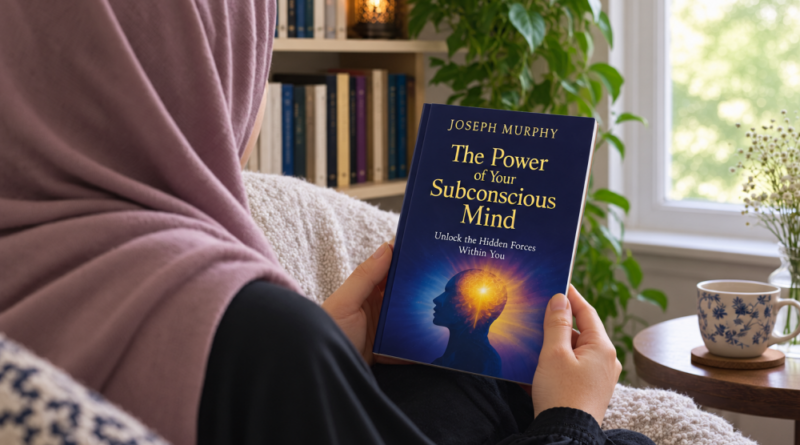
I recently read Joseph Murphy’s seminal work The Power of Your Subconscious Mind, and it left me thinking about how much power our inner lives can have over the way we experience the world. Murphy writes extensively about thoughts, self-reflection, belief, gratitude, prayer, and the habits of the mind, arguing that what we repeatedly impress upon the subconscious can shape our behaviour, relationships, circumstances, and sense of self. Published in 1963, the book remains an influential work of popular self-help and New Thought literature.
What particularly struck me was how familiar some of these ideas felt. In a time when self-love, positive thinking, gratitude, and optimism are widely discussed but not always easily practised, Murphy’s book reads almost like a practical manual: what to think about before sleeping, what to repeat upon waking, how to cultivate gratitude, and how to approach one’s difficulties with hope rather than despair.
Yet, as a student of Islamic Studies, I could not read the book without thinking about Islam. Many of Murphy’s observations resonated with Islamic teachings, although Islam places them within a very different theological framework. For me, this did not make Murphy’s work redundant; rather, it became an opportunity to think about what Islam says about the inner self, intention, hope, gratitude, prayer, and human agency. Perhaps it instilled in me the idea that Muslims need not approach non-Islamic works with either unquestioning acceptance or complete rejection. We can read widely, appreciate beneficial insights, question assumptions that conflict with our beliefs, and confidently leave behind what does not align with Islam.
Murphy’s Emphasis on Subconscious
In Murphy’s account, the subconscious is presented as possessing a transformative power through which deeply held beliefs can shape one’s circumstances. From an Islamic perspective, however, human intention and psychological disposition do not constitute an independent creative force. The Qur’anic conception of divine power places ultimate causality and control with Allah  , while human beings remain responsible for intention and action. This distinction is important because otherwise a psychological account of the relationship between thought and behaviour can slide into a metaphysical claim about the power of the human mind that is difficult to reconcile with notions of qadr, niyyah and tawḥīd. Murphy gives the subconscious considerable causal power over one’s experiences, circumstances and outcomes. In his formulation, belief becomes a mechanism through which the subconscious produces results. Islam certainly gives human beings agency through intention, choice, action, responsibility, and striving. But Islamic theology does not make the human mind an autonomous source of reality.
Suffering and Manifestation: Inadequacy of Murphy’s Model
Keep supporting MuslimMatters for the sake of Allah
Alhamdulillah, we’re at over 850 supporters. Help us get to 900 supporters this month. All it takes is a small gift from a reader like you to keep us going, for just $2 / month.
The Prophet (SAW) has taught us the best of deeds are those that done consistently, even if they are small.
Click here to support MuslimMatters with a monthly donation of $2 per month. Set it and collect blessings from Allah (swt) for the khayr you’re supporting without thinking about it.
Murphy’s thoughts are inadequate to explain certain circumstances such as suffering. For example, what happens when a person suffers despite sincerely believing, praying, and visualising a positive outcome? Murphy’s framework thus risks making the individual’s internal state the explanation for the external result. Islam, on the other hand, provides a different framework for suffering. A difficulty is not necessarily evidence of deficient thinking or defective belief. It can be understood through concepts such as trial (ibtilāʾ), patience (ṣabr), divine wisdom, decree (qadr), and reward. Murphy tends toward explaining circumstances through the workings of the subconscious, whereas Islam allows suffering to remain meaningful even when it cannot be explained as the consequence of one’s thoughts or beliefs. As Prophet Muhammad ﷺ says:
Strange are the ways of a believer for there is good in every affair of his and this is not the case with anyone else except in the case of a believer for if he has an occasion to feel delight, he thanks (God), thus there is a good for him in it, and if he gets into trouble and shows resignation (and endures it patiently), there is a good for him in it. [Sahih Muslim 2999]
Murphy also frequently interprets religious concepts psychologically. His approach effectively asks: How does this religious belief operate within the human mind? Islam, however, does not reduce religion to its psychological usefulness. For example, prayer in Islam certainly has psychological consequences like peace, hope, patience, and resilience, but its purpose is not exhausted by those effects. ʿIbādah is worship and relationship with Allah , rather than merely a technique for achieving psychological or material outcomes. Murphy’s psychological interpretation can illuminate one dimension of religious practice, but an Islamic reading would resist reducing worship to its psychological function.
The Balance Within
One of the things I appreciated most while reading Murphy was his insistence that we cannot neglect the world within us. We spend so much of our lives fulfilling responsibilities and caring for others that we can easily forget to care for the self that is carrying all of it. The emphasis on balance resonated deeply with me as a Muslim. Islam does not ask us to choose between our spiritual, emotional, physical, and social responsibilities. Rather, it calls us towards a life in which our responsibilities towards Allah , towards others, and towards ourselves are held together. Qur’an repeatedly draws our attention to mīzān (balance, measure and proportion). Allah says, 
“As for the sky, He raised it ˹high˺, and set the balance ˹of justice˺
so that you do not defraud the scales.” [Surah Ar-Rahman; 55:7-8]
Perhaps this is why Murphy’s focus on the inner self felt so relevant to me. Just as we nourish the body, Islam encourages us to nourish the soul; just as we care for our relationships with people, we are called to cultivate our relationship with Allah ; and just as we fulfil our responsibilities towards others, we should not neglect ourselves. The challenge is to keep these dimensions in proportion. An outwardly successful life can still leave a person spiritually empty, while an intense focus on one’s inner world can become detached from one’s responsibilities towards family, society and God. Islam’s conception of balance brings these dimensions together rather than treating them as competing parts of life.
Having Good Thoughts
One of Murphy’s recurring themes is the importance of cultivating constructive thoughts rather than allowing fear, negativity and resentment to dominate one’s inner life. This distinction becomes particularly important in Murphy’s understanding of the subconscious. Islam recognises the influence of thoughts, intentions and attitudes on a person’s actions, but it does not teach that the human mind possesses an independent power to create reality. A Muslim may hope for an outcome, work towards it and ask Allah for it, but the outcome remains ultimately within Allah’s Power and Wisdom. Positive thinking, therefore, cannot become a form of believing that thought itself guarantees reality. There is an interesting Islamic parallel in ḥusn al-ẓann(having a good opinion or favourable expectation).
This applies not only to how we think about ourselves and other people, but most importantly to how we think about Allah . The Qur’an repeatedly warns against despairing of His Mercy. After speaking to those who have wronged themselves through sin, Allah says: 
“Say, ˹O Prophet, that Allah says˺ “O My servants who have exceeded the limits against their souls! Do not lose hope in Allah’s mercy, for Allah certainly forgives all sins. He is indeed the All-Forgiving, Most Merciful.” [Surah Az-Zumar; 39:53]
This is an important distinction. Islamic optimism is not the insistence that everything will necessarily turn out according to our wishes. Rather, it is confidence in Allah’s Mercy and Wisdom even when the outcome is not what we hoped for. That distinction matters. Positive thinking can easily become the belief that our thoughts themselves determine reality. Islamic hope does not grant the human mind such independent power. We think well of Allah , ask Him, strive, and then accept that the outcome ultimately belongs to Him.
Guilt, Repentance, and Beginning Again
Murphy also discusses the destructive effects of continually dwelling on past mistakes. His emphasis on releasing oneself from destructive guilt reminded me of the Qur’anic understanding of tawbah.
The Qur’an does not ask a person to pretend that wrongdoing never happened. It asks the person to acknowledge it, seek forgiveness, and return to Allah . When Musa  recognised his mistake, he said,
“He pleaded, “My Lord! I have definitely wronged my soul, so forgive me.” So He forgave him, ˹for˺ He is indeed the All-Forgiving, Most Merciful. [Surah Al-Qasas; 28:16]
Similarly, Adam and his wife respond to their error not by defending themselves or remaining paralysed by guilt, but by acknowledging their wrongdoing and asking Allah for mercy (Surah Al-‘Araf; 7:23). The supplication of Yunus , after he recognised his situation, likewise demonstrates the posture of turning back to Allah (Surah Al-Anbiya; 21:87). This is where I would slightly qualify Murphy’s idea of “forgiving oneself.” Islam does not erase moral responsibility in the name of self-love. Instead, it offers something more demanding and, perhaps, more hopeful: repent, repair where possible, seek forgiveness, and do not allow your past to become a reason to despair of Allah’s Mercy.
Gratitude Changes How We See What We Have
Murphy repeatedly emphasises gratitude as a practice capable of transforming one’s outlook. Shukr (gratitude) in Islam, however, is more than a psychological exercise (Surah Ibrahim; 14:7). Allah describes Ibrahim —a forefather of the Prophet Muhammad ﷺ, one of Allah’s greatest prophets, and a man tested through immense sacrifice—as ‘grateful’. Despite the trials he endured, it was his gratitude that Allah chose to highlight. This reminds us that shukr is not merely feeling good about our circumstances; it is recognising the One from whom every blessing comes. We can never fully count, let alone thank Allah for, all that He has given us. Yet, like Ibrahim , we are called to recognise His Blessings and strive to live as grateful servants.
 Indeed, Abraham was a model of excellence: devoted to Allah, ˹perfectly˺ upright—not a polytheist ˹utterly˺ grateful for Allah’s favours. ˹So˺ He chose him and guided him to the Straight Path. [Surah An-Nahl; 16:120-21]
It is about recognising blessings as gifts from Allah and responding to them appropriately. This changes the meaning of gratitude. I can be grateful even when everything has not gone according to plan, because gratitude does not depend upon having a perfect life.
But Whom Are We Praying To?
Perhaps the most significant difference between Murphy’s framework and Islam emerges in his discussion of prayer. Murphy encourages readers to pray, visualise desired outcomes, repeat affirmations and impress particular ideas upon the subconscious mind. His “prayer” depends substantially upon the interaction between conscious thought and the subconscious, with the desired outcome being impressed upon the latter. Islam also teaches believers to ask, hope, and pray—but the object of prayer is not an impersonal force within ourselves. It is Allah . The Qur’an says:
“…I respond to the invocation of the supplicant when he calls upon Me…” [Surah Al Baqarah; 2:186]
The difference may appear subtle, but it is fundamental. In Islam, duʿāʾ is not simply a technique for programming the mind to produce a desired reality. It is an act of worship and dependence upon Allah . The believer asks Allah , has confidence in Him, and simultaneously recognises that the answer may come in a form or at a time different from what was imagined. This also means that prayer does not replace effort. The Qur’an speaks of the human being having what they strive for (Surah An-Najm; 53:39).
Murphy presents prayer largely as a process of impressing an idea upon the subconscious. He explicitly argues that the answer to prayer results when the subconscious responds to the mental picture or thought held in the mind. In Islam, duʿāʾ is fundamentally an act of turning toward and asking Allah , not simply a psychological technique for programming oneself. The believer may have hope, positive expectation, and certainty in Allah , but the outcome remains dependent upon Allah’s Will.
Good Intention
There is one concept I found especially significant when reading Murphy through an Islamic lens: niyyah, intention. Murphy speaks extensively about thoughts and the subconscious, but Islamic ethics asks another question: What is the intention behind what I think and do? Two people may perform the same outward action while its spiritual meaning is completely different because their intentions differ. This is why the famous Prophetic teaching that actions are judged by intentions occupies such an important place in Islamic ethical thought.
Islam therefore does not simply ask us to have positive thoughts. It asks us to cultivate an inner orientation that gives our actions their moral and spiritual meaning. A good thought is valuable, but a good intention directs that thought towards a good action; prayer is meaningful because it is directed towards Allah ; gratitude matters because it recognises the Giver; and hope matters because it is ultimately hope in Allah . Murphy asks us to pay attention to the world within us. Islam does too, but it continually reminds us that the journey inward is not meant to end with the self. It should lead us beyond the self, towards Allah . And perhaps that is the most important difference between merely believing in the power within and recognising the One from Whom all power ultimately comes.
Conclusion
Murphy’s work made me understand that reading non-Islamic literature critically does not require us to approach it with either suspicion or uncritical admiration. It requires us to engage with ideas thoughtfully, recognise what is beneficial, examine what conflicts with our beliefs, and have the confidence to accept the former while leaving the latter. Perhaps this is one of the most valuable habits we can cultivate as Muslim readers: to read widely, think critically, and remain rooted in the worldview of Islam.
I did not find his book as an alternative to Islam, but rather a different vocabulary for reflecting on ideas that Islam has long emphasised: nurturing the inner self, cultivating gratitude, holding onto hope, seeking forgiveness, and being conscious of our intentions. Yet Islam takes these ideas beyond the self. Our thoughts matter, but so do our intentions; hope matters, but so does tawakkul; gratitude matters because it recognises the Giver; and prayer matters because it turns the servant towards Allah . Murphy invites us to look within, but Islam reminds us that the journey inward should ultimately lead beyond the self to Allah .
Related:
– A New Way To Read Fiction: Critical Islamic Mindful Reading
– Thinking About Thinking: Can Islamic Nurture Be Critical And Reflective?