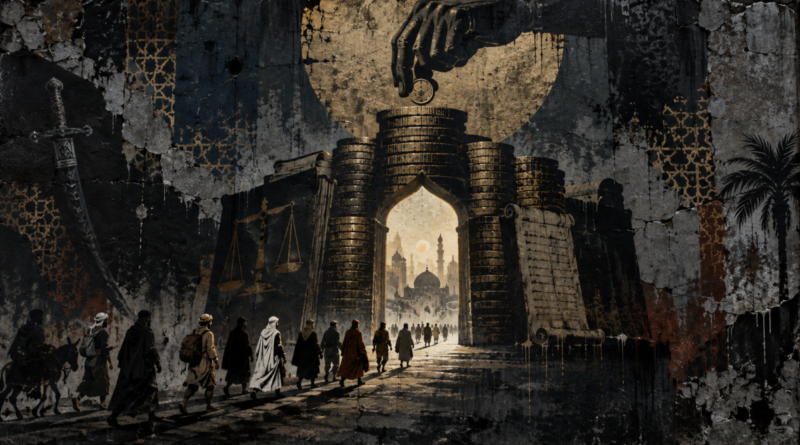
No Compulsion, No Invitation: How Islam Spread When the Caliphate Had Every Reason to Slow It
The oldest and most durable charge against Islam is that it spread by the sword: convert or die, a religion carried on the points of Arab lances into the throats of the conquered. It is a clean story, and almost everything about it is wrong for the period when it should be most true. For the first century and more after the Prophet’s death, the caliphate was not a conversion machine. It was a tribute machine. And a tribute machine, it turns out, has powerful reasons not to want its subjects to convert at all.
The early Arab-Muslim state conquered enormous populations and then, for the most part, left their religions alone. More than that: when those populations began to convert anyway, the state frequently resisted, taxed the converts as though they had never converted, and treated them as second-class members of the faith they had joined. Forced conversion, the thing everyone assumes, was largely absent. The real story runs the other way, and it raises three questions worth taking in order. What was the early stance toward conversion? Was anyone ever forced? And if the empire had every fiscal and political reason to keep the conquered in their ancestral faiths, how did so many of them end up Muslim?
The Scripture Said No Compulsion
Begin with the text the conquerors carried, because it is unambiguous. “There shall be no compulsion in religion,” the Quran states flatly, “the right way is now distinct from the wrong way” (2:256). The point is not made once. “Had your Lord willed,” another passage asks the Prophet directly, “all the people on earth would have believed. Do you want to force the people to become believers?” (10:99). Belief is framed as an open choice with consequences left to God: “whoever wills let him believe, and whoever wills let him disbelieve” (18:29). The Prophet’s own role is bounded. “You shall remind,” he is told, “for your mission is to deliver this reminder. You cannot force them” (88:21-22). And to the unbelievers of Mecca the address is final and pluralist: “To you is your religion, and to me is my religion” (109:6).
Alongside this runs the framework that would govern the conquests: the recognition of the People of the Book. The Quran names Jews, Christians, and the converts among the communities whose righteous are promised their reward by God, each left to their own path (2:62, 5:69). Its harsh war passages, read in their own context, are aimed narrowly and temporally. Verse 9:5, the so-called sword verse, addresses the Arabian idolaters who had broken a standing peace treaty, and even it opens a door back to peace. Verse 9:29, regarding the jizya was in reference to war reperations that the Quraish owed the beleivers who were exiled from their land and expected resititution for their losses was only later used retroactively applied toward the poll tax insituted against the people of the book who were considered protected (dhimmi) by the caliphate.
The tribute system the empire actually ran did not come from that verse. It came from the ground. Both the Sasanian and the Byzantine states the Arabs overran already taxed their subjects along lines of status and standing—graduated poll taxes and land taxes from which soldiers, officials, and clergy were commonly exempt—and the conquerors, few in number and dependent on the officials already in place, kept the existing machinery turning and redirected its yield. They mapped the inherited brackets onto their own categories: the Muslim warrior, the client, the protected non-Muslim, the slave. The arrangement that let a conquered Christian or Zoroastrian keep his faith and purchase his security with a payment was therefore a continuation of imperial fiscal practice, not a scriptural invention, and only later, as the jurists assembled the formal law of dhimmi status, was 9:29 recruited to sanctify a system that had been inherited rather than revealed. However it came to be justified after the fact, the working settlement institutionalized a third option the “convert or die” story cannot accommodate.
Submission, Not Souls
The conquests under the Rashidun caliphs (632-661) were built on exactly that logic. Their object was political submission and revenue, not the salvation of the conquered. City after city surrendered on terms, and the terms were remarkably consistent: the inhabitants kept their lives, their property, their churches, and their faith in exchange for tribute and obedience. The capitulation agreements for Damascus (surrendered 635), for Egypt under Amr ibn al-As (conquered 640-642), and for the towns of Iraq and Iran—where the Sasanian empire collapsed after the battles of Qadisiyya (636) and Nihavand (642)—all follow this shape. Later tradition elaborated these arrangements into the formal code of dhimmi status, and some of that elaboration—the document known as the Pact of Umar chief among it—is of debated authenticity and probably later than the conquests it claims to describe. But the underlying settlement is real and early: protection and autonomy in return for submission and a tax.
The conquerors had no interest in dissolving into the conquered. They were a small ruling minority sitting atop populations that outnumbered them many times over, and they organized themselves to stay distinct. Rather than settling among their new subjects, they built garrison cities—Basra and Kufa in Iraq, Fustat in Egypt (founded 641), Kairouan in North Africa (founded 670)—where the Arab warriors lived apart and kept the sharp line between ruler and ruled.
It was the second caliph, Umar (r. 634-644), who fixed this arrangement in institutional form when he established the diwan, the register of those entitled to draw an annual cash stipend, the ata’, from the treasury. Enrollment was reserved for the fighting men of the conquest and ranked by precedence in Islam and tribal standing, so that the warrior’s share of the spoils hardened into a hereditary Arab entitlement. Islam in this arrangement functioned less as a universal invitation than as the marker of a conquering caste. The empire’s whole fiscal structure assumed the line would hold: Muslims paid the light alms tax, drew stipends, and took their share of booty; non-Muslims paid the poll tax, the jizya, and the land tax, the kharaj, and it was their payments that filled the treasury and funded the stipends. The conquered were worth more to the state as taxpaying Christians, Jews, and Zoroastrians than they would be as fellow Muslims.
Was Anyone Forced?
Against that backdrop the answer comes into focus, and it is not the answer the popular story expects. Systematic forced conversion of the conquered was not the policy of the Rashidun or Umayyad state, and for the People of the Book it was essentially never the policy at all. Their entire legal category existed precisely so they would not have to convert. A Christian in Umayyad Syria or a Zoroastrian in Umayyad Iran was not offered the sword and the shahada; he was handed a tax bill. Zoroastrians, whose scriptural standing the jurists actually debated, were in practice folded into the protected category and allowed to pay and remain, which tells you how far the working preference ran from forced conversion.
The one genuine exception lay inside Arabia and applied to a specific target: the Arabian polytheists, the mushrikun, who had no recognized scripture and who, in the Quran’s framing, had broken faith. Here the alternatives narrowed toward submission or the sword, and the Ridda wars that Abu Bakr fought in 632-633 pressed Arabian tribes back into the fold of the Medinan state by force. But even the Ridda wars were as much about political secession and the refusal to pay the alms tax as about theology, a rebellion against the state’s authority answered as such. Beyond the peninsula, among the scriptural peoples who made up the overwhelming bulk of the conquered, the coercive model simply was not operative.
None of this makes the early empire a liberal order. There was pressure of every kind short of the sword: legal disability, social subordination, sumptuary rules, the standing humiliation encoded in a tax paid by the ruled to the rulers. Pressure is not force, but it is not freedom either, and honesty requires holding both facts at once. What did not exist was the thing everyone assumes did: a program to march the conquered into the mosque at spearpoint.
The State That Frowned on Conversion
Here the story turns genuinely strange, because the early state did not merely tolerate its non-Muslim majority. It had concrete reasons to prefer that the majority stay non-Muslim, and at times it acted on them.
The reason was money. The empire ran on the taxes of the conquered. Every dhimmi who converted was, in the crude arithmetic of the treasury, a taxpayer lost—a man who would now claim exemption from the jizya and expect the lighter obligations of a Muslim, and who might further expect a share of the stipends reserved for the conquering caste. Under the Umayyads (661-750) this arithmetic collided with an ideology that made the problem worse. The Umayyad order was, in the judgment of most historians, an Arab kingdom as much as an Islamic one, in which full membership in the ruling community was bound up with Arab descent. Islam and Arabness had grown so entangled in practice that a Persian or Aramean or Berber who accepted Islam did not thereby become an equal. He became a mawla, a client, obliged to attach himself to an Arab tribe as a subordinate.
The mawali were the living contradiction of the Quran’s universalism. They were Muslims who prayed as Muslims and fought in Muslim armies, and they were still treated as lesser—frequently still made to pay the taxes of unbelievers, largely shut out of the military stipend rolls, and socially marked as dependents of their Arab patrons. Their conversion had bought them the obligations of the faith without its privileges.
The stipend rolls are the sharpest illustration, because military service was the single most valuable door a convert could hope to pass through. To be enrolled in the diwan as a warrior was to escape the poll tax, draw an annual cash payment and rations, and share in the plunder of the next campaign—a bundle of rewards far richer than tax relief alone. This was the prize, and it was exactly the prize the Arab establishment guarded most jealously, since every non-Arab admitted to the rolls diluted both the treasury and the conquerors’ own share of it. It could still be won at the moment of conquest, when fighters were scarce and a defecting unit’s bargaining power was high: the Asawira, the elite heavy cavalry of the shattered Sasanian army, converted during the conquest of Iran under Umar and negotiated enrollment at the highest stipend grade along with alliance to a leading Arab tribe, and Persian units such as the Hamra who settled at Kufa did much the same. But what a battle-hardened regiment could extract in the 640s, an ordinary peasant convert two generations later could not. The door that had stood open at the frontier was pulled shut behind the settled population, and joining the army ceased to be a route the average dhimmi could simply walk through. Because their conversion threatened the tax base while delivering the state a class of aggrieved subordinates, administrators came to see conversion itself as a problem to be managed rather than a triumph to be welcomed.
They managed it accordingly. The most notorious case is al-Hajjaj ibn Yusuf, the formidable governor of Iraq (c. 694-714) under the caliphs Abd al-Malik (r. 685-705) and al-Walid I (r. 705-715). Peasants had been abandoning their land for the garrison cities of Basra and Kufa, converting to Islam, and trying to enroll among the Muslim fighters—in no small part to escape the crushing weight of the land tax and lay claim to the warrior’s stipend. Al-Hajjaj’s response was to expel the converts from the cities, drive them back to their villages, and reimpose the taxes they had converted to shed. Conversion, in his hands, changed nothing about what a man owed. The message could not have been plainer: the state would not let a profession of faith empty its coffers or crowd its payroll.
Umar II and the Reassertion of the Text
The tension between what the Quran said and what the treasury needed came to a head in the brief reign of Umar ibn Abd al-Aziz, Umar II (717-720), remembered in the tradition as the one Umayyad who governed as though the scripture meant what it said. He ruled that converts should be relieved of the jizya, that the mawali should be treated as the equals their faith made them, and that conversion should be received as the good it was rather than resisted as the loss it represented. For a moment the universalist logic of the Quran was official policy.
It did not survive him intact. The reforms strained a fiscal system that had been built to tax unbelief, and his successors rolled much of the program back, precisely because the state still depended on the revenue and privilege that his reforms dissolved. The episode is the whole conflict in miniature: a scripture that recognized no ethnic aristocracy and welcomed the convert, running up against an empire whose finances and self-image required a taxable, subordinate, and preferably unconverted majority. In that contest, for the length of the Umayyad century, the empire mostly won.
The Revolt of the Converts
The empire won the fiscal argument and lost the political one. The mawali did not stay quiet under a system that took their faith and denied them its rewards, and their resentment became one of the great engines of the age. It gathered most dangerously in the distant northeastern province of Khurasan, among Persian converts and disaffected Arabs alike, and it was there that the Abbasid movement raised its black banners and marched west. The revolution that destroyed the Umayyads between 747 and 750 was carried in large part by exactly the population the Umayyad order had refused to treat as full Muslims, mobilized under a promise that being Muslim would finally count for more than being Arab.
The Abbasid victory changed the terms permanently. The new caliphate styled itself a universal Islamic empire rather than an Arab kingdom, and it drew its administrators, soldiers, and scholars from across the converted peoples of its domains, Persians prominent among them. The ethnic ceiling did not vanish overnight, but the ideology that had held it in place was broken. For the first time since the conquests, becoming Muslim could mean joining the ruling community rather than attaching oneself to it as a client. The largest barrier to conversion had been not a closed mosque but a closed aristocracy, and the aristocracy had just fallen.
How the Many Finally Converted
Only now, generations after the conquests, does mass conversion actually begin—which is itself the strongest evidence against the sword. If Islam had been imposed by force in the 630s and 640s, the conquered lands would have been Muslim by the 650s. They were not. The most influential attempt to date the process, Richard Bulliet’s study of the timing of Muslim names in the biographical dictionaries, models conversion as a slow curve that stays shallow for a century or more after conquest and then steepens sharply, with the bulk of the population in the Iranian, Iraqi, Syrian, and Egyptian heartlands turning Muslim only across the ninth and tenth centuries. The model has its critics and its data limits, but its central shape is widely accepted: conversion was late, gradual, and cumulative, not sudden and imposed.
What drove the curve upward was the removal of barriers and the alignment of incentives, not compulsion. With the Arab ceiling gone under the early Abbasids—al-Saffah (r. 750-754) and al-Mansur (r. 754-775) drew their soldiers and secretaries from the converted eastern peoples—conversion now delivered real membership, and the army that had once rationed its stipends opened to non-Arab Muslims as a matter of course. Fiscal reform did the rest of the work from both directions. The land tax was detached from the owner’s faith and fixed permanently to the land itself, a principle the jurist Abu Yusuf (d. 798) set out in the Kitab al-Kharaj he composed for Harun al-Rashid (r. 786-809); it stabilized the treasury and quietly dissolved the state’s old reason to block conversion, since a convert’s fields kept paying either way. At the same time, escaping the poll tax and the accumulating disabilities of dhimmi life—the restrictions, the distinctive dress, the diminished legal standing, the recurring episodes of pressure—gave the individual a steady, rational motive to convert that had nothing to do with a soldier at the door.
Then the ordinary social physics took over. Being Muslim opened offices, courts, marriages, and urban networks that were closing to everyone else. Muslim men married non-Muslim women whose children were raised in the faith. The old religious hierarchies, stripped of state support, lost their ablest people to the rising community, which made them weaker still and accelerated the next round of departures. Each conversion made the next one easier and the holdout lonelier. This is the mechanism behind the steep part of Bulliet’s curve, and it is the opposite of coercion: it is gravity. A faith that began as the marker of a conquering minority became, over three or four unhurried centuries, the majority religion of the lands the minority had conquered, and it did so mostly after the sword had been sheathed.
The Reluctant Empire
Return to where the scripture started. “There shall be no compulsion in religion” (2:256). The history of the early caliphate is, against every expectation, a long and awkward vindication of that verse—not because the conquerors were tolerant idealists, but because their interests ran so hard against forcing conversion that the verse and the balance sheet pointed the same way. The sword spread Arab-Muslim rule with stunning speed. It did not spread the faith. The faith spread later and slower, and it spread when the barriers the state itself had built against it finally came down, when being Muslim stopped meaning being the client of an Arab and started meaning what the Quran had said it meant from the beginning.
The deepest irony of the period is that the empire spent its first century with every fiscal and political reason to keep the conquered in their ancestral religions, and taxed, expelled, and demoted those who converted anyway. The conquered converted all the same, once the choice became genuinely theirs to make. An empire that had no wish to evangelize was, in the end, absorbed by the very universalism it had spent a hundred years trying to ration.