Trump speeds review of psychedelics after Joe Rogan texted him about ibogaine. 'Sounds great. Do you want FDA approval? Let's do it' | Fortune
President Donald Trump on Saturday directed his administration to speed up reviews of certain psychedelic drugs, including ibogaine, which recently has been embraced by combat veterans and conservative lawmakers despite having serious safety risks.
Ibogaine and other psychedelics remain banned under the federal government’s most restrictive category for illegal, high-risk drugs. But the administration is taking steps to ease restrictions and spur research on using the drugs for medical purposes, including conditions like severe depression.
“Today’s order will ensure that people suffering from debilitating symptoms might finally have a chance to reclaim their lives and lead a happier life,” Trump said as he signed an executive order on the drugs. The Republican president said his directive will help “dramatically accelerate” access to potential treatments. “If these turn out to be as good as people are saying, it’s going to have a tremendous impact,” he said.
Veteran organizations and psychedelic advocates have long contended that ibogaine, which is made from a shrub native to West Africa, has great promise for hard-to-treat conditions such as post-traumatic stress disorder and opioid addiction.
Trump’s announcement follows pledges by Health Secretary Robert F. Kennedy Jr. and other administration officials to ease access to psychedelics for medical use, an issue that has won rare bipartisan support.
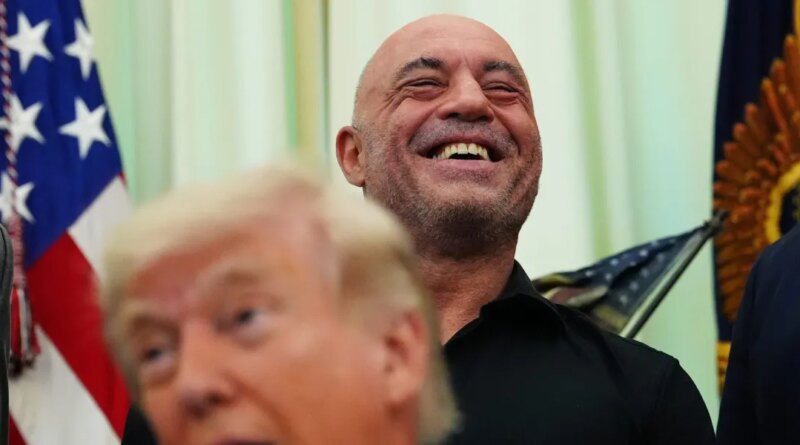
Joining Trump in the Oval Office were his top health officials, conservative podcaster Joe Rogan and Marcus Luttrell, the former Navy SEAL whose memoir about a deadly mission in Afghanistan was the basis of the film “Lone Survivor.” Rogan said he texted Trump information on ibogaine and the president responded: “Sounds great. Do you want FDA approval? Let’s do it.”
“You’re going to save a lot of lives through it,” Luttrell told Trump during the ceremony. “It absolutely changed my life for the better.”
The Food and Drug Administration next week will issue national priority vouchers for three psychedelics, which the agency’s commissioner, Marty Makary, said will allow certain drugs to be approved quickly “if they are in line with our national priorities.” The vouchers can cut review times from several months to a period of weeks. It is the first time the FDA has offered that fast-tracking to any psychedelics.
The FDA is also taking steps to clear the way for the first-ever human trials of ibogaine in the U.S.
Trump’s action surprised many longtime advocates and researchers in the psychedelic fieldgiven that ibogaine is known to sometimes trigger potentially fatal heart problems. The National Institutes of Health briefly funded research on the drug in the 1990s, but discontinued the work due to ibogaine’s “cardiovascular toxicity.”
“It’s been incredibly difficult to study ibogaine in the U.S. because of its known cardiotoxicity,” said Frederick Barrett, director of the Johns Hopkins Center for Psychedelic and Consciousness Research. “If the executive order can pave the way for doing objective, scientific research with this compound, it would help us understand whether it is truly a better psychedelic therapy than others.”
No psychedelic has been approved in the United States, but a number of them are being studied in large trials for various mental health conditions, including psilocybin, MDMA and LSD. All those drugs remain illegal, classified as Schedule I substances alongside drugs such as heroin. Two states — Oregon and Colorado — have legalized psychedelic therapy with psilocybin.
Ibogaine was first used by members of the Bwiti religion in African nations like Gabon during their religious ceremonies.
In recent years, U.S. veterans have reported benefiting from the drug after traveling to clinics in Mexico that administer it.
Backing from veterans groups and former Texas Gov. Rick Perry led to a law last year providing $50 million for ibogaine research in that state. Perry, who co-founded a group called Americans for Ibogaine, recently appeared on Rogan’s podcast, making the case for reducing federal limits on the drug. It was his second time talking about ibogaine on the popular podcast in the past two years.
Trump’s order calls on the Department of Health and Human Services to direct at least $50 million to states that have enacted or are developing programs to advance psychedelic drugs for serious mental illness. It’s described as a federal-state partnership to provide funding, technical assistance and data sharing.
Ibogaine is known to cause irregular heart rhythms and has been linked to more than 30 deaths in the medical literature, according to the Multidisciplinary Association for Psychedelic Studies, a nonprofit that conducted some early studies in patients outside the U.S.
The group’s co-executive director, Ismail Lourido Ali, said Trump’s order might encourage other states to follow the Texas model.
“The stigma around Schedule I drugs is significant,” Ali said. “It feels like this would give pretty substantial cover for Republican governors and legislatures to step into the ring in terms of funding research programs at their universities.”
Owners of ibogaine clinics said the impact of the order will not be immediate.
“There will be no insurance coverage, it will still be considered unapproved and non-covered care,” said Tom Feegel of Beond Ibogaine, which operates a clinic in Cancun, Mexico. “But what it does mean is that ibogaine shifts from being fringe and underground to being federally acknowledged.”
Feegel says his clinic treated 2,000 people with ibogaine last year for between $15,000 and $20,000 per person. The company also gave free treatment to about 100 veterans.
Clinics that use the drug typically monitor patients’ heart readings and have emergency medical equipment on hand.
One of the only recent studies conducted by U.S. researchers found that veterans treated with ibogaine showed improvements in symptoms of traumatic brain injury, including PTSD, depression and anxiety. The Stanford University study was small — enrolling 30 veterans who received the drug in Mexico. It did not include a placebo group for comparison, an essential feature of rigorous medical research. Patients in the study received a combination of ibogaine mixed with magnesium intended to reduce heart risks.