Turkey promotes ‘Middle Corridor’ as Strait of Hormuz alternative
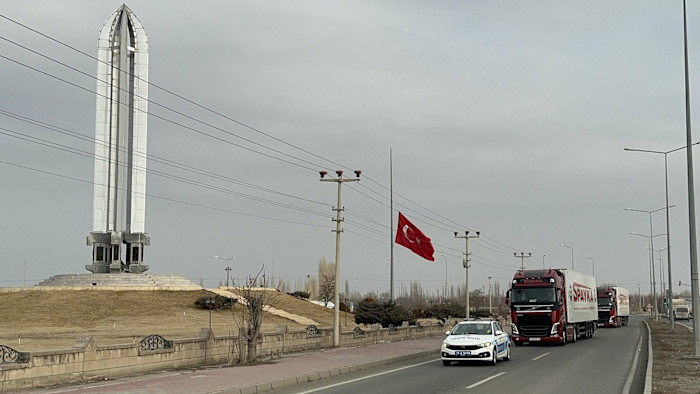
Turkey’s Alican border crossing into Armenia lies at the end of a peaceful spur road. Shepherds tend their flocks in the surrounding fields, and the occasional tractor kicks up dust that hangs in the air. Even the military bunkers scattered across the landscape seem half asleep in the sun.
Yet Turkey hopes this tranquil cul-de-sac could soon become part of a global trade junction. Earlier this year, officials began installing the systems needed to process passports at the border, closed for 32 years — a move that could unlock a crucial trade route linking Asia to Europe.
The project, backed by the US president as part of peace plans for Armenia and Azerbaijan, even has a grandiose name: the “Trump Route for International Peace and Prosperity” (TRIPP).
The geopolitical stakes are large. The eventual reopening of the Armenian border forms part of Ankara’s efforts to position Turkey as a secure trade hub for goods and energy flows rerouted away from geopolitical chokepoint — above all the war-threatened Strait of Hormuz.
“We don’t know when the border will open, the date keeps changing,” said one Turkish border guard during a recent visit. “But everyone thinks it will be soon.”
Since Tehran first mooted closing the strait last June, Ankara has intensified efforts to market Turkey as a stable alternative trade corridor. That pitch has intensified as conflict and sanctions have disrupted traditional routes through Russia, Iran, the Red Sea and the Gulf.
“Turkey stands out as an island of stability and a safe haven,” President Recep Tayyip Erdoğan said last week. “Discussions have begun on safer alternatives for energy transmission lines,” he added. “We wholeheartedly believe that this global crisis will open new doors for our country.”
The vision is compelling, even if it faces enormous obstacles that many expect will thwart Turkey’s grand ambitions.
Nato member Turkey has avoided direct involvement in both the Ukraine war and latest Gulf conflict. Its territory has already become a de facto transit zone: last month, commercial flights between Europe and Asia were funnelled over Turkey as airspace to the north and south narrowed.
“Europe-Asia trade is about $3tn a year, and 90 per cent goes by sea,” said Binali Yıldırım, a former prime minister involved in promoting Turkish trade routes. “The shortest [marine] journey takes about 40 days.”
By contrast, the Middle Corridor — the overland route that links China to Europe via the Caucasus and Turkey, and which Ankara is promoting — “can take 12 to 15 days”, he said. Current trade flows are small but “there is great potential”.
European officials appear keen. EU commissioner Marta Kos this year described Turkey as “a critical partner”, calling its proposed expansion of the Middle Corridor a “game changer”.
“Developing alternative routes has become a necessity,” Turkey’s transport minister Abdulkadir Uraloğlu said in February, days before the US and Israel launched massive air strikes against Iran.

Two projects lie at the centre of Ankara’s vision. The first is the Development Road, a road and rail network that links the Gulf to Europe via Turkey, bypassing maritime chokepoints such as the Strait of Hormuz and Suez Canal. But it is still in the planning stage, requires billions of dollars in investment, and passes through unstable Iraq.
“It would be easier to go through Saudi Arabia, Jordan and Syria,” said one regional transport economist. “Maybe in a decade it could happen.”
The second project, an expansion of the Middle Corridor, holds more promise. Its centrepiece is the TRIPP — a US-sponsored road and rail link between Turkey and Azerbaijan that passes through Armenia, adding needed capacity to an existing route through Georgia.
Unveiled to great fanfare at the White House in February, alongside a preliminary peace agreement between Armenia and Azerbaijan, the TRIPP is partly designed to help end their four-decade conflict. Turkey has signalled it would reopen its border once a final peace deal is reached, allowing work on the TRIPP to begin.
“A great honour for me,” Donald Trump said at the time.

Turkish construction companies such as Kalyon, which are close to Ankara and have built flagship state projects such as Istanbul’s new airport, have started work on the Azerbaijan side, according to Azerbaijani officials, as well as railway extensions in Turkey.
If completed, Middle Corridor trade volumes, which tripled between 2021 and 2025, could rise from 5mn tonnes a year to 20mn, according to Yildrim. But there are multiple complexities.
The route depends on slow ferry crossings across the Caspian Sea, uneven rail infrastructure with different gauges, and complex customs procedures across multiple borders. That makes it far slower than the northern corridor, which joins China to Europe via a direct rail link through Russia, and already carries 40mn tonnes of freight a year.
The Middle Corridor is a route “that everyone needs, but few choose to use”, as JPMorgan, an investment bank, described it in a recent report.
The TRIPP also skirts Iran, making it vulnerable to attack. Russia, which has traditionally dominated the Caucasus, is also alarmed. Earlier this month President Vladimir Putin warned Armenia it might curb Russian gas supplies to the country if it continued to reorientate its trade flows towards Europe.
“The problem with the TRIPP is that it forms one of several transport options,” said one logistics executive who consulted on the project. “It only became possible because Russia was distracted by the war in Ukraine. The route is close to Iran — which is another risk. It also hinges on US funding and political support to happen.”
Turkey’s geography — which “condemns the country to geopolitical significance”, as one western diplomat put it — all but ensures its role as a logistics hub linking Europe, Asia and the Middle East.
More than 3.5mn barrels of oil already transit the Bosphorus every day, and a 1,700km pipeline from Baku to the Turkish port of Ceyhan on the Mediterranean already carries up to 1.2mn barrels of oil a day.
After Iran closed the Strait of Hormuz, Iraq and Kurdistan agreed to reopen the Kirkuk-Ceyhan pipeline carrying 250,000 b/d. The TRIPP could even reawaken the dormant Trans-Caspian pipeline project, carrying 1tn cubic feet of gas to Europe from central Asia through Turkey.
But trade officials and economists caution that the idea of cross-Turkey land routes providing an alternative any time soon to maritime chokepoints in the Gulf — or even to the established northern corridor through Russia — is a pipe dream.
As for the TRIPP, its future depends as much on politics as engineering. The last time the US president lent his name to a project in the Caucasus — the Trump Tower Baku — it came unstuck amid allegations of corruption and links to Iran’s Revolutionary Guards — and never opened.
Cartography by Jana Tauschinski