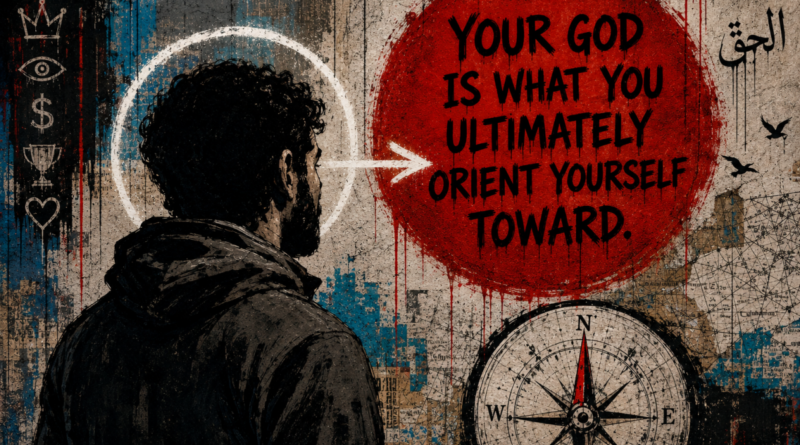
Your god is what you ultimately orient yourself toward
In a previous article, we said that God gave the traveler two instruments. He gave a map—the revelation, a true representation of the terrain and of where the destination lies. And He gave a compass—the moral orientation written into the soul and refined by knowing who God is. We said that both are needed, that a right map with a corrupted compass leads a person confidently astray, and that a working compass reading off a forged map does the same. Certainty is not the test. Alignment is the test.
But there is a question that sits underneath the whole picture, and it is the most important question of all. A compass does not merely tell you where you are. It tells you which way is north. It only works because there is a fixed point outside the traveler that the needle answers to. So the real question is not whether you have a compass. Nearly everyone has one. The question is: what is your north? What have you fixed as the point that every other direction is measured against? Because whatever that is—the thing you orient your whole self toward, the destination you are actually walking to—that, in the Quran’s language, is your god.
The direction is chosen
Notice first that the Quran does not treat orientation as something that happens to us. It treats it as something we choose.
[2:148] Each of you chooses the direction to follow; you shall race towards righteousness. Wherever you may be, GOD will summon you all. GOD is Omnipotent.
The word rendered here as “the direction to follow” is wijha (وِجْهَة)—a facing, the way a person turns. It shares its root with wajh (وَجْه), the face. To choose a wijha is to decide which way to point yourself. And the verse is blunt about the freedom involved: each of you chooses. The compass will answer honestly to whatever you fix as north, but you are the one who decides what to call north. You can walk the true bearing or any other, and you will feel equally certain either way. This is the freedom that makes the whole moral drama serious. Guidance is not imposed on a passive instrument. A person turns, and keeps turning, toward something.
What the Quran calls a god
The Quran defines the false god not as a statue but as a direction of the heart.
[25:43] Have you seen the one whose god is his own ego? Will you be his advocate?
Dr. Khalifa renders the key word as “ego.” The Arabic is hawā (هَوَىٰ). Its root means to fall, to plunge, to descend—the same root gives us the word for the empty air a thing drops through. From that comes its second meaning: to incline, to lean, to be pulled toward. So hawā is not simply “desire” in the abstract. It is the direction your own weight pulls you when nothing corrects it—the bearing you would drift to if you simply followed your inclination downhill. And the verse says that when a man takes that drift as the thing he orients toward, it has become his god. He did not carve anything. He did not bow to anything. He simply made his own pull his north, and that was enough.
The point is repeated, and sharpened:
[45:23] Have you noted the one who took his ego as his god? Consequently, GOD sends him astray, despite his knowledge, seals his hearing and his mind, and places a veil on his eyes.
This is a person with knowledge—he has, as it were, seen the map. And still he is astray, because knowing where the destination lies is not the same as facing it. He has recalibrated his compass to point at himself, his own opinions rather than reality. Every reading it gives is now internally consistent and completely wrong, and the veil over his eyes is not ignorance of the map but a self-chosen direction of travel.
The Quran defines a god by function, not by claim. A god is not first of all a being you say exists. It is the thing you finally turn to, the direction your longing runs, the point every other bearing is set against.
And this is why the trap is subtler than simply swapping God for a rival. Most who fall into it never mean to replace God at all. They mean to reach Him—through someone closer, someone better placed, an intermediary who can carry the petition the rest of the way.
[39:3] …Those who set up idols beside Him say, “We idolize them only to bring us closer to GOD; for they are in a better position!”
Notice the defense. They are not denying God; they are protesting their devotion to Him. The idol is not offered as a rival but as a route—a way of drawing near, zulfā, a nearness sought through an intermediary. And the Quran still names it idolatry, because the direction is what counts, and their direction stops short. The devotion that was meant to pass through the intermediary and on to God comes to rest on the intermediary instead. A waypoint has been mistaken for the destination. Whatever your longing finally halts at—even something you swear you face only in order to face God—is where you have actually set your north.
Which means the Quran’s definition and its warning are the same sentence read twice. Your god is what you ultimately orient yourself toward. And what you ultimately orient yourself toward is, therefore, your god. There is no third option where a person faces nothing.
[17:57] Even the idols that they implore are seeking the ways and means towards their Lord. They pray for His mercy, and fear His retribution. Surely, the retribution of your Lord is dreadful.
Orientation is the whole self
Because orientation is this fundamental, the Quran describes the act of faith itself as a turning of the face—not the face as a body part, but the face as the leading edge of the entire self, the part of you that goes first into whatever you approach.
[2:112] Indeed, those who submit themselves absolutely to GOD alone, while leading a righteous life, will receive their recompense from their Lord.
“Submit themselves absolutely” translates aslama wajhahu—surrendered his face to God. To surrender your face is to hand over the direction you point, to let something outside yourself set your bearing. This is exactly what Abraham does when he breaks with his people’s idols:
[6:79] I have set my face towards the One who initiated the heavens and the earth; I will never be an idol worshiper.
Wajjahtu wajhiya—”I have turned my face.” Abraham’s monotheism is not first a doctrine he affirms. It is a direction he faces. And its opposite is described the same way—as a matter of what the heart is pulled toward:
[2:165] Yet, some people set up idols to rival GOD, and love them as if they are GOD. Those who believe love GOD the most.
The idolater and the believer are separated not by whether they love, or turn, or orient—everyone does that—but by toward what, and how much. Love is a vector. Fear is a vector. Hope, trust, obedience, longing: each is a direction the self runs in. Whatever collects the most of these vectors, whatever they all finally point at, is functioning as your god no matter what your tongue professes. This is why the ancient temptation was never really about stone. The stone was only a place to aim a devotion that had already chosen its north.
You can hold the map and still face the wrong way
This is the sober warning that separates Part Two from Part One. In Part One the danger was a false map or a corrupted compass. Here the danger is subtler and closer to home: you can possess a true map, own a functioning compass, even recite the name of the destination—and still be walking a different bearing.
[12:106] The majority of those who believe in GOD do not do so without committing idol worship.
Most who believe still face something else in the part of them that decides. They keep a second qibla in the heart. The clearest picture of it is the generation that stood at Sinai and took the covenant directly, handed the map from the mountain itself:
[2:93] …They said, “We hear, but we disobey.” Their hearts became filled with adoration for the calf, due to their disbelief. Say, “Miserable indeed is what your faith dictates upon you, if you do have any faith.”
Their mouths gave the map its due—we hear—while their hearts had already turned. The Arabic is more physical than “filled with adoration”: ushribū fī qulūbihim, their hearts were made to drink in the calf, to absorb it the way a cloth takes up a dye, until it colored everything they saw. That is what a chosen north does. It does not sit politely beside your other loyalties; it saturates them. And the closing line refuses them the excuse: miserable is what your faith dictates, if you have any faith. These were not people without faith. They had a faith—it simply commanded the wrong thing, because it faced the wrong way. What your faith bids you do is the surest reading of what you actually worship.
Sometimes the misdirected devotion is aimed at people:
[9:31] They have set up their religious leaders and scholars as lords, instead of GOD.
Nothing here requires anyone to deny God with their lips. It requires only that ultimate obedience—the bearing you actually follow when the map and the man disagree—be handed to something other than God. Whoever you obey at the end of the line is the rabb you have chosen, whatever you call Him. The compass reads true to whatever you have fixed as north, and a person can fix a scholar, a movement, a tradition, an appetite, an image of himself, and never once feel that the needle has moved.
Recalibration
If the disease is a false north, the cure is a single, deliberate recalibration, and the Quran states it as a formula with two motions in it. Lā ilāha—there is no god: the negation that clears every false north off the dial, every rival bearing, every drift the self would fall toward. And then illā Allāh—except God: the one fixed point relaid at the center, so that the needle finally answers to the Real and to nothing else. The confession is not a slogan. It is the act of demagnetizing a compass that the world, and the self, have been quietly pulling off true, and re-fixing it to the one direction that does not bend.
This is also, quietly, the reason for the physical qibla. A body turned five times a day to one direction is a compass being trained. The point was never that God is located to the southeast. The point is the opposite:
[2:115] To GOD belongs the east and the west; wherever you go there will be the presence of GOD. GOD is Omnipresent, Omniscient.
“The presence of GOD” translates wajh Allāh—the face of God. And the verse dissolves the very idea that God is one direction among the others. He is not a point on the compass. He is the reality that makes the compass mean anything, the horizon present in whichever way you turn. The physical qibla trains the body in singular facing so that the heart can learn a facing that no longer depends on any spot on the earth. You aim at Mecca to learn how to aim the whole self at the One who is beyond all aiming.
And what is at the end of that bearing is named plainly:
[53:42] To your Lord is the final destiny.
Ilā rabbika al-muntahā—to your Lord is the muntahā, the utmost end, the terminus where all going finally arrives. This is the destination the map was always drawn to reach. Every road on it, correctly read, runs there. The map and the compass were never the point of the journey; they exist to get you facing the one direction whose end is not another leg of the trip but the arrival itself.
So the question that decides a life is smaller and harder than the questions we usually ask about belief. Not do you affirm that God exists—the man in 45:23 had knowledge and was still lost. The question is where you are actually facing when no one is watching the dial. What do you fall toward when your own weight is left uncorrected? What do you obey when the map and the crowd disagree? What is the fixed point that every other direction in your life is quietly measured against?
Whatever that is, you have already found your god. The only thing left to decide is whether it is worthy of the name—whether your north is the Real, al-Ḥaqq, in whom the journey ends, or only your own drift dressed up as a destination, a needle bent back to point at the one holding it. The map is true. The compass works. Everything now depends on which way you choose to face.