Xi Issues Warning to Trump Over Taiwan During China Visit: Live Updates
Nearly a year after his pugnacious exit from the White House, Elon Musk joined President Trump in Beijing on Thursday as an ambassador for American business in China.
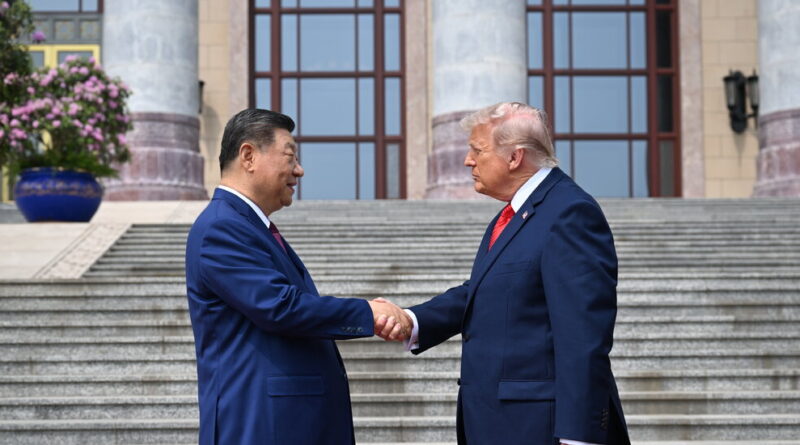
Mr. Trump’s tariffs have complicated Mr. Musk’s business interests in China. Though the two had previously fallen out, Mr. Musk stood alongside cabinet officials at the Great Hall of the People on Thursday when Mr. Trump shook hands with China’s leader, Xi Jinping.
Few American business leaders have a more tangled relationship with China. While China has long been a key manufacturing base for his solar, battery and electric-car businesses, Mr. Musk now faces increasingly stiff competition there.
U.S. officials have said that Mr. Trump wanted to discuss creating a board of investment and a board of trade with China. As the two leaders met, Mr. Musk was joined by Tim Cook, the outgoing chief executive of Apple, and Jensen Huang, the chief executive of American chip maker Nvidia. “Many good things” had been achieved, Mr. Musk said on Thursday.
Mr. Musk brought his son, X Æ A-XII, to the Chinese capital. The six-year-old has often visited the Oval Office with his father.
China is the most important market outside of the United States for Tesla, Mr. Musk’s electric car company. It is also home to the factory where Tesla produces half of all its cars, mostly for export to other parts of the world.
But in China, Tesla has been losing ground to local rivals. BYD has surpassed Tesla as the world’s largest electric carmaker. Chinese drivers now have many other electric vehicle options at far lower prices. And Mr. Musk’s role as an adviser to Mr. Trump has added to mounting negative consumer sentiment.
Mr. Musk’s other global ventures also face intensifying competition from Chinese companies, which have the financial backing of China’s state-owned banks.
For decades, the Chinese government has heavily subsidized the development of a homegrown green energy industry, while shielding some sectors, including wind turbines and electric car batteries, from foreign competition. Now, Chinese companies produce the most efficient and affordable renewable energy and grid storage technologies, like solar panels and large batteries for data centers.
Contemporary Amperex Technology Ltd., or CATL, has become the world’s largest maker of electric vehicle batteries. It also supplies them to Tesla.
Mr. Musk’s deep ties to China have extended to the reputation of Starlink, the satellite internet service operated by his rocket company, SpaceX. When officials in Taiwan, which China claims is part of its territory, sought to make the island’s communications network more resilient to natural disasters or military conflicts, they chose not to work with SpaceX.
The Chinese government has also imposed limits on Mr. Musk and his companies. Tesla cars are barred from some sensitive sites, including military bases. Beijing has also delayed approval for Tesla’s autonomous driving technology, even as Chinese automakers have been allowed to deploy theirs. Tesla executives said on a recent earnings call that they expect approval later this year.
Differences over domestic policy led Mr. Musk to leave the administration’s government-overhaul effort last May. He had spent almost $300 million to help elect Mr. Trump in 2024.
The rift peaked in June with a public falling-out, carried out largely on their competing social media platforms. Mr. Musk implied that the president was connected to the crimes of Jeffrey Epstein, the sex offender, while Mr. Trump threatened to cancel the government subsidies and contracts held by Mr. Musk’s companies.
By contrast, Mr. Musk has avoided criticizing Beijing, instead praising China on X as the world leader in electric vehicles and solar power.
Xinyun Wu contributed research from Taipei.