When a Law Is Not a Law: Cicero, the natural-law tradition, and the Quran’s higher standard
There is a moment in Cicero’s On the Laws where the old lawyer stops arguing like a lawyer and starts arguing like a physician. He has been asked, in effect, the most dangerous question anyone can ask a legal system: if a rule is passed correctly, by the right people, with the right stamps and signatures, is it therefore a law? Cicero’s answer is a flat, startling no.
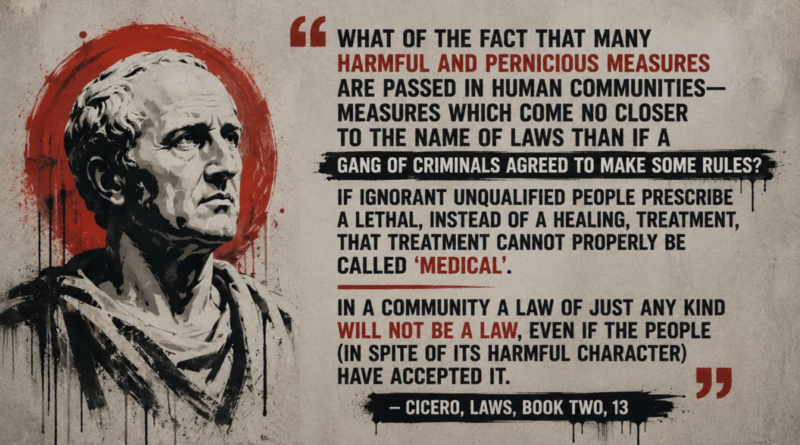
“What of the fact that many harmful and pernicious measures are passed in human communities—measures which come no closer to the name of laws than if a gang of criminals agreed to make some rules? If ignorant unqualified people prescribe a lethal, instead of a healing, treatment, that treatment cannot properly be called ‘medical’. In a community a law of just any kind will not be a law, even if the people (in spite of its harmful character) have accepted it.” — Cicero, Laws, Book Two, 13
This fact is a bomb placed under the foundations of every regime that ever hid cruelty behind legal proceedings.
The claim beneath the claim
Cicero is not making the trivial point that some laws are bad. Everyone knows some laws are bad. He is making the far more radical point that a sufficiently bad “law” is not a law at all—that it forfeits the name the way a poison forfeits the name of medicine. Legality and legitimacy, on this view, are two different things. A measure can be perfectly legal, ratified by every legitimate body, obeyed by a compliant public, and still be, in the deepest sense, no law.
To feel the force of this, you have to understand what Cicero thought law was. For him, law was not fundamentally the will of a legislature. It was, as he puts it earlier in the same work, “the highest reason, implanted in nature.” Law is a discovery before it is an invention. It is the attempt of a community to write down, in human language, a justice that was already true before anyone voted on it. On that understanding, a legislature no more manufactures justice by decree than a parliament could repeal gravity by acclamation. It can align with the moral order or defy it—but it cannot replace it.
This is why the two analogies in the passage are so precisely chosen.
The physician who kills
Medicine is the perfect test case, because medicine is defined entirely by its purpose. We do not call something “medical” because a person in a white coat administered it, or because it came in a labeled bottle, or because a board approved it. We call it medical because it heals, or is at least a reasonable attempt to heal. The moment a treatment reliably kills the patient—and is meant to—it has not become bad medicine. It has stopped being medicine and become poisoning. The white coat and the bottle and the board are the trappings. Healing is the thing itself.
Cicero’s argument is that law works the same way. Law exists for the good of the community—for justice, for the protection of the weak from the strong, for the flourishing of ordinary life. A measure that is designed to do the opposite, that unravels the very goods law exists to secure, has not become a bad law. It has stopped being law and become organized harm. The vote and the seal and the courthouse provide the illusion of law, but without justice, the appearance is all that remains.
Notice how much this stings a modern nerve. The state wanting to retain its authority has trained its constituency to treat legality as the last word. That if the paperwork is in order, the conversation is over. Cicero says: the paperwork is never the last word, because the paperwork was never the point, only the formality.
A gang that agreed to make rules
The other image is even more corrosive: a “law of just any kind” is no closer to real law than the house rules of a criminal gang. A band of thieves has procedures. It has a hierarchy, an agreed division of the spoils, penalties for informers. It is, in a narrow sense, a rule-governed community. What it lacks is the one thing that turns rules into law: the aim of justice. Take justice out of a state, and you have not abolished order; you have simply enlarged the gang.
Augustine, writing centuries after Cicero, would sharpen this into a single unforgettable line: without justice, what are kingdoms but great robberies? The insight is the same. Scale does not sanctify. A robbery committed by one man with a knife is a crime; the identical logic executed by a bureaucracy with letterhead is not thereby cleansed. If anything, it is more dangerous, because it has learned to call itself righteous.
History’s legal atrocities
The reason this ancient passage refuses to age is that the twentieth century turned it into documentary footage.
The Nuremberg Laws of 1935 were law in every procedural sense. They were drafted, debated, promulgated, and enforced by a functioning state. They stripped a minority of citizenship and set the legal machinery of a nation against its own people. When the survivors of that machinery were finally judged, the prosecutors at Nuremberg faced Cicero’s exact problem: the accused had, in many cases, followed the law of their land. The tribunal’s answer was Cicero’s answer. There is a standard above the statute. A command can be legal and criminal at once, and “it was the law” is not, in the end, a defense—because a measure that orders mass murder never earned the name of law to begin with.
Apartheid ran on statutes. The pass laws, the Group Areas Act, the whole architecture of racial control was legislation, enforced by courts that considered themselves legitimate. Chattel slavery in the United States was legal, and the Fugitive Slave Act made complicity in it a legal duty for free citizens hundreds of miles away. When Martin Luther King Jr. sat in the Birmingham jail and wrote that “an unjust law is no law at all,” he was not inventing a slogan. He was quoting a chain of reasoning that runs from Cicero through Augustine and Aquinas, and he was applying it to a legal order that had every stamp of legitimacy and none of its substance.
In each case the powerful said what the powerful always say: this is the law, and you will obey it. And in each case, eventually, the human conscience answered with Cicero: a law of just any kind will not be a law.
But who decides?
However, if any citizen can declare any statute “not a real law” whenever it displeases him, then law dissolves into a shouting match of private consciences, and the strongest shouter wins. The tax I resent, the ruling I dislike, the regulation I find inconvenient—am I now free to wave each away as a “lethal prescription”? That road ends not in justice but in chaos, which is its own kind of gang rule.
Cicero would answer that the appeal is not to preference but to reason—to a moral order that is public, arguable, and shared, not to a personal desire pretending to be a universal principle. The distinction between healing and lethal treatment is not a matter of taste; a competent physician can defend it, and so can the standard of justice. The natural-law claim is not that I may nullify whatever I please. It is narrower and harder: that legality and justice are genuinely different measures, that the gap between them is real, and that pretending the two are identical is the precise error that lets atrocity masquerade itself as legitimacy. The safeguard against tyranny and the safeguard against anarchy turn out to be the same safeguard—an objective standard, above both the mob and the state, to which both can be held.
Which raises the obvious question: where does such a standard come from?
The measure above the statute
This is exactly the seam where Cicero’s Roman argument meets the Quran—and where the two illuminate each other.
The Quran’s entire moral vision rests on the claim Cicero was reaching for: that right and wrong are real, woven into the structure of things by their Author, not manufactured by human decree. It calls God al-Haqq, the Truth, the Reality—and it insists that justice is not a human convention but a divine command. “GOD advocates justice, charity, and regarding the relatives. And He forbids evil, vice, and transgression” (16:90). Justice here is not what the assembly happens to ratify. It is the standard by which every assembly is itself measured.
And the standard is meant to bind even against our own interests. “O you who believe,” says 4:135, “you shall be absolutely equitable, and observe GOD, when you serve as witnesses, even against yourselves, or your parents, or your relatives.” A community can vote; it cannot vote justice out of existence. The scale is held from above.
The Quran even anticipates Cicero’s warning that harm can be dressed as order. Of the corrupters it says: “When they are told, ‘Do not commit evil,’ they say, ‘But we are righteous!’” (2:11). They have kept the vocabulary of law and lost the substance of it—the exact counterfeit Cicero described, the gang that calls its rules a constitution. And it names the deeper disorder underneath: the ruler or the man who “takes his own ego as his god” (45:23), who makes his desire the measure of law rather than submitting his law to a measure. That is the difference in a sentence. Legitimate law submits to justice. Tyranny makes its own will the definition of justice and dares anyone to object.
The Quran has a face for that second posture, and it is Pharaoh. Pharaoh is not lawless in the sense of chaotic; his Egypt is the most administered state in the ancient imagination. He is lawless in Cicero’s sense: he “turned into a tyrant on earth, and discriminated against some people” (28:4), and finally declared, “I am your Lord, most high” (79:24). That is the ultimate collapse of the distinction between legality and justice—the sovereign who no longer claims to serve the standard but to be it. The Quran presents him not as an exception to the logic of power but as its terminus, the honest end of any system that lets the statute outrank the truth.
Even the act of legislating carries this warning. “You shall not utter lies with your own tongues stating: ‘This is lawful, and this is unlawful,’ to fabricate lies and attribute them to GOD” (16:116). To decree is not the same as to make right. Calling a thing lawful does not make it just, any more than calling a poison a medicine makes it heal.
The purpose was never the label
There is one more convergence. Cicero grounded law in its purpose—healing, the good of the community. Similarly, the Quran puts the highest regard on the preservation of life, along with faith, intellect, family, and property (4:29, 10:99, 2:261, 6:151). A ruling that shredded the very goods the law exists to protect would be suspect precisely because it betrayed the law’s own aim. Here the physician’s scalpel and the jurist’s pen point in the same direction. Law is not a set of arbitrary commands to be obeyed for their own sake. It is a craft with an end, and when a measure works against that end—when it spreads what the Quran calls fasad, corruption in the land, rather than restraining it—it has failed at being law, whatever it is called.
This is what Cicero saw from inside a collapsing republic and what the Quran declares from first principle: the name of a thing is not the thing. A treatment that kills is not medicine. A rule that devours justice is not law. And a community that forgets the difference has not become more orderly. It has only agreed, politely and in writing, to be governed by a gang.
The unsettling gift of the passage is that it hands the test to us. Every generation is tempted to end its hardest moral arguments with three words—it is legal—as though legality were a wall no question could climb. Both Cicero and the Quran insist there is always a further question, the only one that finally matters: legal, yes—but is it just? A law of just any kind will not be a law. What is passed in your name still has to answer to something higher than the fact that it was passed.