Visit Nagasaki: A Crowd-Free Alternative To Japan’s Golden Route
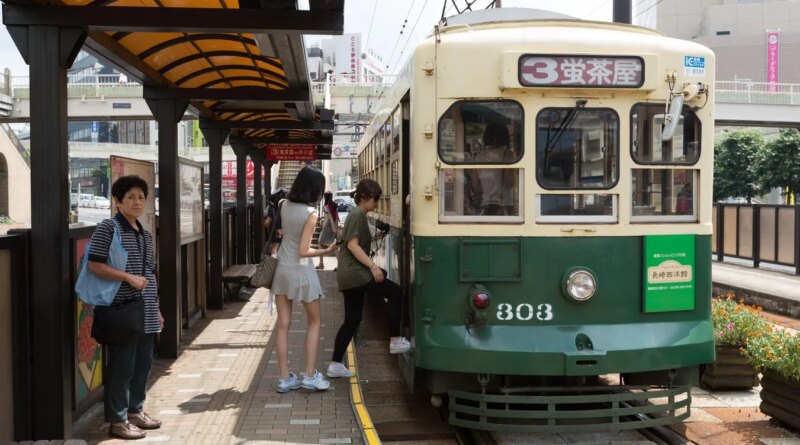
The Tram lines in Nagasaki provide easy access to most of the city’s main attractions.
getty
Most first-time travelers to Japan follow the so-called “Golden Route,” stopping at magnificent cities like Tokyo, Kyoto and Osaka. These are must-see cities because they offer an abundance of sights and activities, but be prepared: All are densely populated and over-touristed.
Whether it’s at popular restaurants, shops or train stations, Japanese people seem accustomed to waiting in long lines. Any images you’ve seen of the mass migration of pedestrians across two directions at Shibuya Crossing in Tokyo are not an exaggeration.
Nagasaki: Venture Off The Well-Traveled Road
Ironically, geography has been kinder to Nagasaki. Almost 90% of the city’s surrounding mountains and hills are steep and difficult to build on, so far fewer people live there, with most living in the center’s lowlands. Established in 1570, it was the first town built on the long Nagasaki Peninsula.
Nagasaki also tends to attract fewer tourists. To reach the city, located on the westernmost coast of Kyushu Island, U.S. travelers have to first stop in Tokyo or Osaka and then take a domestic flight. Even the 5-7 hour bullet train from Tokyo involves a transfer.
Thus, Nagasaki is a destination that isn’t on the way to someplace else. You have to want to go there directly. As a result, the city is less jam-packed and feels more authentic and relaxed.
However, once you arrive, getting around the city is easy and inexpensive. The Nagasaki Electric Tramway, Japan’s most historic streetcar system, is the only one with its original tracks intact. Four main lines connect different parts of the city and riding the tram’s boxy, retro cars is like taking a trip back in time.
More Than A One-Day City
The stunning coastline of Nagasaki Prefecture, of which the city is the capital, stretches for more than 2,500 miles, offering beautiful views of the sea and mountains.
My husband and I discovered Nagasaki on a 14-day cruise around Japan on Seabourn Encore. Ours was one of many international cruise ships that stop at the natural harbor, usually for a day. However, after a private one-day tour of Nagasaki, we had pre-arranged with Inside Japanwe felt this was one of the cities that would lure us back to spend more time.
Our English-speaking local tour guide, Ena, met us at the port and shepherded us into a taxi to our first destination, Nagasaki Peace Park.
Some Highlights of One-Day in Nagasaki
Here are some of the highlights of our day, which was self-paced and individualized to our interests:
Nagasaki Peace Park
There are two major parks in Japan that memorialize the dropping of the atomic bombs in 1945 that crippled both cities: The Hiroshima Peace Memorial and the Nagasaki Peace Park.
The somber park in Nagasaki is dominated by a giant sculpture by local artist Seibo Kitamura, a pledge to world peace in remembrance of those who perished. In addition to the Nagasaki Atomic Bomb Museum and the hypocenter of the bombing, this complex, whose scale is smaller than that of the one in Hiroshima, features a Fountain of Peace, statues donated by other countries, and beautifully landscaped gardens.
With current threats of the use of nuclear weapons, it’s a poignant reminder of the terrors of war and an admonition that history should not be repeated.
Dejima Island
A traditionally dressed Japanese man walks through the street in Dejima, Nagasaki
getty
We hopped off the noisy #1 streetcar to reach Dejima, an open-air museum featuring 16 meticulously restored or reconstructed structures dating back to the 17th century, when the artificial island served as a trading post.
The reconstruction mimics the original architecture of the gates and warehouses, which are also furnished with artifacts reflecting life during the Edo period. The opulence of the Captain’s Quarters was particularly impressive.
The island and the project are significant because Japan was a closed society for two centuries (from 1641 to 1859). Nagasaki opened a window to European and Chinese culture and knowledge through trade, offering the country a gateway to Western science and technology. Due to this rich history, Nagasaki culture (Was Ka Ran) blends Japanese, Chinese and Dutch elements.
Shinchi Chinatown
Lantern Festival held in Nagasaki China Town.
getty
A large gate welcomes visitors to Nagasaki’s Shinchi Chinatown, the oldest of Japan’s three largest Chinatowns (the others are in Kobe and Yokohama).
The long city block looks like a movie set, lined with family-owned restaurants, street food stalls, and small shops. Like Dejima, it also sits on reclaimed land that exists because Chinese traders, unlike the Dutch, were allowed to live in a confined district near Shinchi.
Our stop for lunch at a traditional restaurant with sliding doors and bright red painted panes gave us the chance to taste some local specialties: Champon (a soup with thick ramen noodles and vegetables boiled in a pork broth), Nagasaki Udon (noodles with seafood, pork, and vegetables) and a dish of crunchy bamboo shoots and shitake mushrooms in a savory sauce.
Continuing our walk after the hearty meal, we swore we couldn’t eat another bite, but Ena insisted that we stop to taste an irresistible steamed pork bun (Baozi), freshly made by a street vendor, another local specialty food of Nagasaki.
Megane Bridge in Negasaki
The Megane (Spectacles Bridge) was built in Nagasaki in 1634.
getty
The picture-worthy stone bridges of Nagasaki have a charm of their own that almost rivals the beauty of those across the Grand Canal in Venice. The Megane Bridge, one of the most famous and oldest surviving stone bridges in Japan, is designated as an Important Cultural Property.
Built in 1634 by a Chinese monk, the arched bridge over the Nakashima River is sometimes called the “Spectacles Bridge” because its reflection on the water looks like a pair of glasses.
One of a chain of nine stone bridges, this charming area invites locals to stroll along the riverbanks, walk along stepping stones in the river, and visit local shops and eateries.
Shokando Castella Ship & Cafe
Naagasaki is the epicenter of Castella cakes
getty
From the first days of our trip to Japan, my sweet tooth became a devotee of castilethe Japanese cake introduced to Japan by the Portuguese. When I tasted a Castella sandwich at the Bunmeido Cafe in Tokyo’s Ginza district, it was love at first bite. The yellow cake is fluffy and golden, sweetened with some honey and a bottom layer of sugar.
However, Nagasaki is the epicenter of Castella. The cake was initially brought here by Portuguese merchants and missionaries in the 16th century, and soon became a favorite across the country.
Of course, I told our guide, Ena, that I wanted to taste Castella at its source, so she took us to her favorite place, the Shokanda Castella Shop & Cafe, near the Megane Bridge. The shop is famous for creating confectionery for the Imperial family.
Here, we were able to taste a slice of the cake fresh out of the oven, elegantly served with green tea in the intimate cafe. It was impossible to resist the beautifully packaged cakes to take home as gifts.
Nagasaki Kofukuji Temple
Kōfuku-ji is an Obaku Zen Buddhist temple established in 1624 in Nagasaki.
getty
Like most Japanese cities, Nagasaki has an abundance of temples and shrines, especially in the Tera-machi neighborhood. (One tour guide in Tokyo humorously asked us if we were “over-shrined and over-templed.”) Passing a cat shrine (Japan is obsessed with cats), we climbed the hill to the Kofukuji Temple, after a short walk through a shopping street.
Shrines and temples were built at the foot of Mt. Kazahashira, lining the neighborhood now dubbed “Temple Town” for its Chinese-style architecture. A monk from this still-active Buddhist temple, now a nationally designated Important Cultural Property, is said to have built the stone bridges to connect worshippers from across the river.
It was created as a haven for the Chinese to pray for a safe voyage in a country that strictly prohibited Christianity, even among Chinese residents of Nagasaki. The grounds were beautifully tended single-handedly by the temple’s current monk.
Nagasaki Town Hall
Nagasaki, Japan downtown cityscape
getty
Toward the end of the day, Ena took us into one of the highest buildings in Nagasaki, the city’s town hall. It looked as if we had mistakenly entered a DMV office in New York City. Residents were patiently sitting in rows of chairs, waiting to be called to file administrative papers.
Elevators whisked us to the top-floor observation deck of the recently constructed (2023) building. College students were on a relaxing patio studying for exams. As we walked the perimeter and gazed around us, we got a bird’s eye view of the city’s Japanese-style wooden houses (machiya) with internal gardens.
Looking over Nagasaki, we saw most of the landmarks we visited in a single day with our guide, well aware that this was a place beckoning us to return. Before we hugged Ena goodbye, thanked her for our “best day in Japan,” and reached the cruise terminal well in time for our ship’s departure, she handed us a folder of maps and guides for Nagasaki. The folder was made by her mother using traditional Japanese paper made from tree bark.
About Inside Japan: This niche travel company (we discovered online) offers tours of Nagasaki, ranging from multi-day small-group tours to fully customizable, self-guided itineraries. Part of the Inside Travel group, it has provided experience-led travel across Japan and Southeast Asia for 25 years.