UK By-Election Live Updates: After Burnham's Win in Makerfield, Starmer Says He 'Will Stand' in Any Leadership Race
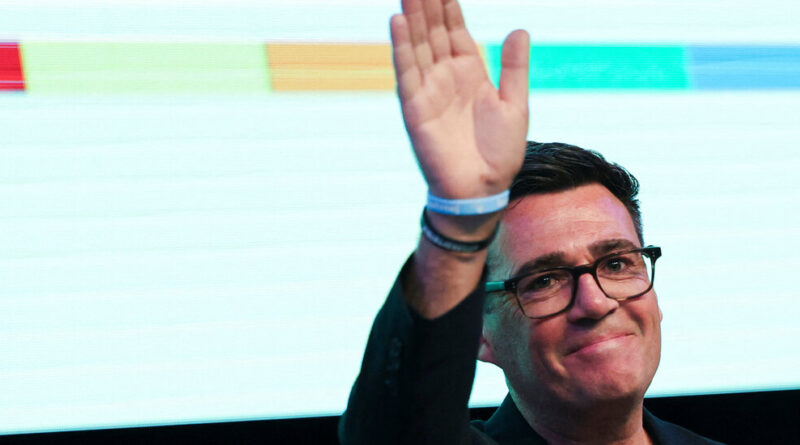
Andy Burnham has twice run unsuccessfully for the leadership of Britain’s governing Labour Party. Now his decisive victory in a special parliamentary election puts him within reach not just of that goal, but of entering Downing Street as prime minister.
A fluent communicator known for his bonhomie and charisma, Mr. Burnham has for nine years been mayor of Greater Manchester, where he cultivated an image of optimism, activism and the type of authentic plain speaking characteristic of northern England.
With a seat in Parliament representing Makerfield, in northwest England, Mr. Burnham will need the support of 80 fellow Labour lawmakers to mount a leadership challenge to the country’s unpopular prime minister, Keir Starmer.
Supporters see Mr. Burnham — who in Manchester won the nickname “king of the North” for his defense of the area during the Covid-19 pandemic — as Labour’s potential savior against the populist right-wing Reform U.K. party, led by Nigel Farage. Critics portray Mr. Burnham as a political chameleon who would face the same economic constraints that have stymied Mr. Starmer’s lackluster government, and the same restless, impatient electorate.
Either way, he would be a different kind of leader from the one he wants to replace.
“He’s just optimistic and happy and seems to enjoy being a politician,” said John McTernan, an adviser to Tony Blair when he was prime minister and someone who has known Mr. Burnham since his days as a researcher for a lawmaker in south London. “Leaders either inspire you, or they slightly depress you,” Mr. McTernan added, noting that there had been several recent prime ministers “who didn’t really seem to enjoy it” — Mr. Starmer included.
Mr. Burnham was born in Liverpool in 1970, to a father who was a phone engineer and a mother who was a doctor’s receptionist. He was raised in Culcheth, a village in Cheshire not far from Makerfield. Of Irish heritage, he attended Roman Catholic state schools and has spoken of his Catholicism, including meeting Pope Francis in 2023.
“My mum was with me, and even though I’m not a Catholic in that full sense of the word, I felt the magnetic pull of the Vatican,” he saidlikening his faith to his lifelong devotion to Everton soccer club. If you stop going to matches, he added, “you’re still an Evertonian; you can stop going to church but you’re still a Catholic.”
Mr. Burnham won a place to study English at the University of Cambridge and after graduating, took a familiar path to political prominence, first as a researcher for Tessa Jowell, a lawmaker in south London, then as an adviser to the then-culture secretary Chris Smith.
While at Cambridge he met Marie-France Van Heel, who was born in the Netherlands, and they later married and had three children.
“When my wife got pregnant we actually hadn’t planned to have children at that time because I felt stability was important. We got married in October 2000 when Jimmy was 8 months old and I was in a difficult battle to win the nomination,” Mr. Burnham told The Guardian in 2009, referring to his efforts to run for Parliament.
After he won election in 2001, representing Leigh, a northern district close to where he was raised, he became a junior minister in the New Labour government of Tony Blair. He was promoted to the cabinet under Gordon Brown and served as chief secretary to the Treasury, as secretary for culture, media and sport, and then as health secretary.
In 2009 Mr. Burnham was heckled at a memorial service on the 20th anniversary of the Hillsborough disasterwhich resulted in the deaths of 97 Liverpool F.C. soccer fans in a stadium crush. It made a deep impression, convincing him that the families deserved justice after the police, investigators and the news media tried to depict the victims as hooligans and to blame them for the disaster. Pressure from Mr. Burnham helped secure a second inquiry.
After Labour lost the general election in 2010, Mr. Burnham ran for party leader, coming in fourth. In 2015 he tried again and was the early front-runner, only to lose to the left-winger Jeremy Corbyn, on whose team he later served.
In 2017 Mr. Burnham left Parliament after deciding his future lay outside Westminster, and he was elected as mayor of Greater Manchester.
Robert Ford, a professor of politics at the University of Manchester, said Mr. Burnham had presided over a thriving local economy there, and had showed his political skills by increasing control and regulation of the city’s buses — winning a fight with transportation companies in the process.
“He turned what could have been a rather bland technocratic bit of policy — believe me, if Keir Starmer had been there it would have been — into a David versus Goliath fight,” Professor Ford said. “His big strength is he is very effective communicator, a very effective storyteller; he’s good at giving voters a sense of who he is, who he’s for, and what he’s trying to do.”
“In all these respects,” Professor Ford said, “he is quite a contrast with the incumbent Labour prime minister.”
Mr. Burnham also led from the front during the pandemic, complaining that government lockdowns were penalizing regions like his, and making a speech in central Manchester that became famous.
Perhaps the most consistent criticism leveled against Mr. Burnham, who served under three very different Labour leaders in Mr. Blair, Mr. Brown and Mr. Corbyn, is that he is politically malleable.
In 2022, after the last soccer World Cup, Mr. Starmer himself poked fun at his former colleague. In a speech to reporters, Mr. Starmer joked that Mr. Burnham “got to see his boyhood team Argentina win the World Cup” but that “it was a mixed bag because he also got to see his boyhood team France lose the final and his boyhood teams Morocco and Croatia lose in the semis.”
Mr. McTernan acknowledged that Mr. Burnham’s reputation is of a politician who “likes people to like him” but said: “A people pleaser as a politician is much better than a people hater.”
One common thread through Mr. Burnham’s career has been the idea that British politics and the news media is too London-centricand that regional inequality has damaged the country, a point he made in his first speech to Parliament in 2001. During one recent interview Mr. Burnham said Britain had been “on the wrong path for 40 years.”
Mr. Burnham raised concern among some last year when the said that the Labour Party ought to get “beyond being in hock to the bond markets” — a phrase he has subsequently said was misinterpreted. More recently he appeared hazy over an aspect of economic policy in one BBC interview. But in Manchester he pursued business-friendly policies to attract investment.
According to Professor Ford, as a mayor, Mr. Burnham “got relatively used to saying whatever was in his mind” but, now has “been getting a rather sharp lesson in the need to weigh his words more carefully.”
How the skills he showed in Manchester would prepare him for the top job in British politics is hard to predict.
“It’s very different when you are sailing into the storm of 10 Downing Street, where there will be 150 issues on your desk every day,” Professor Ford said. “You don’t really get that much control over which ones to pick fights over, and you have no time to think.”