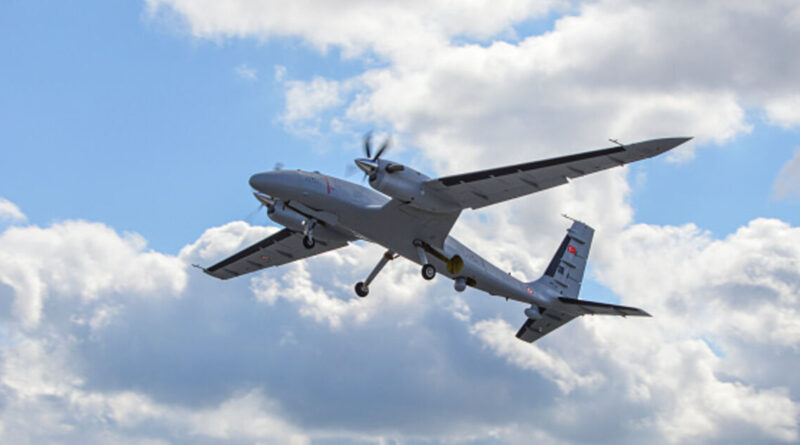
Turkey’s Baykar tests K2 swarm kamikaze drones for first time: What to know
Turkey’s drone giant Baykar has tested its K2 kamikaze drones alongside new loitering systems for the first time, marking a further step in Ankara’s push toward autonomous battlefield technologies and the ability to operate when GPS signals are jammed.
Details: In a press release on Friday, the company said its K2 kamikaze UAV was tested at its flight test and training center in Turkey’s northwestern Edirne province.
The UAVs, the company said, feature AI-supported swarm autonomy, navigation in GPS-denied environments, and automatic target detection and strike capabilities, enabling operations in hostile environments.
Baykar also demonstrated “Sivrisinek” — meaning “mosquito” in Turkish — loitering munitions, small self-guided drones designed to search for and strike targets.
Baykar said the systems will be publicly displayed for the first time at the SAHA 2026 defense exhibition — one of the region’s largest defense exhibitions — in Istanbul from May 5 to May 9. Last year, the exhibition drew more than 1,500 companies and over 100,000 visitors.
Background: Baykar, owned by the family of Selcuk Bayraktar — son-in-law of Turkish President Recep Tayyip Erdogan — has emerged as a central player in Turkey’s expanding defense exports.
The company ranked 73rd globally among the world’s top 100 arms-producing and military services companies, generating roughly $1.9 billion in arms revenue in 2024, about 95% of it from exports, according to data released in December 2025 by the independent arms watchdog Stockholm International Peace Research Institute.
Why it matters: The demonstration reflects Baykar’s move toward coordinated swarm-capable, AI-enabled drone systems designed to operate in contested environments where satellite navigation may be jammed.
Turkey has previously tested swarm-capable drones, including the KARGU loitering munition. Developed by STM and first fielded in 2018, it is a portable rotary-wing system capable of autonomous targeting and swarm operations, serving as Turkey’s earlier baseline for coordinated kamikaze drone systems.
Baykar’s latest demonstration, meanwhile, points to a deeper integration of AI-supported navigation, target detection and multi-platform coordination.
The Iran war has shown how waves of simpler drones can strain air defenses, forcing militaries to use costly interceptors against lower-cost threats, while AI-enabled swarms represent the next phase of that challenge.
Know more: Baykar is best known for its Bayraktar TB2 drone, exported to dozens of countries and used in conflicts from Ukraine to Libya.
The company also produces more advanced systems such as the Bayraktar Akinci combat drone and the naval-focused Bayraktar TB3.