
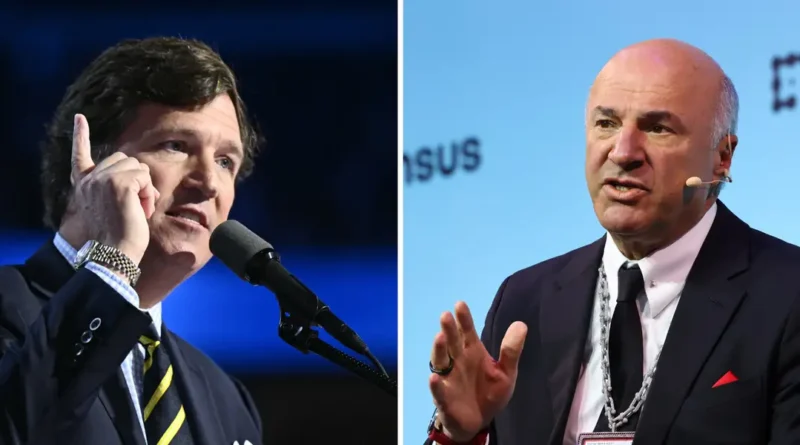
Kevin O'Leary pushes back on Tucker Carlson's data center concerns: 'Welcome to America, buddy!'
Kevin O’Leary and Tucker Carlson clashed over AI, taxpayer subsidies for O’Leary’s planned Utah data center projectand China, during a wide-ranging interview published Wednesday.
The “Shark Tank” investor defended the Utah development as a necessary investment in America’s AI future, as Carlson questioned why taxpayers should help fund infrastructure that could primarily benefit tech giants like Amazon, Microsoft, and Google.
Carlson repeatedly asked O’Leary why taxpayers should subsidize a private business whose tenants could be “some of the richest companies in the world.”
“They don’t necessarily have to do that,” O’Leary replied, referring to taxpayers, adding that states that don’t subsidize such projects “just won’t win any contracts. It’s a competition.”
When Carlson pressed him on tax breaks, O’Leary said incentives are standard practice for major projects. Carlson argued that tax breaks still shift costs onto ordinary taxpayers.
“Why, if it’s such a good business, would you be asking taxpayers to help pay for it without giving them equity in the company?” Carlson asked.
The interview comes amid mounting backlash over O’Leary’s proposed 40,000-acre Stratos data center project in Utah, which opponents say could strain the state’s water and power resources while offering relatively few long-term jobs.
The project, which was unanimously approved by county commissioners, is expected to consume up to 9 gigawatts of energy — more than double Utah’s current electricity usage.
O’Leary has dismissed many critics as “professional protesters” and argued that the center will drive significant economic growth and job opportunities in the region, saying it would create jobs and generate tax revenue, comparing it to other manufacturing projects competing for state incentives.
Carlson and O’Leary also sparred in their interview over whether AI will create or destroy jobs. O’Leary argued that new technologies historically create industries that are impossible to predict in advance. Carlson countered that O’Leary’s own examples — AI-powered medical scans and photo cataloging — showed machines replacing human labor.
More than a labor issuethe geopolitical battle with China is at the heart of the AI race, O’Leary said.
“Would you prefer all of us that are developing these data centers put down our shovels and stop while the Chinese accelerate theirs?” he asked, saying the US and its allies need to expand power generation and data-center capacity or risk falling behind Beijing technologically and militarily.
Carlson remained skeptical of taxpayer-backed incentives for billion-dollar AI projects, arguing that states were transferring wealth from ordinary taxpayers to some of the country’s richest companies.
“Welcome to America, buddy,” O’Leary replied. “This is how it’s gone on for 200 years.”
O’Leary is a Canadian citizen.