The Thirteenth Apostle
Constantine murdered his son, his wife, and his rivals; he was baptized only as he lay dying; and he reshaped Christianity more deeply than anyone since its founders—for reasons of state. The church made him a saint and, in the same breath, taught itself to forget how much of the faith he built.
Ask a well-informed Christian what Constantine did for their religion, and you will usually get a short, tidy answer. He stopped the persecutions. He legalized the faith. He saw a cross in the sky before a battle and won. He called the bishops together at Nicaea. Then, having nudged history in the right direction, he steps offstage, and the real story—the theology, the spirituality, the slow inner growth of the church—resumes without him.
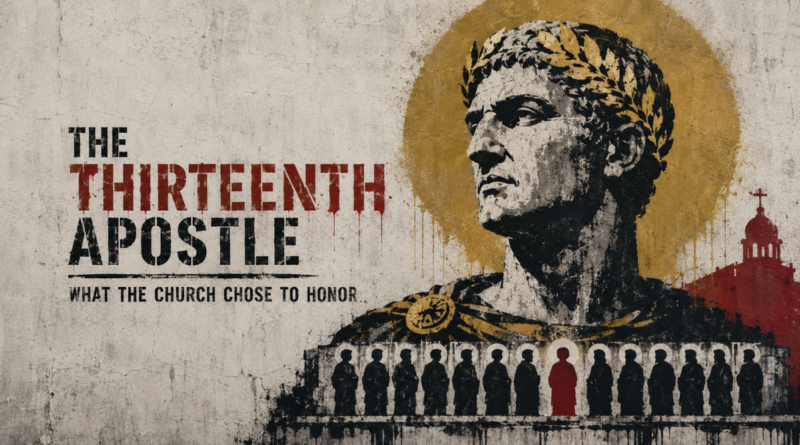
This is a remarkably convenient picture, and it is wrong in both directions at once. It honors Constantine too much and understands him far too little. The same tradition that shrank him to a helpful footnote also enrolled him among the apostles—named him isapostolos, “equal-to-the-apostles,” and laid him in a tomb ringed by the twelve, a self-appointed thirteenth. Both gestures, the shrug and the halo, work to obscure the same fact: that a Roman emperor who remained an unbaptized layman almost to his dying breath, and who murdered his own son and wife, did more to determine the shape of Christianity—its institutions, its wealth, its enforceable creed, its holy places, its very self-image—than any theologian who ever lived. And he did it for reasons that had almost nothing to do with God.
The Man Before the Halo
Constantine was born around 272 in the Balkan city of Naissus, the son of a rising military officer, Constantius, and a woman of humble birth named Helena—by some accounts an innkeeper’s daughter. He came of age inside the Roman army and the ruthless power politics of the tetrarchy, Diocletian’s four-ruler system for governing a sprawling empire. When his father died at York in 306, the troops proclaimed Constantine emperor on the spot, and he spent the next eighteen years doing what ambitious Roman commanders did: fighting his way to the top of a crowded field of rivals.
The famous turning point came in 312 at the Milvian Bridge outside Rome, where he defeated his rival Maxentius—who drowned in the Tiber—after reportedly seeing a sign of the Christian God in the sky and marking his soldiers’ shields. Whatever happened that day, its consequences were political before they were spiritual. Constantine had found a patron deity who delivered victory and a growing constituency, the Christians, who could be bound to his cause.
It is worth dwelling on what his religion actually looked like, because the popular image of a converted, pious emperor does not survive contact with the evidence. Constantine went on minting coins with the sun-god Sol Invictus for years after his supposed conversion. He kept the pagan title pontifex maximus, chief priest of Rome’s state cult, until his death. He built a Christian capital and filled it with classical statuary looted from pagan temples. And, most tellingly, he declined baptism—the act that actually makes one a Christian in that era—until he lay dying in 337, when he received it from Eusebius of Nicomedia, a bishop of the very Arian party the church would later condemn. For a quarter-century after the Milvian Bridge, the most powerful Christian in the world was not, technically, a Christian at all. He was a patron. The distinction matters.
Blood in the Purple
If his faith was ambiguous, his ambition was not. Constantine secured his throne the way Roman emperors usually did—by eliminating everyone who stood near it, including his own family.
In 324, he defeated his last rival, his brother-in-law and co-emperor Licinius, at Chrysopolis. Licinius surrendered only after Constantine’s own half-sister, Licinius’s wife, extracted a sworn promise that his life would be spared. The promise lasted a few months. In 325, Constantine had him executed on a charge of conspiracy; his co-emperor Martinian, spared under the same terms, was killed as well. About a year later the couple’s son—Constantine’s own nephew, a boy of perhaps ten—was put to death too.
The year 326 was worse, and it reached inside his own household. Constantine ordered the execution of his eldest son, Crispus, a capable young general who had fought at his side. Apparently, he had him poisoned at Pola without trial. Soon after, his wife Fausta died in an overheated bath, scalded or suffocated by steam on the emperor’s orders—the account preserved by later writers and by the pagan historian Zosimus. The ancient sources tie the two deaths together in a lurid tangle: an accusation, possibly false, that Crispus had made advances on his stepmother; a father’s fatal rage; and then, in one version, the reproaches of Constantine’s mother Helena, grieving for her murdered grandson, driving him to turn on his wife in turn.
Honesty requires a caveat, though it darkens the motive rather than softening it. Constantine imposed damnatio memoriae on Crispus and Fausta, scrubbing their names from monuments and suppressing the record, so the precise truth of 326 can no longer be recovered; historians have proposed conspiracy, scandal, and political purge in roughly equal measure. What is not in doubt is the shape of the thing. Within two years, the emperor who was then presenting himself to the Christian world as its divinely chosen protector broke a sacred oath to kill a surrendered rival, executed that rival’s child, and murdered his own son and wife.
The Church Acquires a Balance Sheet
None of this disqualified him in the tradition’s eyes, because the tradition was not weighing his soul. It was weighing what he had done for the institution. And what he had done was to remake it from the ground up.
For its first three centuries, Christianity had been a network of private, often precarious associations—legally vulnerable, periodically persecuted, and limited in what they could own. Diocletian’s persecution had stripped congregations of their buildings and books only a decade before Constantine’s rise. Then, in a single generation, everything changed—not the theology, but the material foundation the theology stood on.
When Constantine and Licinius issued their grant of toleration in 313, they did not merely stop the killing; they ordered confiscated church property restored, at public expense where necessary. That was the opening move in a sustained transfer of wealth and privilege:
- The right to inherit. Around 321, Constantine gave churches the legal power to receive bequests. In a society where wealth moved through inheritance, this turned the church into a permanent heir; over generations it accumulated estates on a scale no persecuted sect could have dreamed of.
- Exemption from civic burdens. Clergy were released from the munera, the crushing and compulsory obligations that fell on the propertied classes of Roman towns. The exemption was so valuable that wealthy men began seeking ordination to escape their tax liabilities, and Constantine had to pass a law forbidding town councilors from taking clerical orders as a shelter. That such a law was needed tells you exactly what ordination had become.
- Direct imperial subsidy. He poured money into monumental churches and granted congregations regular allotments of grain and cash for clergy and charity. The church did not merely gain the right to grow rich; it was made rich, directly, from the imperial treasury.
The effect was structural. Within a generation the church had what it had never possessed: a revenue stream, a balance sheet, and a powerful stake in the emperor’s continued favor. Nowhere did this register more sharply than in the office of bishop. Before Constantine, a bishop led a vulnerable community and was more likely to be exiled than enriched. After him, the bishop administered the grain dole and the charitable funds, held a state-backed judicial role, and controlled property, appointments, and the flow of imperial money into his city. The see had become an asset—in the great cities, an enormous one.
The evidence of what it became is best read a generation later, once the transformation had matured. The pagan senator Praetextatus is remembered joking to Pope Damasus that he would convert tomorrow if they would only make him bishop of Rome. In the 360s, the contested Roman succession between Damasus and a rival spilled into lethal street fighting, and the historian Ammianus Marcellinus, surveying the bodies, remarked how understandable such ambition was given the wealth the office now conferred. Bishops had become men worth killing to become.
The point is not that the bishops were cynics who sold their theology. Most were sincere, and many suffered for their convictions. The point is subtler and more important: Constantine had rebuilt the entire incentive structure around belief. To be a bishop in communion with the emperor’s church now meant security, wealth, and standing; to be on the wrong side meant deposition, exile, and the loss of everything. The cost of dissent and the reward of conformity had both risen enormously. Sincere men still make sincere choices—but they make them on a landscape, and Constantine had just rebuilt the landscape.
Orthodoxy Gets a Police Force
This is the light in which the Council of Nicaea in 325 is best understood: not as a purely spiritual assembly but as an act of imperial administration, which is precisely what it was.
Constantine convened it. He summoned some three hundred bishops, moved them across the empire on the imperial post normally reserved for state business, housed and fed them, presided over the opening, involved himself in the debate, and lent the outcome the enforcement power of the state. When Arius and two bishops refused to sign, they were not merely censured; they were exiled by imperial order and stripped of their sees.
Why would an emperor spend so lavishly on an abstruse quarrel about the relationship between the Father and the Son? Because a divided church was useless to him and a united one was a gift. Constantine’s consistent priority was concord—a single, orderly, cohesive church that could help bind a fractious empire together. The metaphysics interested him mainly as a threat to public order. He was willing to throw his weight behind the decisive, contested term homoousios, “of one substance,” pressed on him by his adviser Ossius of Cordoba, though by all accounts he barely grasped what it meant. What he wanted was a formula that would end the fight and a mechanism that would enforce the peace.
That is Nicaea’s deepest significance. It established that Christian doctrine was now something the state had an interest in fixing and the church every incentive to let it fix. Correct belief had acquired a treasury and a police power. Orthodoxy became, for the first time, an enforceable and endowed condition.
Here an honest account has to confront a fact that wrecks the crude version of this story—the version in which Nicene doctrine simply won because it paid. For roughly two generations after 325, imperial favor did not rest with the Nicene party at all. Constantine himself drifted toward the Arian camp and died in its arms. His son Constantius II and the later emperor Valens were committed opponents of the Nicene formula, and under them it was the Nicene champions who were dispossessed. Athanasius of Alexandria, the great defender of homoousios, was driven from his see five separate times. Jerome, looking back on the nadir, wrote that the world awoke to find itself Arian.
If money mechanically determined doctrine, the Nicene Creed should have died in the 350s. It did not, and that is the clearest proof that the convictions in play were real and could not simply be bought. So the financial reading has to be stated precisely. Constantine’s revolution did not decide which doctrine would win. It decided something more durable: that whoever won would win totally—that the losing side would forfeit its buildings, its endowments, its legal standing, and its sees, and be driven to the margins. He installed the operating system: doctrine enforced by imperial power, bishoprics handed out as spoils, conformity rewarded and dissent dispossessed. For fifty years his opponents ran that system. The system itself, not any party’s grip on it, was his permanent bequest.
Manufacturing the Holy Land
An empire needs more than administration; it needs sacred geography. A faith elevated to the center of imperial life required tangible places—shrines a ruler could build, endow, and be seen to honor. So around 326, in the same grim span in which he was killing his family, Constantine turned to Jerusalem.
The motive was of a piece with everything else. A monumental Christian holy land would sacralize the new order, bind the dynasty to the divine, and give the imperial faith a visible home—much as his mother’s grand pilgrimage, underwritten from the treasury, advertised the piety of the ruling house. Some historians suspect the timing was not innocent, that the Holy Land building program and Helena’s journey were partly acts of expiation after the blood of 326. If so, it only sharpens the point: even the penance was a matter of imperial image, guilt managed in marble and gold rather than a soul reaching for God.
Two centuries earlier, Hadrian had razed Jerusalem, rebuilt it as a pagan colony, and raised a temple to Venus over one of its quarters. Constantine ordered the temple torn down and the ground beneath it excavated—and there, according to Eusebius, “beyond the hopes of all,” a rock-cut tomb emerged, which the bishop of Jerusalem promptly identified as the very sepulcher of Christ. Over it Constantine built the Church of the Holy Sepulcher, consecrated in 335, the most magnificent sanctuary in the Christian world.
Consider what that identification asked one to believe. Nearly three hundred years had passed. Jerusalem had been destroyed twice, its population killed or scattered, its ground buried under a pagan city. The tomb, if it had ever borne a marker, bore none now. Yet the emperor’s men, having demolished a temple and dug up a hillside, announced with perfect confidence that among the many first-century tombs of the area they had located the one that mattered. The method, stripped of its glory, amounted to local Christians pointing at the spot and saying: there.
To be fair, the location is not absurd on its face—it lay outside the ancient walls, in ground once used for quarrying and burial, and may have drawn Christian veneration before Constantine’s builders arrived. What was manufactured was not so much the place as the certainty. And the certainty did not stop at a tomb. The same enterprise soon produced the wood of the True Cross, which pious tradition credited to Helena: on her pilgrimage. The story went, she happened upon the buried crosses of Calvary and identified the true one when its touch healed a dying woman. It is a marvelous story, and it has one revealing flaw. Eusebius, the contemporary who described the discovery of the tomb in ecstatic detail, says nothing whatever about Helena finding the Cross. The most venerated relic in Christendom enters the record only decades later, swelling with each retelling—the signature of a legend, not an event. For her credited holiness, Helena is honored as “Equal-to-the-Apostles” (isapostolos) in the Eastern Orthodox tradition.
The habit outlived the man and spread across the map. The hill that Christians still call Mount Zion is not the biblical Zion at all; the real one was the ridge of the City of David, southeast of the Temple Mount. But Byzantine pilgrims looked at Jerusalem’s grander southwestern hill, decided it must be Zion, and pinned the sacred name to the wrong slope, where it has remained ever since. That particular error came after Constantine’s death—yet it belongs entirely to the world he made, a world in which the sacred landscape was named to fit the story the faith required rather than anything that could actually be known.
The Thirteenth Apostle
Set the whole record side by side—the broken oaths, the murdered son and wife, the political creed-making, the manufactured tomb and invented relic, the quarter-century of unbaptized patronage—and then place beside it the honor the church settled on the man responsible.
He is a saint. He is commemorated each year alongside his mother. He is titled isapostolos, equal-to-the-apostles, and he arranged to be buried at the center of the Church of the Holy Apostles in his new capital, flanked by memorials to the twelve, six on each side, so that he would lie among them as a thirteenth. His court bishop Eusebius had already prepared the frame, casting him throughout his biography as a new Moses—the God-chosen liberator who leads his people out of tyranny and hands down divine law, with Maxentius’s drowned soldiers standing in for Pharaoh’s army in the sea. Scholars have noticed what that particular comparison quietly accomplished: unlike the apostles, Moses was a lawgiver who took life, and the parallel supplied a biblical warrant for exactly the kind of ruler Constantine was. The mold was chosen to fit the man—blood and all.
The tradition, pressed on the point, has a defense, and it is an accidentally devastating one. The title, its defenders explain, was never a claim about Constantine’s personal holiness. He was no martyr; he shed no blood for the faith; he died a barely-baptized layman. The honor recognizes instead his historical work—ending the persecutions, endowing the church, convening the council, building the shrines. He stands with the apostles not for his sanctity but for the sheer scale of what he did for the faith.
Look closely at that defense, because it gives away the entire game. In order to rescue the honor, it concedes that the man was not holy—and then justifies ranking him with the apostles on the ground that he founded so much of the actual church. Which is to say: the tradition’s own explanation for calling Constantine an apostle is that he shaped Christianity as profoundly as the apostles did. The absurd title turns out to be the single most honest thing the church ever said about him. He really was a founder. He simply was not a holy one, and his founding was done for an empire, not for God.
The Convenient Amnesia
Which brings us back to the shrug. If the church of late antiquity understood Constantine’s foundational role well enough to seat him among the apostles, why do so many Christians today wave him away as a minor administrator—the man who happened to legalize the faith and then got out of the way?
Because the full acknowledgment is intolerable. To see Constantine clearly is to see that the foundational features of institutional Christianity were poured by a politician for political reasons, and that they have very little to do with anything in the Gospels. Consider what actually traces back to him and the settlement he built:
- The very idea of a single, enforceable orthodoxy. Before Constantine, Christian belief was genuinely plural, held together by persuasion and local authority because there was no power to compel it. The notion of one fixed, empire-wide creed, defined by a council and backed by the state, is his innovation. You cannot enforce uniformity without a mechanism of enforcement, and he is where the church acquired one.
- The wealthy, established, hierarchical church. The landed, tax-privileged institution led by bishops who are at once pastors and magnates—the template that runs straight through the medieval papacy, the great episcopal estates, and the state churches of Europe—is the Constantinian church. When people picture “the Church” as a power in the world, they are picturing his creation.
- The doctrinal map of Christendom. The losing parties at these councils were not merely refuted; they were dispossessed and expelled. Arian Christianity survived among the Goths beyond the frontier; later the Nestorian and Miaphysite churches developed in Persia, Egypt, Syria, and Armenia, outside imperial control. Which Christians hold which doctrines today was shaped substantially by who kept the buildings and endowments in the fourth century and who was driven out.
- Even the language of Christian self-criticism. Because the Constantinian church was rich and powerful, it generated a permanent counter-tradition longing for the poorer, purer church of the martyrs—the desert monastics, the medieval apostolic-poverty movements, the radical Reformation. The very critique of the “Constantinian” church is a product of the Constantinian settlement. He shaped even the terms of the objection to him.
This is not superficial influence. It is foundational—reaching into theology, structure, geography, and identity alike. And it sits alongside the other half of the tradition’s evasion: the sainthood. The two moves look opposite but serve the same end. Canonizing him sanctifies the worldly settlement; trivializing his real impact hides how worldly the settlement was. Over-honor the man, under-acknowledge the work, and the political origins of foundational Christianity dissolve into a haze of providence.
Caesar’s Inheritance
Whatever Constantine believed in the privacy of a soul no historian can reach, the pattern of his decisions is unmistakable, and it points in one direction. At every turn he chose what served the empire: toleration to harness a growing constituency, endowment to build a loyal institution, a council to manufacture concord, enforcement to make the concord stick, shrines and relics to give the new order a sacred home, and a place among the apostles to crown the whole arrangement. The god he served most faithfully was the unity and stability of his own realm.
And yet the practical choices of one ambitious emperor, made for reasons of state seventeen centuries ago, still structure the faith of more than two billion people. The shape of their institutions, the fixity of their creed, the boundaries of their orthodoxy, the sacred sites they visit, the relics they revere, and even the way they criticize their own church—all of it bears his fingerprints. The apostles, whatever one makes of them, at least believed they were serving God. The thirteenth did not have to. He was building an empire, and the religion took the shape the empire needed.
That is the reckoning the tradition has never quite allowed itself. It is easier to keep the two comfortable half-truths: the saint on the calendar and the footnote in the textbook. But the honest account lies in the space between them—in the recognition that so much of what Christianity is was decided not in Galilee or in prayer, but in the calculations of a Roman politician who was never quite a Christian, and who murdered his own family in the years he was building their church.