
History Says Energy Beat Every Sector in the Last Bear Market. Here's the Catch if Another One Is Coming. | The Motley Fool
Most investors know that past performance doesn’t guarantee future results. After all, that’s what every financial services company has to put in their advertisements. But the past is all we have to go on, so it is still important to look at past performance. If you are worried about a bear market, the last example was in 2022. Don’t get too enamored with the energy sector, which was a massive standout in that downturn.
Here’s why the energy sector outperformed in 2022 and why it may not do that again if there’s a bear market in 2026 or 2027. The real story boils down to what was happening in the energy sector before that last bear market. As you look at the sector today, as the bull market continues in 2026, things are very different.
Image source: Getty Images.
What happened last time?
During the 2022 bear market, Vanguard S&P 500 ETF (VOO -1.77%) fell by as much as 24% at one point. It ended the year down roughly 19%. It was not a good year. By contrast, Vanguard Energy ETF (VDE +1.80%) rose 55% for the year, hitting a high point of nearly 70%. If you based the future on that past, you’d run out and buy Vanguard Energy ETF if you were worried about a bear market.
There are some caveats here, however. First, if you look closely at the graph below, you’ll see that Vanguard Energy ETF had a sizable dip during the year. It recovered from that drop, but the decline was actually more than 25%. That means if you had bought and sold at the wrong times during the year, perhaps driven by the powerful emotions a bear market can evoke, owning Vanguard Energy ETF could have been a worse decision than owning an exchange-traded fund that tracks the S&P 500 index.
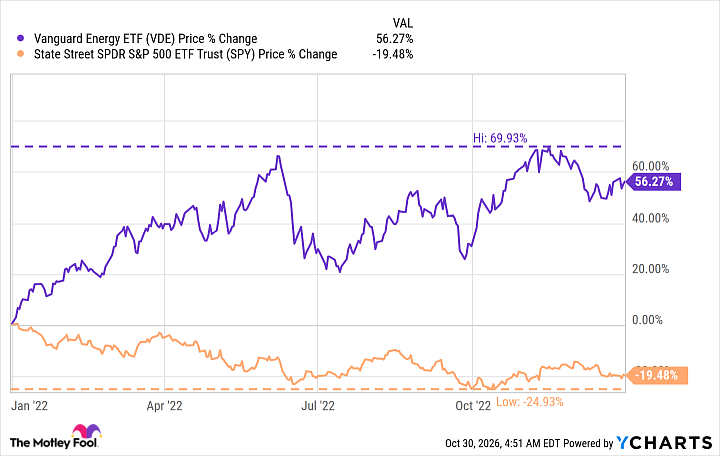
The bigger problem was the lead-up to 2022
The real risk you face in buying into the energy sector today, however, is where it is in the energy cycle. Oil prices are known for being highly volatile, swinging from low to high levels in dramatic, sometimes rapid, fashion. Before the sector’s strong performance in 2022, energy had been mired in a multi-year downturn and was still recovering from that drop. The nadir of that decline came during the coronavirus pandemic, when oil prices fell drastically amid global economic shutdowns.
VDE Vanguard World Fund – Vanguard Energy ETF
$195.46+$3.45 (+1.80%)
NYSEMKT · As of 4:00 PM ET 10/30/26
So, when the 2022 bear market began, the energy sector was still recovering from prior declines. That simply isn’t the case right now, with oil prices at lofty levels thanks to the geopolitical conflict still raging in the Middle East. So the energy sector today is trading at a high point, just like the broader market. That’s not a good place to start if investors sell stocks indiscriminately in a bear market.
Context matters, and this time around could be very different
When you add context to the energy sector’s outperformance during the last bear market, the entire story changes. And when you compare that bear market to the situation today, you may actually decide that you want to avoid the energy sector. The sector’s roughly 25% temporary drop in 2022, despite the strong full-year performance, is a warning sign of what could happen if a bear market drives oil prices lower from their currently elevated levels.
All of that said, energy is an important sector, given that oil is vital to the functioning of the global economy. Most investors should have some exposure. But it probably isn’t a great idea to think of the energy sector as a safe haven if there’s a bear market on the near-term horizon.