The Sacred Journey: How Hajj and the Quran Are Inseparably Linked – The Majestic Quran
There are moments in a believer’s life when faith moves from the heart to the feet, when worship becomes a journey. Hajj is one such moment. Every year, millions of Muslims from every corner of the earth converge on the holy city of Makkah, dressed in white, stripped of all markers of status, answering a call that echoes across fourteen centuries. Yet for all its physical grandeur, Hajj is at its core a Quranic experience. It was shaped by revelation, its rituals breathe Quranic meaning, and its spiritual lessons mirror the deepest themes of the Book of Allah.
A Pilgrimage Born from the Quran
Hajj did not emerge from human tradition or cultural habit. It was ordained by Allah and announced through His Word. The command is direct and unambiguous: “Announce the pilgrimage to people. They will come to you on foot and mounted on all kinds of lean camels, through every deep mountain pass.” (Surah Al-Hajj, 22:27)
This single verse captures something profound: the call to Hajj is Allah’s call, and the response of the believers across history is an answer to that divine summons. Long before the Prophet Muhammad ﷺ, this call was placed on the lips of Prophet Ibrahim (Abraham), peace be upon him, and the Quran traces that lineage with care. Hajj is, in the truest sense, a Quranic institution.
The Story of Ibrahim: The Quran’s Backbone of Hajj
If you want to understand why pilgrims do what they do at Hajj, you must open the Quran. Almost every major ritual of the pilgrimage finds its origin in the story of Ibrahim, his wife Hajar, and his son Isma’il, a story told and retold throughout the Quran with extraordinary depth.
The Sa’i between Safa and Marwa, the hurried walk back and forth between two hills, commemorates Hajar’s desperate search for water for her infant son. The Quran honours this act of motherly faith by enshrining it as a rite: “The hills of Safa and Marwa are Symbols of Allah.” (Surah Al-Baqarah, 2:158)
The stoning of the Jamarat recalls the moment Ibrahim was confronted by Shaytan as he walked to carry out Allah’s command, and he drove him away. The Quran speaks of Ibrahim’s willingness to submit completely, even when the command was unlike anything a father could imagine: “When he was old enough to work with him, one day he told him: ‘My son, I saw in a dream I’m sacrificing you; tell me what you think?” He replied, “Father, do as you were told; you’ll find me patient, Allah willing.” (Surah As-Saffat, 37:102)
The sacrifice of Eid Al-Adha that concludes Hajj is the culmination of that same story, an act of total surrender that the Quran describes not merely as history, but as a trial, a lesson, and a divine ransom: “We saved Ismael in exchange for a slaughtered ram.” (Surah As-Saffat, 37:107)
To perform Hajj is, in a very real sense, to walk through the pages of the Quran.
The Ka’bah: The Quran’s Sacred Centre
The Quran describes the Ka’bah not merely as a building, but as the Bayt Allah, the House of Allah, and as a centre of guidance and security for all of humanity: “The first house founded for people to worship in was that in Bakka, as a blessing and source of guidance for all people.” (Surah Ale-Imran, 3:96)
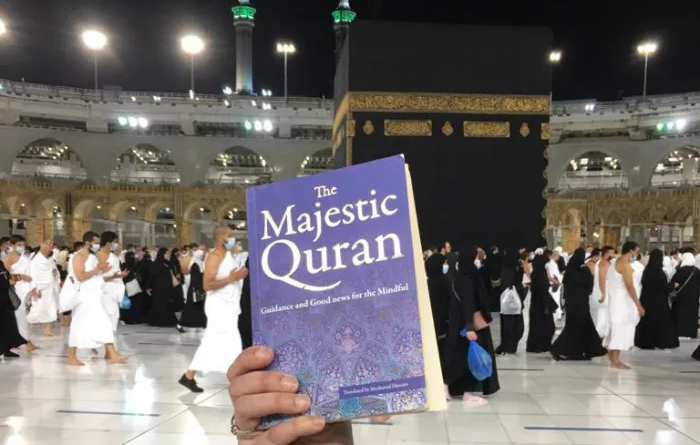
When pilgrims perform Tawaf, the seven circuits around the Ka’bah, they are enacting something the Quran directly commands and blesses. They are orbiting the spiritual centre of the earth, a point the Quran has made sacred. The act of Tawaf is itself a living commentary on this verse: the House is blessed, and those who encircle it are seeking that blessing in the most physical, embodied way possible.
Talbiyah: The Pilgrim’s Quranic Cry
From the moment a pilgrim enters the state of Ihram, the Talbiyah is on their lips: “Labbayk Allahumma Labbayk”, “Here I am, O Allah, here I am.” This phrase is a living echo of the Quranic verse in Surah Al-Hajj, where Allah commands Ibrahim to make the proclamation. Every pilgrim who utters these words is responding, personally, physically, and spiritually, to a divine call preserved in the Quran.
The Day of Arafah: The Quran’s Most Celebrated Moment
Of all the days of Hajj, none carries more weight than the Day of Arafah. Standing on the plains of Arafah, supplicating to Allah from midday until sunset, is considered the very heart of the pilgrimage. The Prophet ﷺ said: “Hajj is Arafah.”
Remarkably, it was on the Day of Arafah that one of the most celebrated verses of the Quran was revealed, “Today, I have completed your religion for you; I gave My favour in full, and I am pleased that Islam is your religion.” (Surah Al-Ma’idah, 5:3)
The Quran was completed, and its completion was announced, on the holiest day of the holiest pilgrimage. The bond between the Book and the journey could not be more intimate.
Shared Themes: What Hajj and the Quran Both Teach
Beyond rituals and historical narrative, Hajj and the Quran share a set of profound spiritual lessons that illuminate one another.
Unity: The Quran repeatedly affirms that the believers are one ummah, one community. Hajj makes this visible. Millions of people, regardless of nationality, language, wealth, or colour, stand side by side in identical white garments. What the Quran declares, Hajj demonstrates.
Tawbah, returning to Allah: The Quran is filled with invitations to turn back to Allah, to seek His forgiveness, to begin again. Hajj is perhaps the most powerful enactment of this. The Prophet ﷺ said that whoever performs Hajj sincerely returns as sinless as the day they were born. The pilgrim’s journey is a Quranic journey of repentance and renewal.
Remembrance: Dhikr, the remembrance of Allah, is not incidental to Hajj; it is its purpose. Every act of the pilgrimage is an act of remembrance, and the Quran is the supreme dhikr.
Submission: The very word Islam means submission, and no ritual expresses it more completely than Hajj. Ibrahim submitted. Hajar submitted. Isma’il submitted. And every pilgrim who performs Hajj is, in their own way, saying what Ibrahim said: “I submit myself to the Lord of the Universe.” (Surah Al-Baqarah, 2:131)
The Quran as the Pilgrim’s Companion
For those who cannot make the journey this year, and for those preparing to make it, the Quran offers a way to participate spiritually. Surah Al-Hajj, Surah Al-Baqarah, Surah Al-Imran, Surah As-Saffat, and Surah Ibrahim are among the chapters most deeply connected to the pilgrimage. Reading them during the days of Hajj, reflecting on the stories of Ibrahim and the commands of Allah, is a way of joining the caravan in spirit, even from afar.
The scholars have long noted that reciting and pondering the Quran during the blessed days of Dhul Hijjah, the ten days before and during Hajj, is among the most rewarding acts of worship a believer can perform.
Conclusion
Hajj is not simply a trip. It is a walk through the Quran, through its stories, its commands, its lessons, and its promise of divine mercy. Every stone placed, every valley crossed, every supplication offered on the plains of Arafah is a verse brought to life. For the Muslim, the Quran and Hajj are two expressions of the same truth: that we were created to know Allah, to submit to Him, and to return to Him. The book points the way. The pilgrimage is the walk.
Labbayk Allahumma Labbayk.