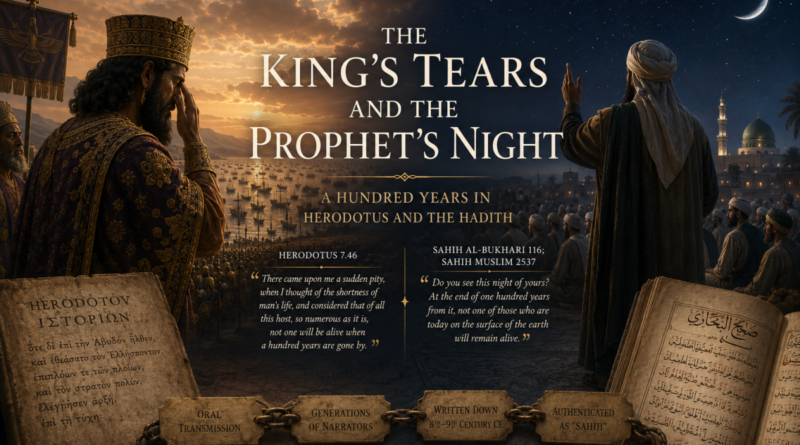
A Hundred Years in Herodotus and the Hadith
In the spring of 480 BC, Xerxes stood at Abydos and looked out over the Hellespont. The strait was covered with his ships; the shore and every plain around the city were dark with men. Herodotus tells us the Persian king congratulated himself on his good fortune—and then, a moment later, he wept.
His uncle Artabanus asked the obvious question: how could a man weep at the height of his triumph? Xerxes answered:
“There came upon me a sudden pity, when I thought of the shortness of man’s life, and considered that of all this host, so numerous as it is, not one will be alive when a hundred years are gone by.”
Herodotus recorded this scene in his Histories (7.46), written around 440 BC. It became one of the most famous passages in Greek literature—copied, quoted, and moralized upon for centuries across the Mediterranean world.
Now consider a hadith found in the two most authoritative Sunni collections. Narrated by Abdullah ibn Umar, it reports that the Prophet led the night prayer toward the end of his life and then said:
Sa`id bin Ufayr told us, he said: Al-Layth told me, he said: Abd al-Rahman bin Khalid told me, on the authority of Ibn Shihab, on the authority of Salim, and my father, Bakr bin Suleiman bin Abi Hathamah said that Abdullah bin Omar said, “The Prophet, may God bless him and grant him peace, led the evening prayer with us at the end of his life.” “This is your night, for at the beginning of a hundred years, not a single person on the surface of the earth will remain.”
Narrated Abdullah binUmar: Once the Prophet (ﷺ) led us in the `Isha’ prayer during the last days of his life and after finishing it (the prayer) (with Taslim) he said: “Do you realize (the importance of) this night?” Nobody present on the surface of the earth tonight will be living after the completion of one hundred years from this night.”
Sahih al-Bukhari 116
https://sunnah.com/bukhari:116
The structure is identical. A leader surveys the living—an army in one case, a generation in the other—and pronounces that in one hundred years, not one of them will remain. The same rhetorical frame, the same round number, the same melancholy sweep of the eye across a crowd of the doomed. Xerxes said it a thousand years before the hadith collectors wrote it down.
The Gap Where Sayings Grow
This parallel matters because of when the hadith corpus took shape. Bukhari died in 870 CE, Muslim in 875—roughly two and a half centuries after the Prophet’s death. The sayings they compiled had passed through generations of oral transmission before being fixed in writing, and they were fixed precisely during the Abbasid era, when the great translation movement was pouring Greek learning into Arabic. Baghdad’s scholars were rendering Aristotle, Galen, Ptolemy, and the moral literature of late antiquity into the language of the empire. Greek wisdom sayings, anecdotes of kings, and philosophical commonplaces circulated freely in adab literature and court culture.
In that environment, a famous line about the brevity of life—one of the most quoted passages in the Greek historical tradition—did not need to travel far to find a new speaker. Sayings are the most portable of all literary forms. They detach from their original context, circulate anonymously, and reattach themselves to whatever authoritative figure a community reveres. The Greeks attributed floating maxims to Solon or Socrates; the Muslims of the second and third Islamic centuries attributed them to the Prophet. This was not necessarily conscious forgery. It is simply how oral cultures work: a beautiful truth gravitates toward the most beautiful mouth available.
What the Isnad Cannot See
The deeper lesson concerns the machinery of hadith authentication itself. This hadith is not marginal—it is sahihcertified by both Bukhari and Muslim, the gold standard of the science. The chain of narrators was examined and found sound. Every transmitter was judged trustworthy, every link continuous.
And yet here is the same statement, in a Greek text composed a millennium earlier, placed in the mouth of a Persian king.
This exposes the structural blindness of isnad criticism: it evaluates the chainnever the content. A saying that entered circulation early enough—within the first century or so after the Prophet—could acquire a perfectly respectable chain, because the chain only had to be plausible from the point of insertion forward. The methodology could catch late fabrications with clumsy pedigrees; it could not catch a well-traveled piece of ancient wisdom that had been absorbed into the community’s memory of its founder. The tools measured transmission, not origin.
The hadith even created theological complications of its own. Taken literally, it implied that no one alive at the Prophet’s final years—and by extension figures some traditions held to be immortal or long-lived—could survive past a fixed date. Commentators labored over it for centuries. The labor would have been unnecessary had they recognized what the passage most plausibly was: a piece of universal human reflection on mortality, older than Islam, older than Christianity, at least as old as a king weeping over his army at the Hellespont.
The Quranic Contrast
While the sentiment of the observation is moving—which is precisely why it most likely survived and migrated. And even though the Quran expresses the same reality in its own voice: “Every soul shall taste death” (3:185); “Everyone on earth perishes. Only the presence of your Lord lasts. Possessor of Majesty and Honor” (55:26-27). There is a difference between a scripture that states a truth and a corpus that retroactively places truths—wherever they were found—into the mouth of one man.
The Quran claims divine authorship and stands or falls on its own textual integrity. The hadith corpus claims to be the recorded speech of the Prophet, and its credibility rests on the reliability of human memory across generations. When we find the Prophet’s most authenticated sayings anticipated verbatim by Herodotus, we are not learning something scandalous about the Prophet. We are learning something sobering about the corpus—that it is a reservoir of the ancient world’s accumulated wisdom, piety, and folklore, poured into a single attribution.
Xerxes wept at Abydos because not one of his host would be alive in a hundred years. He was right. And in a sense he was more right than he knew: not only the men, but the words themselves would outlive their speaker, wandering for a thousand years until they found a new king, a new night, and a new chain of narrators willing to swear they heard them firsthand.
Additional Resources: