The Paradox of Eternity: What Infinity Reveals About the Hereafter
Consider the following thought experiment.
If you suffer one minute out of every hour for eternity, how much do you suffer in total? The answer is: infinitely. But how much do you not suffer? Also infinitely. Two infinities coexist—infinite suffering and infinite relief—which means neither is ultimately dominant. The punishment is no more ultimate than the comfort.
If we apply this paradox to the idea of Heaven and Hell, it indicates that one can have an eternity of punishment and relief simultaneously. Such that any relief or punishment at all—however brief, however small a fraction of each hour—repeated across infinite time, produces both infinite relief and infinite punishment. The torment and the comfort become mathematically equivalent.
The thought experiment creates the paradox by treating eternity as time that never stops. And that may be precisely where it goes wrong. We are trying to apply a clock to a dimension where clocks don’t run.
Eternity Is Allegorical
The Quran is explicit that its depictions of the Hereafter are not literal blueprints of what awaits us. They are the closest human language can come to conveying something for which human language is fundamentally inadequate.
[2:25] Give good news to those who believe and lead a righteous life that they will have gardens with flowing streams. When provided with a provision of fruits therein, they will say, “This is what was provided for us previously.” Thus, they are given allegorical descriptions.
[2:26] GOD does not shy away from citing any kind of allegory, from the tiny mosquito and greater.
We are creatures of time, of bodies, of cause and effect. Every concept we possess was formed inside those constraints. When the Quran speaks of rivers in Heaven or fire in Hell, it is not describing the furniture of another world in literal terms. It is using the most vivid images available to creatures like us to point toward a reality we cannot directly access.
This allegorical frame extends to the concept of eternity itself. When we hear the word “eternal,” we instinctively model it as a very long time—time extended indefinitely into the future. We do arithmetic on it, as in the thought experiment above. But that is not what eternity is. Eternity is not extended time. It is a mode of existence from which time, as we experience it, has been removed entirely. Our concept of “forever” is itself an allegory—the best approximation our time-bound minds can produce for something that lies beyond their reach.
This is not to say the Hereafter is less real than described. The allegorical frame does not soften the reality—it points to something that exceeds what description can capture. The rivers and the fire are not exaggerations of something mild. They are approximations of something that surpasses them.
What it does mean is that the one-minute-per-hour paradox dissolves the moment we take this seriously. That thought experiment assumes time—minutes, hours, intervals of suffering and relief. Strip time away, and the paradox has nothing to stand on. The construct that generated the contradiction was never native to the Hereafter in the first place.
The Quran gives us a remarkable window into what lies on the other side of this boundary—not through description, but through Iblees. When Satan tempted Adam in the garden, he did not promise him pleasure or power. He promised him a different kind of existence:
[7:20] The devil whispered to them, in order to reveal their bodies, which were invisible to them. He said, “Your Lord did not forbid you from this tree, except to prevent you from becoming angels, and from attaining eternal existence.”
Angels are not creatures of time, the way human beings are. They are not subject to mortality, to the erosion of the body, to the scarcity and finitude that structure human experience. Iblees understood this distinction and weaponized it. He offered Adam an exit from the temporal condition.
This tells us something significant: eternal existence and temporal existence are genuinely different modes of being, not simply different quantities of the same thing. The Hereafter is not this world with the clock running longer. It is a fundamentally different state.
Yawm al-Deen: The Day the Debt Comes Due
If eternity lies beyond our comprehension, what can we say with confidence about the Hereafter? The Quran gives us a framework that does not depend on grasping infinity—it depends on understanding debt.
The Arabic word deen (د-ي-ن) is one of the most semantically layered roots in the Quran. It means religion, recompense, judgment, and debt. Yawm al-Deen, as stated in the Fatiha, is not merely the Day of Judgment in a juridical sense. It is the Day of Debt Settlement. The day the accounts are finally closed.
This framing is not incidental. It is structural to how the Quran understands the purpose of this life.
The dunya—this world—functions as a repayment window. Time itself, the very dimension that makes the eternity paradox possible, is the mechanism by which debt can be worked off. Every return to God, every act of righteousness, every sincere effort at moral reform is a payment against what is owed. Religion (deen) is the system through which that repayment occurs. And Yawm al-Deen is when the window closes.
The Quran is equally clear that Hell is not a temporary station. This is not a peripheral point—it is one that the Quran addresses directly, as if anticipating the human desire to soften it.
[2:80] Some have said, “Hell will not touch us, except for a limited number of days.” Say, “Have you taken such a pledge from GOD—GOD never breaks His pledge—or, are you saying about GOD what you do not know?”
The Quran frames this wishful thinking not as mercy but as presumption—as claiming knowledge about God that one does not possess. The verses are unambiguous: those in Hell will receive no relief, no intercession, no respite (4:56, 43:74–75, 78:21–24, 35:36, 22:22). The punishment is unbroken.
Why does this matter? Because it tells us something critical about the nature of the debt. Whatever remains unpaid prior to the Day of Judgment does not disappear. It carries forward—into an existence no longer structured around the possibility of repayment. The debt persists because the debtor persists, and there is no longer a mechanism for settlement.
This is not a punitive imposition from outside. It is the logical consequence of arriving at the closing of the books still carrying an open balance.
The Weight We Carry
The takeaway from this is that sin is something the human being must carry for all of eternity if it is not paid off in this life.
The Quran tells us that in the Hereafter, our vision will be sharp as steel (50:22)—everything concealed will be made fully visible, nothing hidden. In this world, we have what might be called the mercy of forgetting. When something terrible happens—a moment of deep shame, a failure we cannot undo, a wrong we never corrected—time eventually blunts the pain. The memory loses its immediacy. We find a way to live around it. This mercy is built into our existence as temporal creatures. It is, in its way, one of God’s gifts to beings who would otherwise be crushed by the accumulated weight of their own histories.
The Hereafter removes this mercy entirely.
Imagine that the moment of your greatest shame—the clearest instant in which you understood what you had done and what it cost—never diminished. Not in a thousand years. Not in a million. The regret does not numb. The clarity does not fade. You cannot escape into forgetting because forgetting was a feature of time, and time is no longer your dimension. The debt you did not pay sits before you, fully illuminated, permanently fresh, with no mechanism remaining by which it could ever be reduced.
We do not need to imagine a hypothetical person for this. The Quran gives us a concrete example we already know.
When Adam and his wife ate from the forbidden tree, their immediate experience was shame. The moment they defied God’s command, they felt its weight—the acute awareness of having crossed a line that could not be uncrossed. That shame was real and immediate. But what followed is the part we often pass over too quickly: God gave them a path back. They were given the opportunity to repent, to acknowledge the wrong, to begin working off what they had accumulated. The debt was not cancelled, but it was made repayable. They were placed into the very condition—time, mortality, scarcity, the dunya—that makes repayment possible.
Now consider what their existence would have looked like had that opportunity never come. Imagine Adam and his wife carrying that moment of defiance—that precise instant of shame and clarity—not as a memory that fades with time, but as a permanent and undiminishing feature of their existence. Not something that happened to them once, but something woven into what they are, fully visible, never blunted, with no mechanism remaining by which it could ever be addressed or resolved.
That is what it means to carry sin into eternity. Not a series of punishments imposed from outside, but the unrelenting presence of one’s own fully visible failure—a weight that in this world could have been set down, and now cannot be.
The School We Refused
The Arabic word kafir (ك-ف-ر) carries two meanings that are really one: disbeliever, and one who is unappreciative. In the Quran’s framing, these are not separate conditions. Ingratitude and disbelief share the same root—to cover over, to conceal a blessing that is plainly there.
Consider how God has structured this world. Despite possessing infinite abundance, He created a world where people can taste scarcity—where resources must be earned, where health is fragile, where comfort is not guaranteed. Scarcity is a mechanism for learning appreciation. We learn the value of health when we fall ill. We learn the value of safety when we are afraid. Deprivation is not arbitrary—it is curriculum.
But consider what happens when someone is given everything and still refuses the lesson. Imagine a person with every material comfort—the finest food, the most luxurious surroundings, every vanity this world has to offer—yet remains unappreciative. That person will be dissatisfied, resentful, and ultimately miserable. Despite having everything, they suffer. Not because their circumstances are bad, but because they fail to see the value in what they have.
If one dies in this state, they will arrive on the Day of Recompense—constitutionally ungrateful, unable to appreciate any blessings, and thus permanently miserable, having lost the opportunity to fix this defect.
A New State of Being
Everything discussed so far points toward a truth the Quran affirms but that is difficult to fully absorb: the Hereafter is not a continuation of this life under different conditions. It is a new state of being entirely. We will no longer be temporal creatures navigating a world of scarcity and opportunity. We will be something else—something we do not yet have the faculty to fully imagine, just as a person who has never seen color cannot be told what blue looks like.
What this means is that what we bring into that state becomes, in a real sense, what we are. In this life, there is a distinction between the self and its choices—we can regret a decision, walk it back, make amends, change course. The self is always somewhat separate from its history because time keeps moving and the future remains open. But when time is removed, that separation collapses. The choices do not trail behind us as a record. They constitute us.
There is an old story that captures this with unusual precision.
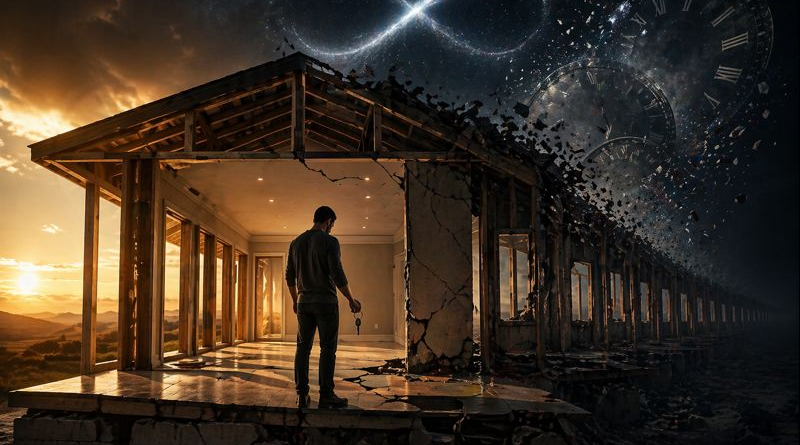
A wealthy man once commissioned a builder to construct a house. It was to be a fine home—spared no expense, built with care, meant to stand for generations. The builder accepted with enthusiasm. It was an opportunity to showcase his craft and secure his reputation.
But as the work began, a thought crept in. No one would inspect every beam. No one would test every joint. If he chose slightly cheaper materials here, cut a corner there, skipped a layer no one would ever see—who would know? The savings would be his. The difference, he told himself, would be negligible.
So he began to compromise. He used wood that wasn’t quite right. He rushed the foundation. He concealed flaws behind polished surfaces. To any observer, the house looked impressive—clean lines, smooth walls, a convincing finish. But beneath it all, it was weak.
When the house was complete, he presented it to the wealthy man, expecting payment. The man walked through it slowly, saying little. When he returned, he smiled, reached into his pocket, and handed the builder a set of keys.
“This house,” he said, “is yours. I built it for you, in return for your work. You will live in it for the rest of your life.”
The builder stood frozen.
In that moment, every hidden flaw became real to him. Every shortcut, every compromise—he would live with them all. There would be no fixing it now. No rebuilding. No escape from what he himself had made.
This is the logic of the Hereafter. This life is the construction. Every choice, every compromise, every concealed flaw, and every act of genuine integrity—we are building something, whether we think of it that way or not. This world is the period in which we still have the tools in our hands, in which the wood can still be changed, in which what is weak can still be reinforced. The Day of Judgment is when the keys are handed over. And the Hereafter is where we live, permanently, as what we built.
The person who arrives having paid their debts, having done the work of genuine moral construction, inherits something that can bear the weight of eternity. The person who arrives having cut every corner, having concealed every flaw behind a polished surface, inherits that too—fully, permanently, with no tools left and no time remaining to begin again.
Conclusion: The Paradox Was the Lesson
We began with a paradox: infinite suffering and infinite relief coexisting, rendering eternal punishment incoherent. But the paradox was never an argument against the Hereafter. It was an insight into the limits of our instruments.
We cannot understand eternity because we are built for time. We cannot fully comprehend the depictions of Heaven and Hell because we are built for bodies and matter. The Quran acknowledges this openly—these are allegorical descriptions, the best approximations available to creatures like us. Even the word “eternal,” as we use it, is an allegory for something our minds cannot directly hold. The paradox exposes this. Minutes and hours and intervals of relief—these are the grammar of a world that will no longer exist in the Hereafter.
What we can understand is debt. What we can understand is the difference between a window that is open and a window that has closed. What we can understand—viscerally, if we let ourselves—is what it would mean to carry the full weight of our unresolved failures into an existence where the mercy of forgetting has been permanently withdrawn, where our vision is sharp as steel, and where the self and its choices are no longer separable.
The builder standing frozen in that doorway, keys in hand, finally understanding what he has made—that moment of total clarity with no recourse remaining gives us a taste of what it will be like on the Day of Judgment. This is absolutely terrifying if we fully comprehend its implications: the self, fully seen, carrying whatever it had become—for eternity, as part of its being.
Related Articles