The Offer Lot Already Knew Would Be Refused
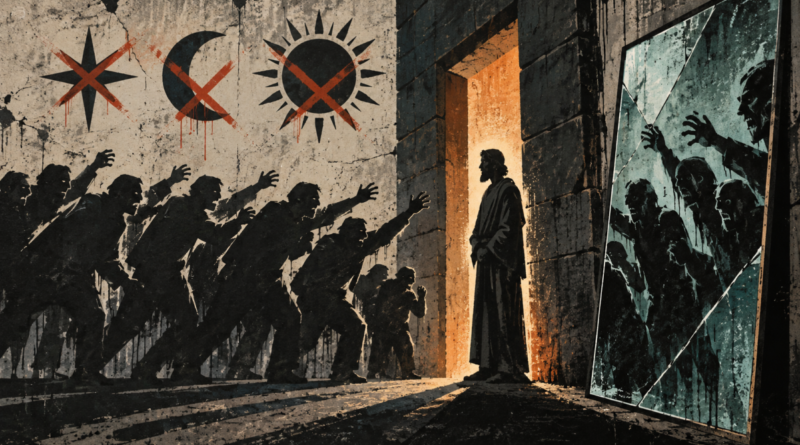
When Lot stands at his door and offers his daughters to the crowd pressing toward his guests, most readers wince. Taken at face value, it reads as a father bartering his children to a mob. But the Quran does not leave the episode at face value. Read alongside the way scripture elsewhere shows the wise and the prophetic drawing truth into the open—the offer reveals itself as something other than a transaction. It is a demonstration.
Their own answer gives it away
The decisive detail is not what Lot says but how his people answer.
His people came rushing towards him; they had been indulging in sins. He said, “O my people, it would be purer for you, if you take my daughters instead. You shall reverence GOD; do not embarrass me with my guests. Have you not one reasonable man among you?” They said, “You know well that we have no need for your daughters; you know exactly what we want.” (11:78-79)
“You know well.” The crowd does not accuse Lot of misreading them. They confirm that he understood them perfectly. The Arabic sharpens this: وَإِنَّكَ لَتَعْلَمُ مَا نُرِيدُ—”and you surely know what we want,” where the emphatic لَـ on ta’lam presses the point that Lot’s knowledge was never in doubt. He knew his daughters held no interest for them. He made the offer anyway.
Why offer what you know will be refused? For the same reason a teacher poses a question whose answer he already holds—to make the room say the truth out loud. Lot’s offer did not tempt his people; it exposed them. It drew from their own mouths the admission that nothing—not the lawful, not the natural, not a father’s plea before his guests—could turn them from what they wanted. The offer was a mirror, and they described their own reflection.
Abraham did the same with the sky
The Quran gives us a clear template for a prophet who voices what he does not believe in order to lead his audience to a conclusion. Before Abraham ever looks up at the heavens, we are told that God “showed Abraham the marvels of the heavens and the earth, and blessed him with certainty” (6:75). He already has certainty. What follows, then, is not a search. It is staged for the benefit of a people who worshipped the celestial bodies.
When the night fell, he saw a shining planet. “Maybe this is my Lord,” he said. When it disappeared, he said, “I do not like (gods) that disappear.” When he saw the moon rising, he said, “Maybe this is my Lord!” When it disappeared, he said, “Unless my Lord guides me, I will be with the strayers.” When he saw the sun rising, he said, “This must be my Lord. This is the biggest.” But when it set, he said, “O my people, I denounce your idolatry.” (6:76-78)
The final line unmasks the whole sequence. “O my people, I denounce your idolatry.” Abraham was never a candidate for star-worship; he was walking his people, object by object, through the failure of each thing they revered—until the setting sun delivered the verdict he had intended from the start. “Maybe this is my Lord?” was rhetorical. He knew the answer. He wanted them to arrive at it.
Solomon did it with a sword
The Bible preserves the same move in its most concentrated form. Two women come to Solomon, each claiming a living child as her own, with no witness to settle which of them is lying. So the king calls for a sword:
And the king said, Divide the living child in two, and give half to the one, and half to the other. (1 Kings 3:25)
Solomon had no intention of harming the child. The command was a probe. The true mother recoils at once—she would sooner surrender her son than watch him die—while the false claimant is content to let the sword fall. In a single stroke the truth stands exposed, drawn out not by interrogation but by a proposal the judge never meant to carry out. The sword was never for the baby. It was for the lie.
The same method, the graver subject
Set the three episodes side by side and the pattern is unmistakable. A figure who already knows the truth stages an apparent concession or an unthinkable proposal—Abraham entertains the gods of his people; Solomon raises the sword over the child; Lot extends what should be an acceptable alternative—precisely so that the falsehood, the lie, or the corruption will declare itself.
The difference is the stakes. Solomon’s sword exposed a single lie between two women; Abraham and Lot turned the same instrument on whole nations. Abraham’s demonstration measured how far his people’s reason had strayed. Lot’s measured how far their appetite had—and what it exposed was the more damning of the two. Here was a people so consumed that they would not so much as pause at the offer, who answered a father at his own threshold by telling him, in effect, that he already knew nothing would move them. That was the point. Their refusal was the proof.
None of the three was naive. Each put forward a thing he did not mean—an offer, a question, a sentence—so that those before him would confess a thing they did. The concession, the question, and the sword were never real. The corruption, the idolatry, and the lie they laid bare were.