The Moral Philosophy of the Quran
Most treatments of Quranic ethics begin and end with a catalog: a list of things enjoined and things forbidden, prayer and charity on one side, theft and slander on the other. This is jurisprudence, not moral philosophy. It answers what but never why, and it mistakes the surface for the structure. A command is only the visible edge of a moral vision, the way a coastline is the visible edge of a continent. The interesting question is not what the Quran commands or forbids, but what understanding of reality, freedom, and the good makes those commands the natural expression of a coherent moral vision rather than arbitrary decrees.
Read at this depth, the Quran turns out to carry a remarkably coherent moral philosophy. One that can be stated in the vocabulary of the philosophical tradition without being distorted by it. It is a form of theistic moral realism grounded in the divine nature rather than divine whim. Its epistemology is a natural-law epistemology in which moral knowledge is accessible through innate disposition and reason, with revelation functioning as a reminder rather than as the sole source of moral truth. Its psychology is a virtue psychology centered on the cultivation and purification of the soul. And its telos is not merely the avoidance of punishment but an orientation toward the Real. What follows is an attempt to excavate the moral philosophy of the Quran.
The Ground of Value: Al-Haqq and the Dissolution of Euthyphro
Any moral philosophy that grounds obligation in God must eventually face the question Plato pressed in the Euthyphro: is an act good because God commands it, or does God command it because it is good? Both horns look fatal. If the good is whatever God happens to will, then morality is arbitrary. God could have commanded cruelty and cruelty would then be righteous. But if God commands things because they are already good, then goodness is a standard independent of and prior to God, and the divine has been quietly demoted to a messenger reporting on a moral order it did not author.
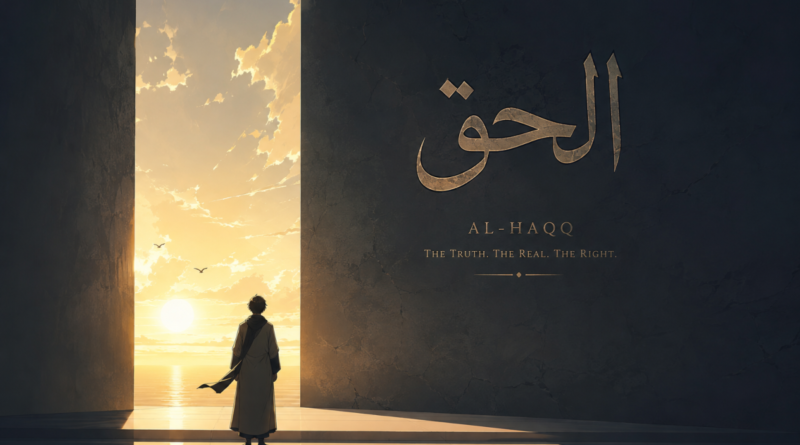
The Quran’s resolution runs between the horns, and it runs there by way of a single word: al-Haqq. The term is usually translated “the Truth” or “the Real,” and it is among the names the Quran gives to God directly—”That is because God is al-Haqq (the Truth)” (22:6, 31:30). This implies not only that God is Truth, but God is the Real, the true reality. But haqq also means the right, the due, the just, that which is owed. In the Quranic usage, these are not separate meanings loosely sharing a root; they are one meaning seen from different angles. To be real, to be true, and to be right are aspects of a single thing. The moral order is not a set of rules laid over a morally neutral universe. It is a feature of the way things actually are.
This matters because it locates the good neither in bare divine will nor in a standard external to God, but in the divine nature itself. God does not consult an independent good; God is al-Haqq, and the commands flow from what God is. And that nature is not merely real but absolute: “GOD, the Absolute” (al-Ikhlas, 112:2), the one on whom everything depends while itself depending on nothing, underived where all else is derived. Everything other than God is relative to something else, contingent, liable to change; God alone is constant and self-subsisting. This is the metaphysical ground beneath the moral point. An order anchored in something merely stable would still be hostage to whatever that thing depended on, but an order grounded in the Absolute cannot shift, because the ground admits no dependency through which change could enter. Al-Haqq and al-Samad are one claim seen from two sides—the Real is the Unchanging—which is why moral facts anchored in this nature are fixed rather than provisional.
The Quran is emphatic that the created order is itself built “by the truth” (bi’l-haqq), a phrase that recurs dozens of times:
[39:5] He created the heavens and the earth truthfully (bi’l-haqq). He rolls the night over the day, and rolls the day over the night. He committed the sun and the moon, each running for a finite period. Absolutely, He is the Almighty, the Forgiving.
Creation is not morally inert. Its very fabric is haqq, and injustice is therefore not merely disobedience but a kind of falsehood, a contradiction of reality. This is why the Quran so consistently pairs its ethical vocabulary with its ontological vocabulary, why transgression is spoken of as a violation of a limit that was really there, not a limit merely posited.
The Euthyphro dilemma dissolves because it assumed that will and nature could be separated, that a command must issue either from arbitrary choice or from deference to an outside standard. If goodness is what God is rather than what God arbitrarily decrees or passively observes, then the commanded good is neither arbitrary nor independent. It is the practical expression of God, the Truth, the Real. This is a moral realism—there are moral facts, they are not up to us, and they are not up to divine whim either—but a theistic one, in which the moral facts and the ground of being are not two things.
[74:56] They cannot take heed against GOD’s will. He is the source of righteousness; He is the source of forgiveness.
The Trilateral Epistemology: Fitra, Reason, Reminder
If the good is grounded in the nature of the Real, a further question follows immediately: how do human beings come to know it? A purely command-based ethics has a simple answer—we know the good because we are told it, and without being told we would know nothing. The Quran gives a far more interesting answer, and it is here that its natural-law character becomes unmistakable. Moral knowledge, on the Quranic account, comes from the convergence of three sources: innate disposition, reason, and revelation. Crucially, revelation is the last of the three and is described not as the origination of moral knowledge but as its reminder.
The first source is the fitra, the original constitution upon which human beings are made.
[30:30] Therefore, you shall devote yourself to the religion of strict monotheism. Such is the natural instinct (fitra) placed into the people by GOD. Such creation of GOD will never change. This is the perfect religion, but most people do not know.
The fitra is a moral endowment written into human nature at creation, an orientation toward the true and the good that precedes any instruction. Even more directly, the oath-passage of Sura 91 declares that God provided innate knowledge to the human soul when He “showed it what is evil and what is good” (91:8). The capacity to distinguish moral failure from moral fidelity is inspired into the self as such, part of the equipment of being human. Conscience, in this framing, is not a cultural artifact but a created faculty.
The second source is reason. The Quran’s appeal to the intellect is relentless and structural, not decorative. “Do you not reason?” (a-fa-la ta’qilun), “do you not reflect?” (a-fa-la tatafakkarun), “for a people who understand.” These refrains punctuate the text hundreds of times. Moral and theological claims are routinely offered as conclusions to be reasoned toward, from evidence in the natural order and from the internal coherence of the claims themselves. The Quran does not typically say “believe because we say so”; it argues, it points to signs, it invites inference. This presupposes that human reason is competent to track moral and metaphysical truth, which is precisely the presupposition of natural law.
The dignity the Quran accords to reason carries a sharp negative corollary: the refusal of inherited, unexamined belief. The text returns repeatedly to a single damning excuse offered by the morally complacent—”We found our parents following certain practices, and we will continue in their footsteps.” (43:23), “What we found our parents doing is sufficient for us.” (5:104), “We follow only what we found our parents doing” (2:170). Each time it treats this appeal to ancestral custom as no justification at all, asking whether they would follow even “if their parents did not understand, and were not guided” (2:170). This is not a minor theme. It is a moral-epistemological duty: belief received passively from tradition, held because it was handed down rather than because it was examined, is not counted as belief with any moral worth.
[17:36] You shall not accept any information, unless you verify it for yourself. I have given you the hearing, the eyesight, and the brain, and you are responsible for using them.
The corresponding freedom is stated at its starkest in 18:29:
[18:29] Proclaim: “This is the truth from your Lord,” then whoever wills let him believe, and whoever wills let him disbelieve…
The moral life requires that a person stand before the truth as an individual and judge, rather than borrow a verdict from the crowd or the past. Conscience and reason are not merely permitted to operate; their operation is obligatory, and the outsourcing of moral judgment to inherited authority is itself a failure.
The third source is revelation—but note how the Quran describes its own function. It calls itself dhikr, a reminder (as in 15:9, 38:87, and throughout). A reminder is not new information; it is the recall of something already, in some sense, known. Revelation on this model does not install a moral sense in a creature that lacked one. It reactivates and clarifies a moral knowledge that the fitra already carries, and that reason can already partly reach, a knowledge that neglect, self-interest, and social corruption have overlaid and dimmed. This is why the Quran can hold people morally accountable across time and place, and why it treats the wrongdoer not as ignorant of an unknowable rule but as one who “knew” and “covered over” the knowledge.
That last phrase is not incidental, and it opens onto one of the Quran’s deepest moral ideas. The word for disbelief, kufr, is built on a root meaning to cover, to bury, to conceal—the same root used for the farmer (kaffar) who buries seed under soil. Disbelief in the Quranic sense is not primarily an intellectual error about a proposition. It is the active covering-over of a truth one has already, at some level, apprehended: ingratitude toward a gift one has actually received, denial of a reality one has actually met. This is why kufr and unappreciation are the same word. The moral failure at the root of the Quran’s anthropology is not ignorance but suppression—the will refusing what the fitra and reason present to it.
The Divided Self: The Nafs and Its States
A moral philosophy needs an account of the moral agent, of what it is in a human being that succeeds or fails. The Quran’s account is a psychology of the nafs, the self or soul, and it is a psychology of internal division and possible integration rather than of a simple faculty.
The Quran names different states of the nafs, and later reflection rightly read them as a developmental sequence. The lowest is al-nafs al-ammara bi’l-su’, “the self is an advocate of vice” (12:53)—the self driven by appetite and impulse, taking its own desires as the measure of value. Above it is al-nafs al-lawwama, “the blaming soul” (75:2)—the self that has developed a conscience, that catches itself, that experiences the friction of falling short. This is the self at war with itself, and the Quran swears an oath by it, dignifying the very capacity for self-reproach as a moral achievement. Highest is al-nafs al-mutma’inna, “the content soul” (89:27)—the integrated self in which desire and conscience no longer war because the will has been reordered, the self that is addressed at death with “return to your Lord, well-pleased and pleasing.”
This is a virtue psychology in the fullest sense. Moral life is not merely a series of right choices but a project of becoming, of the reshaping of the self over time until acting well is no longer a victory over a divided nature but the expression of an integrated one. The Quran gives this project a name: tazkiyat al-nafs, the purification of the self. Sura 91, immediately after locating both wickedness and righteousness within the self, states the stakes with unusual bluntness:
[91:9-10] Successful is one who redeems it (purifies it). Failing is one who neglects it (corrupts it).
The verb for failure there, dassaha, in addition to corrupting also carries the sense of covering over and stunting—the same burial-and-concealment metaphor that runs through kufr. Moral failure is the self smothering its own best capacities.
Presiding over this psychology is the master concept of taqwa. The word is difficult to fully translate with a single word—rendered variously as righteous, God-consciousness, piety, mindfulness, reverent awareness—and its root sense is protective vigilance, a guarding of the self. Taqwa is the disposition of one who lives in continuous awareness of the moral weight of action, who guards against the self that commands to evil, who acts as though the Real is really present because it is. It is not a single virtue among others but the orientation from which the virtues grow, the moral seriousness that keeps the whole enterprise awake. And notably, the Quran makes taqwa the sole criterion of human worth: “The best among you in the sight of GOD is the one with the most Taqwa” (49:13). Not the most powerful, not the highest-born, not the most learned—the most morally awake, righteous.
Freedom and the Weight of Responsibility
Moral realism plus moral knowledge would amount to nothing without moral freedom. A creature that could not do otherwise could be neither praised nor blamed, and the entire apparatus of accountability would collapse into theater. The Quran’s treatment of freedom is layered, and it holds together commitments that a flatter theology would have to choose between.
The keystone image is the amana, the trust, in one of the Quran’s most arresting verses:
[33:72] We have offered the responsibility (freedom of choice) to the heavens and the earth, and the mountains, but they refused to bear it, and were afraid of it. But the human being accepted it; he was transgressing, ignorant.
This trust, responsibility, constituted by the freedom of choice, implies accountability for one’s actions, of which they must be free to choose. This freedom was a weight the rest of creation refused, and the human being alone took it up. The line “he was transgressing and ignorant” is not simple condemnation; it names the terrible openness of a creature who can be unjust, who can fail, precisely because nothing compels its choices. The dignity and the danger are the same fact. To be the kind of being who can bear the trust is to be the kind of being who can betray it.
The genuine difficulty in the Quran’s treatment of freedom lies in its language of guidance and misguidance, its statements that God “guides whom He wills and lets go astray whom He wills.” Read in isolation, these can suggest a determinism that would swallow the whole edifice of responsibility. But the text supplies its own correction: the going-astray is consistently presented as a response to a prior human turning-away. “When they deviated, GOD diverted their hearts” (61:5); the sealing of hearts follows upon rejection; it does not precede and cause it; it is the result of the cause. In other words, God created the system, and therefore all actions are in accordance with God’s will, as nothing comes into being aside from God’s will.
[19:75] Say, “Those who choose to go astray, the Most Gracious will lead them on, until they see what is promised for them—either the retribution or the Hour. That is when they find out who really is worse off, and weaker in power.”
[19:76] GOD augments the guidance of those who choose to be guided. For the good deeds are eternally rewarded by your Lord, and bring far better returns.
The grammar of both verses is the grammar of ratification. Those who choose to go astray are led further on; those who choose to be guided have their guidance augmented. In each case the divine response follows and amplifies a human choice already made—a hardening of the heart the heart itself has courted, or a widening of the road the traveler has already turned onto—rather than an arbitrary predestining of the unwilling. The freedom that bore the trust is real, and the moral drama depends on its being real.
A cluster of firm commitments follows from this inner freedom—the freedom to believe, to be obligated, and to be judged. There is no coercion in the moral and religious core: “There shall be no compulsion in religion: the right way is now distinct from the wrong way” (2:256). The image is one of clarity—the right course has been made visible, and the human being is left genuinely free to take it or refuse it. Obligation is bounded by capacity: “God does not burden a self beyond its means” (2:286), a principle that makes the moral law responsive to the real limits of real agents and rules out the demand for the impossible. And responsibility is strictly individual and non-transferable: “none bears the burden of another” (6:164, 17:15, 35:18)—a repeated formula that severs moral desert from inheritance, lineage, and collective guilt.
The Limit on Force: The Non-Aggression Principle
The freedom of conscience just described is not only an inner endowment; it has an outer condition. A being free to believe or disbelieve can still be coerced—attacked, driven from its home, prevented by force from worshipping as it judges right. The Quran’s ethics of force is, at bottom, the defense of that outer condition, and it is governed by exactly the concept that governs the rest of its moral vision: the limit, the boundary that must not be transgressed. The passage that states this most fully is in Sura 2:
[2:190] You may fight in the cause of GOD against those who attack you, but do not aggress. GOD does not love the aggressors.
[2:191] You may kill those who wage war against you, and you may evict them whence they evicted you. Oppression is worse than murder. Do not fight them at the Sacred Mosque (Masjid), unless they attack you therein. If they attack you, you may kill them. This is the just retribution for those disbelievers.
[2:192] If they refrain, then GOD is Forgiver, Most Merciful.
[2:193] You may also fight them to eliminate oppression, and to worship GOD freely. If they refrain, you shall not aggress; aggression is permitted only against the aggressors.
Read as a structure rather than as a slogan, the passage is remarkably disciplined. Every clause is conditioned on a prior attack. Fighting is permitted “against those who attack you”; killing tracks “those who wage war against you”; eviction answers eviction, “whence they evicted you.” And the moment the aggression stops, the permission evaporates: “if they refrain, then GOD is Forgiver, Most Merciful” (2:192), and again, closing the passage, “if they refrain, you shall not aggress.” The permission to use force is therefore strictly derivative. It does not exist in its own right; it exists only as a response to a violation, and it terminates precisely when the violation terminates. Force is never a good in itself here—it is the restoration of a limit that someone else broke.
The command that anchors the whole passage is “do not aggress”—la ta’tadu—and its ground is stated in the same breath: “GOD does not love the aggressors.” This is the interpersonal and geopolitical face of baghy, the transgression of a real boundary, which the earlier sections identified as the master category of wrong at the level of the soul and of society. The mizan that must not be violated in the scales of the marketplace, and that was set into the very structure of the heavens, is the same mizan that must not be violated in the use of force. Aggression is baghy with armies. The non-aggression principle is not a special rule of war grafted onto the ethics from outside; it is ‘adl and the balance applied to the gravest thing human beings do to one another.
One clause is regularly wrenched out of this structure and read as its opposite: “Oppression is worse than murder”—al-fitnah ashaddu min al-qatl (2:191). Note first that “oppression” is already an interpretation; fitnah carries the sense of persecution, sedition, and the active suppression of belief. Taken in isolation, the clause can be made to sound like a license to escalate, as though the gravity of oppression justified any response whatever. In context it does the reverse work. It is the justification for resisting at all. The objection it answers is the pacifist’s: if killing is a terrible thing, how can fighting ever be permitted? The answer is that there is something graver than the violence of resistance—the fitnah that drives people from their homes and bars them from worshipping freely. The clause does not remove the limit on force; it explains why meeting a limit-violation with proportionate force is warranted, and why passivity before oppression is not the higher moral option it can appear to be.
What the fighting is finally for is stated in 2:193, and it closes the loop back to the freedom just discussed: “to eliminate oppression, and to worship GOD freely.” The purpose of resisting aggression is the restoration of the very conditions that “there shall be no compulsion in religion” presupposes. Coercion in matters of conscience is itself the wrong; a being made free to believe or disbelieve is wronged when force decides the question in its place. The permission to fight the aggressor is, in the end, in service of the same principle that forbids compelling the believer—the protection of a space in which conscience operates under no compulsion but its own recognition of the truth. Force is licensed only to restore the limit whose whole purpose is to keep force out of the sphere of belief. The circle is exact: aggression is the transgression of the balance, and the sole warrant for meeting it is the reestablishment of the balance it broke.
The Quran names the stakes of this contrast in a single line:
[4:76] Those who believe are fighting for the cause of GOD, while those who disbelieve are fighting for the cause of tyranny (ṭāghūt). Therefore, you shall fight the devil’s allies; the devil’s power is nil.
The parallel construction is the point—fī sabīl Allāh set against fī sabīl al-ṭāghūt, the same phrase, “in the path of,” turned toward opposite ends. The pivotal word is ṭāghūt, which shares the root ṭ-gh-y with ṭughyān, which means both idols and tyranny. So in contrast, fighting in the cause of God is to fight for freedom and against tyranny.
The Content of the Good: A Layered Architecture of Virtue
What, then, is the good life composed of? The Quran does not offer a systematic table of virtues, but it returns so often to a stable set of terms, and orders them so consistently, that an architecture emerges.
At the base is ‘adl, justice—giving each their due, the rendering of haqq in human relations. Justice is the floor of the moral order, the minimum below which relations become falsehood. But the Quran does not stop at justice, and this is one of its most important moral moves. Being equitable is just the foundation, while the Quran advocates for going beyond that.
[16:126] And if you punish, you shall inflict an equivalent punishment. But if you resort to patience (instead of revenge), it would be better for the patient ones.
In one of its single most comprehensive ethical verses, it commands three things and forbids three:
[16:90] GOD advocates justice, charity (al–ihsan), and regarding the relatives. And He forbids evil, vice, and transgression. He enlightens you, that you may take heed.
The second of the enjoined terms, ihsan, marks a level above justice. Where justice gives what is owed, ihsan—doing the beautiful, doing the excellent, doing more than is strictly due—gives beyond what is owed. Justice would return an equal blow; ihsan forgives it. Justice would repay a debt; ihsan forgives it or adds to it. The moral order has a floor of justice and a ceiling of excellence, and the Quran commands not merely that we stand on the floor but that we climb toward the ceiling.
[28:77] Use the provisions bestowed upon you by GOD to seek the abode of the Hereafter, without neglecting your share in this world. Be charitable (ahsan), as GOD has been charitable (ahsan) towards you. Do not keep on corrupting the earth. GOD does not love the corruptors.
Above and around both sits rahma, mercy—the attribute the Quran predicates of God more than any other, the word with which all but one of its chapters open. Mercy is not sentimentality; it is the active disposition to relieve, to spare, to restore, and the Quran presents it as the deepest grain of reality itself, the thing God has “written upon Himself” (6:12, 6:54). A moral order whose ground is al-Rahman is one in which mercy is not a departure from justice but its fulfillment and its crown.
[6:12] Say, “To whom belongs everything in the heavens and the earth?” Say, “To GOD.” He has decreed that mercy (ٱلرَّحْمَةَ) is His attribute. He will surely summon you all on the Day of Resurrection, which is inevitable. The ones who lose their souls are those who disbelieve.
Gathering these into a single portrait, the Quran offers its famous definition of righteousness in 2:177, a verse worth dwelling on because it is a deliberate polemic against blind ritualism.
[2:177] Righteousness is not turning your faces towards the east or the west. Righteous are those who believe in GOD, the Last Day, the angels, the scripture, and the prophets; and they give the money, cheerfully, to the relatives, the orphans, the needy, the traveling alien, the beggars, and to free the slaves; and they observe the Contact Prayers (Salat) and give the obligatory charity (Zakat); and they keep their word whenever they make a promise; and they steadfastly persevere in the face of persecution, hardship, and war. These are the truthful; these are the righteous.
The verse defines the righteous person not by the direction of prayer but by a texture of belief, generosity that costs something (“in spite of love for it”), fidelity to one’s word, and steadfastness. It is a portrait of a character, not a checklist of observances, and it names the observances only after and among the dispositions.
Interiority: The Orientation of the Will
The 2:177 polemic points to something central: the Quran locates moral worth in the interior orientation of the will, not in external conformity. This is nowhere sharper than in Sura 107, al-Ma’un:
[107:1-7] Do you know who really rejects the faith (bil-din)? That is the one who mistreats the orphans. And does not advocate the feeding of the poor. And woe to those who observe the contact prayers (Salat)—who are totally heedless of their prayers. They only show off. And they forbid charity (small acts of kindness).
The passage is a controlled explosion aimed at the hollow religiosity that performs prayer while turning away the orphan, that has the external form of piety and none of its substance. Prayer performed to be seen (yura’un), coupled with the refusal of even the smallest neighborly help (al-ma’un), is not merely inferior worship. It is placed alongside the denial of the Judgment (din) itself. The heedless, ostentatious pray-er and the denier of the recompense are the same kind of person.
The positive form of this principle is the Quranic ideal of acting for the “face of God,” wajh Allah—disinterested moral action performed for the sake of the Real rather than for reward or recognition. The clearest statement comes in Sura 76, describing those who feed the needy, the orphan, and the captive:
[76:9] “We feed you for the sake of GOD; we expect no reward from you, nor thanks.
And in Sura 92, of the truly righteous:
[92:18-20] Who gives from his money to charity. Seeking nothing in return. Seeking only the face of his Lord, the Most High.
This is the summit of the Quran’s moral psychology—action stripped of every ulterior motive, given neither for what it returns from its recipient nor even, at the highest register, for what it returns from God, but for the sake of the Real as such. What makes an act morally luminous is the purity of the intention behind it, and the mark of that purity is that it seeks nothing back.
The Universal Law: Impartial Justice and the Kantian Resonance
There is a strand in the Quran’s ethics that resonates strongly with the deontological tradition, and specifically with Kant’s insistence that a moral principle worthy of the name must be one we could will universally, without exception for ourselves. The Quran’s version appears as a demand for a justice so impartial that it turns even against the self and those the self most loves:
[4:135] O you who believe, you shall be absolutely equitable, and observe GOD, when you serve as witnesses, even against yourselves, or your parents, or your relatives. Whether the accused is rich or poor, GOD takes care of both. Therefore, do not be biased by your personal wishes. If you deviate or disregard (this commandment), then GOD is fully Cognizant of everything you do.
The verse constructs the hardest possible cases—testimony against your own interest, against your own parents, unbiased by the wealth or poverty of the parties—and demands justice in exactly those cases. This is impartiality raised to a principle: the moral law does not bend around the self. And 5:8 presses further, forbidding even hatred from tilting the scale:
[5:8] O you who believe, you shall be absolutely equitable, and observe GOD, when you serve as witnesses. Do not be provoked by your conflicts with some people into committing injustice. You shall be absolutely equitable, for it is more righteous. You shall observe GOD. GOD is fully Cognizant of everything you do.
There is also a recognizable version of treating persons as ends rather than merely as means—of the intrinsic and irreducible worth of the individual. It appears in one of the Quran’s most sweeping moral claims:
[5:32] Because of this, we decreed for the Children of Israel that anyone who murders any person who had not committed murder or horrendous crimes, it shall be as if he murdered all the people. And anyone who spares a life it shall be as if he spared the lives of all the people. Our messengers went to them with clear proofs and revelations, but most of them, after all this, are still transgressing.
The single life is set equal to the whole. The individual is not a fungible unit whose loss can be traded off against a greater aggregate; each self carries the weight of the entire species. This is a barrier against the consequentialist temptation to dissolve persons into a calculation, and it is stated in the most absolute terms the language allows.
The similarities between the Quran and Kant are real, but there is one crucial difference. Both teach that moral principles should apply equally to everyone—you should be just even when it hurts your own interests or benefits your enemies. But they disagree about why those principles are binding.
For Kant, the moral law ultimately comes from human reason itself. Rational beings discover the principles they could consistently will for everyone, and in doing so they effectively legislate the moral law for themselves. The authority of morality comes from the autonomy of reason.
The Quran agrees that morality is universal, but it rejects the idea that human reason creates the moral law. Instead, the moral order is grounded in al-Haqq—the Real, the True, God Himself. Reason’s role is not to invent morality but to recognize it. When the Quran commands believers to uphold justice “as witnesses for God,” it presents justice as an objective reality that exists independently of us. We do not make the moral law; we bear witness to it.
In that sense, the Quran reaches a conclusion that often looks remarkably Kantian—universal, impartial moral principles—but it arrives there by a different path. Kant grounds morality in the autonomy of rational reason. The Quran grounds it in the nature of reality itself, with reason serving as the faculty that perceives and responds to that reality.
The Transcendence of Retribution: Mercy Above Justice
One of the most philosophically striking features of Quranic ethics is the way it handles retributive justice—by permitting it and then, in the same breath, urging its transcendence. The Quran does not deny the justice of proportionate retaliation. But it consistently positions forgiveness above justice as the higher and preferred response, without abolishing the justice below it.
[2:194] During the Sacred Months, aggression may be met by an equivalent response. If they attack you, you may retaliate by inflicting an equitable retribution. You shall observe GOD and know that GOD is with the righteous.
[5:45] And we decreed for them in it that: the life for the life, the eye for the eye, the nose for the nose, the ear for the ear, the tooth for the tooth, and an equivalent injury for any injury. If one forfeits what is due to him as a charity, it will atone for his sins. Those who do not rule in accordance with GOD’s revelations are the unjust.
A pivotal verse is 42:40:
[42:40] Although the just requital for an injustice is an equivalent retribution, those who pardon and maintain righteousness are rewarded by GOD. He does not love the unjust.
The first clause concedes the strict justice of proportionate response—an evil may be met with an equal evil, no more. The second clause immediately overleaps it: the one who pardons and reconciles has his reward “with God,” lifted out of the ledger of exact exchange into the economy of grace. Justice sets the ceiling on retaliation—never more than the harm received—and mercy invites the agent to forgo even that. The moral vision is not that vengeance is forbidden, but that magnanimity is higher.
The Quran then pushes past even forbearance to something more radical: the transformation of enmity through active good.
[41:34] Not equal is the good response and the bad response. You shall resort to the nicest possible response. Thus, the one who used to be your enemy, may become your best friend.
This is not passivity in the face of wrong but an aggressive goodness that aims to convert the relationship, to dissolve enmity rather than requite it. The verse names the goal explicitly—not the neutralization of the enemy but their becoming a wali hamim, an intimate friend. And the portrait of the righteous in 3:134 gathers the same disposition into character:
[3:134] who give to charity during the good times, as well as the bad times. They are suppressors of anger, and pardoners of the people. GOD loves the charitable.
Anger is not denied; it is felt and mastered. Pardon is not weakness; it is the strength of a self that has been reordered. Here the virtue psychology, the account of ihsan as the level above justice, and the primacy of mercy in the divine nature all converge on a single practical shape: the person who could justly strike back and chooses instead to heal.
The Social Horizon: Justice as Order
The Quran’s ethics is never merely a private cultivation of the soul. Its moral vision extends outward into an insistence on social justice so persistent that it constitutes one of the text’s dominant preoccupations. The recurring objects of moral concern are the structurally vulnerable—the orphan, the poor, the wayfarer, the captive, the debtor, the enslaved. These figures appear again and again as the test cases of righteousness, the people whose treatment reveals whether a piety is real.
Several structural commitments organize this social ethic. The first reframes ownership itself: wealth is not an absolute possession but a delegated trust.
[57:7] Believe in GOD and His messenger, and give from what He has bestowed upon you. Those among you who believe and give (to charity) have deserved a great recompense.
ءَامِنُوا۟ بِٱللَّهِ وَرَسُولِهِۦ وَأَنفِقُوا۟ مِمَّا جَعَلَكُم مُّسْتَخْلَفِينَ فِيهِ فَٱلَّذِينَ ءَامَنُوا۟ مِنكُمْ وَأَنفَقُوا۟ لَهُمْ أَجْرٌ كَبِيرٌ
The Arabic for “give from what He bestowed upon you,” can literally be translated as, “spend from what He appointed you inheritors of.” The term for inheritors is a mustakhlaf, one made steward over goods that remain, at the deepest level, not his own. The idea extends beyond our relationship to the poor. It also reframes our relationship to those who come after us. The Quran repeatedly singles out the orphan as the paradigmatic victim of injustice, condemning those who consume the orphan’s property or deprive him of his inheritance. On one level, these commands address literal orphans. But they also illuminate a broader moral principle. The orphan represents the person whose interests are real but whose voice is absent—the one who cannot defend what already belongs to him.
Future generations occupy precisely this position. They cannot speak in today’s councils, vote in today’s elections, or bargain with those who consume the world’s resources today. Yet they will inherit whatever we leave behind. If wealth itself is something over which we have merely been appointed mustakhlaf—stewards rather than owners—then the same is true of the world itself. We do not possess it absolutely. We hold it in trust, both from God and for those who will come after us. To squander the inheritance of future generations is, in this broader sense, to commit the same moral failure as consuming the wealth of the orphan: taking for ourselves what was never ours alone.
This is why the Quran’s social ethic consistently looks beyond immediate self-interest. Justice is measured not only by how we treat our contemporaries, but by whether we preserve the conditions that allow those who come after us to flourish. Stewardship, in the Quranic sense, is therefore an intergenerational responsibility. We inherit from those before us only to become faithful custodians for those yet to come.
The Obligatory Charity (Zakat), the purifying due, is not charity in the sense of optional generosity but a right the poor hold in the wealth of the rich: “in their wealth is a recognized due for the beggar and the deprived” (70:24-25). Hoarding is condemned in the strongest terms (9:34-35), and the concentration of wealth is treated as a moral pathology, wealth meant not to “circulate only among the rich among you” (59:7). Economic exploitation through usury, riba, is prohibited as a violation of the just relation between persons. Honest measure is demanded, and the cheating of weights and scales is denounced with a whole sura of woe (Sura 83, al-Mutaffifin).
[83:1-3] Woe to the cheaters. Who demand full measure when receiving from the people. But when giving them the measures or weights, they cheat.
Underneath these particulars lies a single cosmological principle that the Quran makes the ground of the whole ethic of moderation: the mizan, the scale.
[55:1] The Most Gracious.
[55:2] Teacher of the Quran.
[55:3] Creator of the human beings.
[55:4] He taught them how to distinguish.
[55:5] The sun and the moon are perfectly calculated.
[55:6] The stars and the trees prostrate.
[55:7] He constructed the sky and established the law (mizan).
[55:8] You shall not transgress the law (mizan).
[55:9] You shall establish justice; do not violate the law (mizan).
The passage is remarkable for how it moves. It begins with the cosmic order—the balance woven into the structure of the heavens—and then, in the same breath and the same word, turns to the marketplace: do not cheat the scales. The equilibrium of creation and the honesty of a merchant’s weights are the same mizan seen at two scales, and to falsify the one is to transgress the other. Human morality here is quite literally the imitation of a cosmic order; the balance in the soul and in the shop mirrors the balance in the stars. From this flows the Quran’s consistent hostility to every form of excess: the vision of a “impartial (balanced) community,” an ummatan wasatan (2:143), a middle nation avoiding the extremes, and the rebuke of israf, wasteful excess—”eat and drink moderately. Surely, He does not love the gluttons” (7:31). Even in the ethics of consumption the mean between deficiency and excess appears, an Aristotelian shape arrived at independently and grounded not in prudence but in the structure of the real.
What unifies the private and social dimensions is the recognition that injustice is a contradiction of the real order, whether it occurs in a single heart or in the structure of a society. The same baghy—transgression of limits—that corrupts the individual soul corrupts the community, and the same ‘adl that reorders the self reorders the polity. Morality is not divided into a private sphere of virtue and a public sphere of policy. It is one thing, the alignment of human life with haqq, seen at two scales.
Eschatology and the Problem of Moral Motivation
A serious objection presses at this point. The Quran everywhere frames moral action against the horizon of the Judgment—the meticulous accounting in which “whoever does an atom’s weight of good will see it, and whoever does an atom’s weight of evil will see it” (99:7-8). Does this not reduce Quranic ethics to prudence, to a sophisticated self-interest that does good to secure paradise and avoids evil to escape the fire? If the whole edifice runs on reward and punishment, then the agent is not moral at all in any deep sense; he is merely calculating, and the calculation happens to point toward decent behavior.
The Quran contains its own answer to this objection, and the answer is the wajh Allah ideal already discussed. The highest moral action in the Quran is explicitly the action performed without regard to reward.
[76:9] “We feed you for the sake of GOD; we expect no reward from you, nor thanks.
If the highest form of moral action in the Quran is to seek only the “sake of God”—to do good for the sake of the Real itself—then reward and punishment cannot be the foundation of its ethics. They serve a different purpose. They are the beginning of moral education, not its destination.
We see this pattern in ordinary life. Imagine a young child reaching toward an electrical outlet. A parent shouts, rushes over, and firmly says, “Don’t touch that!” At first, the child obeys for the simplest of reasons: Mom gets upset if I do this. The parent’s authority is enough because the child cannot yet understand electricity.
But as the child grows, something changes. He learns what electricity is, how it works, and why the outlet is dangerous. Eventually, he no longer avoids it because he fears his parents’ disapproval. He avoids it because he understands reality itself. The parent’s warning has done its job. It has led him from obedience based on consequences to action based on understanding.
The Quran’s moral education follows a similar pattern. For the self still governed by appetite, the language of Paradise and Hell speaks in the only language it can yet hear. Reward and punishment draw the soul toward what is good before it can recognize the good for itself. But they are scaffolding, not the building. As the soul is purified, it begins to love justice, mercy, and truth not merely because they are rewarded, but because they are expressions of al-Haqq, the Real. Judgment remains true and important, just as electricity remains dangerous. But the mature believer no longer acts primarily to avoid punishment or secure reward. Like the grown child who no longer needs to fear his parents to stay away from the socket, he acts because he has come to see reality as it is. His will has been transformed, and he seeks the face of God because it is worthy of being sought.
It is worth adding that this eschatological horizon does not devalue the present world, and the Quran is careful to block that inference. It rejects world-denial as firmly as it rejects hedonism, refusing the ascetic’s contempt for material life no less than the pleasure-seeker’s absorption in it. The balance is stated directly:
[28:77] Use the provisions bestowed upon you by GOD to seek the abode of the Hereafter, without neglecting your share in this world. Be charitable, as GOD has been charitable towards you. Do not keep on corrupting the earth. GOD does not love the corruptors.
The two homes are not rivals in which the second is won by despising the first. The share of this world is legitimate, its goods are real, and the moral task is to hold the present and the ultimate in right proportion rather than to sacrifice one to the other. Flourishing, on this account, is meant for both homes—the good life here ordered toward, but not annihilated by, the life to come.
There is a further point. The precision of the accounting—”an atom’s weight”—expresses something beyond incentive. It expresses the claim that nothing is morally lost, that the moral texture of reality is so fine that no act falls below its notice. This is a statement about the reality of moral value as much as about reward: the good you did that no one saw was still real, still registered in the fabric of haqq, still counts. Against the nihilist suspicion that unwitnessed goodness evaporates, that the private kindness and the secret cruelty alike dissolve into indifferent matter, the Quran insists that moral value is woven into being at the finest grain. The eschatology is, among other things, the Quran’s way of affirming moral realism against the void.
The Shape of the Whole
Stepping back from the details, a single coherent philosophy comes into view. The Quran’s moral vision is a theistic moral realism in which the good is grounded in the nature of the Real, al-Haqq, rather than in arbitrary command or in a standard external to God. That good is knowable through a convergence of innate disposition, reason, and revelatory reminder, which is to say it is a natural-law ethics in which revelation clarifies and reactivates a moral knowledge that human nature already carries. It is pursued by a self that is really free—free enough to have borne a trust the mountains refused—and really divided, through a lifelong project of purification that moves the self from being commanded by its appetites, through the reproach of an awakened conscience, toward an integrated peace. Its content is a layered architecture rising from a floor of justice through the excellence of ihsan toward the summit of mercy, and its measure of worth is not external conformity but the interior orientation of the will, purest when it seeks nothing back. It demands an impartial justice that turns even against the self, treats each individual as of infinite and non-fungible worth, and prefers the transcendence of retribution to its exercise. It extends without a break from the reordering of the heart to the reordering of society. And it holds all of this within an eschatological horizon that functions less as a system of bribes and threats than as the affirmation that moral value is real, that nothing good is ever lost, and that the mature moral life is finally the life lived toward the Real for its own sake.
The commands, in the end, are the coastline. The continent is this—an account of a real good, a knowing creature, a free and divided self, and a life whose whole task is the alignment of the will with what is actually there. To read the Quran only for its prohibitions is to walk the shore and never learn there was a country behind it.