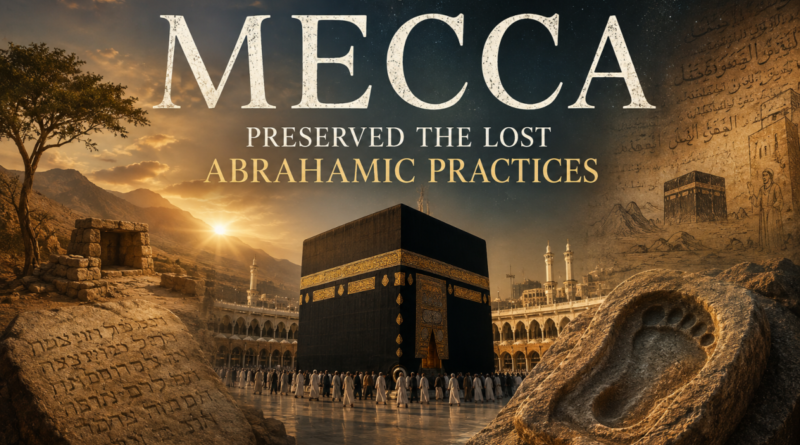
The House the Center Forgot: How Mecca Preserved the Lost Abrahamic Practices
There is a well-known and slightly counterintuitive law in historical linguistics: the oldest form of a word is often found not at the center of a language’s homeland but at its farthest margins. Linguists call the principle by several names—lateral areas, peripheral archaism, the conservatism of the isolated dialect—but the mechanism is the same everywhere. Innovation is a social act. It spreads outward from the places where prestige, population, commerce, and cultural energy concentrate, and it dies out, or never arrives, in the backwaters. The result is that the periphery becomes a kind of accidental museum. The center keeps moving; the edge holds still.
Icelandic is the standard illustration. Marooned in the North Atlantic, cut off from the trade routes and courts that reshaped the Scandinavian mainland, Icelandic preserved the grammar and much of the vocabulary of Old Norse so faithfully that a modern Reykjavík schoolchild can read the medieval sagas with less difficulty than an English speaker reads Chaucer. The mainland—Denmark, Sweden, the Norwegian coast—innovated its way into new languages. The island did not. Sardinian, walled off by water, kept features of spoken Latin that vanished everywhere else in the Romance world. The English of the Appalachian hollows preserved turns of phrase and vowel qualities that sounded archaic to visitors from London long before they sounded archaic to the people using them. In each case the outsider hears something strange and assumes it is a corruption, a rustic error. Usually it is the opposite. It is the older form, kept intact precisely because the community was too remote to be reached by the wave of change.
The crucial and disorienting consequence is this: when the isolated community and the innovating center meet again, the center often fails to recognize its own past. The margin is holding a piece of the center’s inheritance, but the center has drifted so far that the inheritance looks foreign. The word sounds like a barbarism. The custom looks like someone else’s custom. And a person standing at the center, secure in the belief that his community is the sole and authoritative custodian of the tradition, will tend to see the peripheral form as an imitation, a borrowing, or a mistake—when in fact he is looking at an earlier layer of himself.
This essay is about that pattern in the history of religion, and specifically about a recurring and under-examined feature of the biblical and Quranic material: the arrival, from outside the covenant community, of practices and recognitions that the community itself had lost. The transmission runs the wrong way. We are trained to imagine religion radiating outward from a chosen center to the nations. But again and again the texts show something moving inward—a Midianite priest correcting the administration of Israel, a foreign seer blessing it, a nomadic clan shaming it, and, much later, a medieval rabbi looking at his Muslim neighbors and recognizing in their devotions the lost gestures of his own prophets.
The priest of Midian
Begin with the clearest case. In Exodus 18, Moses has already led Israel out of Egypt. The sea has been crossed, the law is about to be given at Sinai, the nation is being constituted. And into the camp walks Jethro—not an Israelite, but the priest of Midian, Moses’ father-in-law.
Midian is not a random foreign nation. The Midianites are, in the Genesis genealogy, descendants of Abraham through Keturah, whom Abraham took after Sarah’s death; Midian is named among her sons. They are an Abrahamic people, cousins to Israel, carrying a share of the same patriarchal inheritance—but they are outside the Israelite line entirely, and they had been outside it for generations while Israel was in Egyptian bondage. They are, in other words, an isolated branch of the family.
Notice what Jethro is. He is a priest. He already possesses a functioning cult and a recognized sacerdotal office before he ever meets the God of the Exodus in Moses’ report. When Moses recounts the deliverance, Jethro’s response is not conversion in the ordinary sense but confirmation: he blesses the Lord and declares that now he knows the Lord is greater than all gods. Then Jethro takes a burnt offering and sacrifices to God, and Aaron and all the elders of Israel come and eat bread with Moses’ father-in-law before God. The leadership of Israel sits down to a sacral meal presided over, in effect, by a foreign priest. This is not a minor courtesy. It is Israel’s inner circle participating in worship led from outside its own ranks.
And then Jethro does something that shapes Israel permanently. He watches Moses sitting alone from morning to evening judging every dispute in the nation, and he tells him plainly that this is unsustainable—that he will wear himself out. He hands Moses the entire architecture of delegated justice: appoint capable, God-fearing men as chiefs over thousands, hundreds, fifties, and tens; let them judge the small matters and bring only the hard cases to Moses. This tiered judiciary, the backbone of Israelite governance, is not revealed at Sinai. It is a Midianite’s advice, offered before the law is given, and adopted wholesale. A foundational institution of the covenant people is a gift from the periphery.
The academic study of Israelite origins has taken this pattern much further than the surface narrative, and whatever one makes of the reconstructions, the biblical data they rest on are striking. A cluster of the oldest poetry in the Hebrew Bible places the origin of the God of Israel not in the land of Israel at all but in the deep south—in the deserts of Midian, Edom, and the Sinai. “The Lord came from Sinai and dawned from Seir upon us; he shone forth from Mount Paran,” says the Blessing of Moses. The Song of Deborah, one of the most ancient texts in the corpus, has the Lord going forth from Seir, marching from the region of Edom. The prophet Habakkuk sings that God came from Teman, the Holy One from Mount Paran. Teman and Seir and Paran are not Israelite heartland. They are the southern wilderness—Midianite and Edomite country, the land of Jethro.
Eighth-century inscriptions found at a remote desert waystation in the Sinai, at a site called Kuntillet Ajrud, refer to “Yahweh of Teman”—the God of Israel identified with a southern locale, in the very region the ancient poems name as his point of origin. Out of this convergence, a substantial body of scholarship has proposed what is usually called the Midianite or Kenite hypothesis: that the worship of Yahweh may have entered Israel from these southern, non-Israelite peoples, and that the figure of Jethro—priest of Midian, father-in-law of Moses—is the seam in the narrative where that older, external stream is still visible. One need not accept the full hypothesis to see the shape of the thing. The tradition itself repeatedly locates something original and authoritative outside Israel, in the isolated south, and shows it being carried inward.
A pattern, not an exception
If Jethro stood alone, he could be dismissed as a single odd episode. He does not stand alone.
Long before Sinai, before Israel exists, Abraham returns from battle and is met by Melchizedek, king of Salem, who is called “priest of God Most High”—El Elyon. Melchizedek brings out bread and wine, blesses Abraham in the name of the Most High God, and Abraham gives him a tenth of everything. Here is a legitimate priest of the true God, functioning with full authority, entirely outside the line of promise, and it is Abraham—the father of the whole covenant—who receives the blessing and pays the tithe. The direction of deference runs from the ancestor of Israel toward the foreign priest-king. The later tradition never quite absorbed how strange this is, which is why the Letter to the Hebrews had to expend so much energy explaining a priesthood “after the order of Melchizedek” that outranked the Levitical one it superseded.
Consider Balaam. He is a diviner from Pethor, by the River, in Aramean country—a foreigner hired by a foreign king to curse Israel. And yet the God of Israel speaks to him, genuinely and directly, and turns his mouth so that he can only bless. The narrative grants a pagan seer authentic access to revelation. This is not merely a literary conceit: a plaster inscription unearthed at Deir Alla, in the Jordan Valley and dating to around the eighth century, records the visions of a seer named Balaam son of Beor—the same name, attested in a non-Israelite religious text, a prophet whose reputation lived in the wider region independent of Israel’s scriptures. The tradition of true sight was not confined to the covenant people.
Consider Job. The book that bears his name, which the tradition treats as a summit of wisdom about God and suffering, is set in the land of Uz and concerns a man who is not an Israelite at all. Job worships God, offers sacrifice, is called blameless and upright, and none of it depends on the covenant, the law, or the land. His interlocutors are likewise outsiders—Eliphaz the Temanite among them, Teman again, that same southern country. An entire book of profound and orthodox God-talk is placed, deliberately, in the mouths of foreigners.
Consider, most pointedly, the Rechabites. In the days of Jeremiah, when Judah is sliding into faithlessness on the eve of the exile, the prophet is told to bring a clan called the Rechabites into the Temple and offer them wine. They refuse. Their ancestor Jonadab had commanded them to drink no wine, build no houses, plant no fields—to live in tents as sojourners—and for generations they had kept the command without deviation. The Rechabites are associated with the Kenites, the very clan of Jethro’s descendants, a peripheral, semi-nomadic people never fully absorbed into settled Israelite society. And God uses their fidelity as a weapon against Judah: these outsiders kept the word of their human ancestor faithfully for centuries, while the Israelites did not keep the word of their God. The marginal clan becomes the standard by which the center is condemned.
And behind all of them stands Abraham himself, who is the archetype of the whole phenomenon. Abraham is not a Jew and not an Israelite; those categories do not yet exist. He is a pure monotheist before the tradition crystallized into its later forms—the primordial hanif, in the Quranic idiom, one who submitted to God directly, without the accumulated apparatus that came after. Every later community claims him, and every later community, precisely because it came after, represents a drift away from the unmediated thing he was. The center is always downstream of Abraham. The question is only which of his scattered heirs kept the water clearest.
The cumulative force of these cases is hard to escape. The covenant line was never the sole reservoir of true worship. The margins keep handing something back to the center—a priesthood, a blessing, a wisdom, a fidelity, a judiciary—and the center, if it is honest, has to receive it.
The reservoir in the Hijaz
Now carry the principle east and forward in time, to the deserts of western Arabia.
The locations of Mecca and Medina, known as the Hijaz, in late antiquity were, in the relevant sense, a periphery of the biblical world—arid, tribal, largely beyond the reach of the great imperial churches and rabbinic academies to the north, and inhabited in part by peoples who traced themselves back to Abraham. Here, then, is another isolated Abrahamic branch, structurally parallel to Midian: cousins to Israel, carriers of a share of the patriarchal inheritance, cut off from the developing centers for many centuries.
The Quran’s account of itself is, in precisely these terms, a claim of restoration rather than novelty. It insists that Abraham was neither a Jew nor a Christian but a hanif who submitted to God, and it calls its hearers back to millat Ibrahim, the religion of Abraham, as something older and purer than the sectarian forms that grew up in his name.
[16:123] Then we inspired you (Muhammad) to follow the religion of Abraham,± the monotheist; he never was an idol worshiper.
It presents the Meccan sanctuary not as a new invention but as an ancient foundation: Abraham and Ismail raising the foundations of the House, purifying it for those who would circle it, and God commanding Abraham to proclaim the pilgrimage to humanity. In this self-understanding, the Arabian rites—the shrine, the pilgrimage, the sacrifice—are not borrowings and not local pagan accretions but survivals: the ritual furniture of the Abrahamic religion, kept in the isolated Hijaz through long centuries during which the northern communities elaborated, reformed, centralized, and in the process let some of the old forms lapse or transform beyond recognition.
Whether or not one grants the theological claim, the structural claim is exactly the linguistic principle with which we began. A community on the far edge of the Abrahamic world preserved concrete ritual practices in something like their archaic shape, while the communities at the center innovated past them. And when the two met, the center was inclined to see the peripheral forms as alien—an imitation, a paganism, a mistake—rather than as an older stratum of a shared inheritance. The Icelander’s Old Norse sounds like a foreign tongue to the mainlander who has forgotten it.
[19:59] After them, He substituted generations who lost the Contact Prayers (Salat), and pursued their lusts. They will suffer the consequences.
The rabbi who recognized it
The most remarkable thing about this reading is that it was not first proposed by an outsider or a polemicist. It was pressed, in the thirteenth century, by one of the most authoritative figures in medieval Judaism—the son of its greatest jurist-philosopher.
Moses Maimonides, the Rambam, needs no introduction. His son, Abraham Maimonides, inherited his father’s position as Nagid, the head of the Jewish community of Egypt, and was himself a formidable jurist and physician. And Abraham Maimonides became the leader of a devotional movement, the Egyptian Jewish pietists, that was openly and deliberately shaped by the Sufism of the surrounding Muslim world. His great guide for the spiritual life, the Kifayat al-Abidin—the Comprehensive Guide for the Servants of God—drew without embarrassment on Sufi models of piety.
What makes this more than a case of cultural influence is the reason Abraham gave for it. He did not regard the Sufi practices as attractive foreign customs worth adopting. He regarded them as Israelite—as the authentic devotional discipline of the prophets of Israel, which the Jews had lost in the misery of exile and oppression, and which the Muslim mystics had preserved. In his view, the Sufis were, in effect, walking in the paths of the prophets and imitating their ways; the practices had been taken from Israel because of the sufferings of the exile, and one could now see them, intact, among the gentiles. The proper response was not to admire them from a distance but to reclaim them, because they were ours to begin with.
Acting on this conviction, Abraham Maimonides tried to reintroduce into the synagogue a whole set of devotional postures and disciplines that he believed reconstructed lost prophetic and Temple practice—and that happen to line up closely with Muslim worship: ritual washing extended to the feet, standing in ordered rows, the raising of the hands, kneeling and full prostration, the discipline of nightly vigils, and forms of solitary spiritual retreat. He argued, in each case, that these were not innovations imported from Islam but the original forms of Israelite worship, evidenced in the Bible’s own descriptions of prophets and worshippers falling on their faces, that the Jews had abandoned under the pressures of dispersion. The son of Maimonides, sitting at the very center of the rabbinic tradition, looked at the practices of his Muslim contemporaries and saw the lost gestures of the prophets of Israel looking back at him.
Modern scholarship on the Cairo Geniza and on the Egyptian pietist movement has documented all of this in detail. For our purposes, the significance is precise and hard to blunt. Here is not a Muslim apologist but the Nagid of Egyptian Jewry, heir to the Rambam, asserting that Islam had preserved authentic elements of Israelite prophetic practice that the Jews themselves had lost. It is the periphery-and-center principle stated from inside the center, by a man with every reason to defend the center’s completeness, and choosing instead to concede that the isolated neighbor had kept something the homeland let slip.
The House, the stone, and the black cube
Abraham Maimonides was concerned with postures of prayer. But the same logic, followed further, reaches into the very architecture of pilgrimage—and here the resonances between the Arabian rite and the older Israelite material become genuinely arresting. These should be read as what they are: morphological correspondences within a common Semitic ritual grammar, not as a chain of documented borrowing in either direction. But the shared vocabulary is not trivial, and it is exactly the kind of deep structure that survives at the edges when the surface has been reworked at the center.
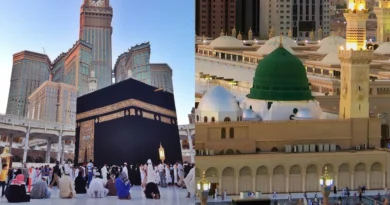
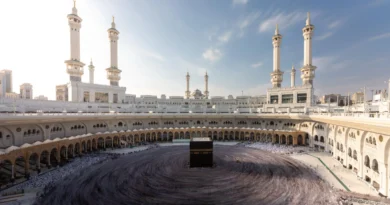
Start with a word. The central object of the Meccan pilgrimage is called, simply, al-Bayt—the House. Bayt Allah, the House of God; al-Bayt al-Haram, the sacred House; al-Bayt al-Atiq, the ancient House. The pilgrim circles the House.
Now recall the founding scene of the sanctuary in Genesis. Jacob, fleeing north, sleeps with a stone for a pillow, dreams of the ladder to heaven, and wakes convinced that the place is the dwelling of God. He takes the stone, sets it up as a standing pillar, pours oil over it to consecrate it, and names the place Beth-El—the House of God, bayt and El, the identical Semitic root. And he says of the stone itself: this stone shall be God’s house. The oldest Israelite sanctuary narrative we have is the story of a man consecrating a sacred stone and calling it, in the same Semitic word the Arabs use for the Kaaba, the House of God. The Greeks later borrowed the very term for such sacred stones—baitylos, the betyl—straight from the Semitic bet-El, the house of God. A venerated stone that is a “house” of the divine is not a Meccan peculiarity. It is a shared Semitic institution, attested in Israel’s own foundational memory.
And the Kaaba has its stone: al-Hajar al-Aswad, the Black Stone, set into the eastern corner. The gesture toward a sacred stone at the House of God recurs across the Semitic world, and the Hijaz preserved it in living ritual form long after the northern traditions had suppressed or spiritualized the veneration of standing stones—which the later biblical law, tellingly, came to prohibit outright. The prohibition is itself evidence: you do not legislate against a practice that no one is doing. Israel had it, and the reforming center drove it out. The periphery kept it.
Then there is the shape, and the color, and this is the detail that should stop the reader. The Kaaba is a cube. The word itself carries the sense of a cubic, four-square structure. And it is draped in black—the kiswa, the black cloth that covers the House. A black cube is the physical center of the Abrahamic pilgrimage.
Consider what a Jew binds to his body every weekday morning. The tefillin—rendered in Greek as phylacteries—are two small black leather boxes containing passages of scripture. One is bound to the arm. The other, the tefillin of the head, is a black cube, set on the forehead at the hairline, worn on the head throughout the morning prayer. And the technical name for that box, in Hebrew, is bayit—a house. The plural is batim, houses. The observant Jew places a small black house of God upon his head. The pilgrim circles a great black House of God in the valley of Mecca. The tefillin is a House you wear; the Kaaba is the House you walk around. The same word, the same cubic form, the same blackness, at two ends of the same Semitic world—one miniaturized and bound to the body of every worshipper, one monumental and fixed at the center of a pilgrimage.
The correspondence extends to the ritual gesture itself. The pilgrim circles the House seven times—the tawaf, seven circuits, counterclockwise, around the black cube. And the arm-tefillin, the black box bound to the arm, is fastened by a long black strap that is wound, in the standard practice, seven times around the forearm before it is wrapped around the hand. Seven windings of the strap around the arm; seven circlings of the body around the House. The number is not incidental in either tradition. Sevenfold circumambulation is, in fact, a native Israelite ritual act: at Jericho the people circle the city once a day for six days, and on the seventh day they circle it seven times, with seven priests blowing seven trumpets, until the wall opens. Circling a sacred site seven times to bring about a divine act is written into Israel’s own conquest narrative. The Hijaz did not invent the sevenfold circuit. It is a Semitic ritual form that Israel also possessed—and the pilgrimage of the periphery preserved it as a standing, repeated, central act of worship, while at the center it survived only as a single remembered miracle at a ruined city.
Even the running has a partner. The pilgrim’s sa’y, the sevenfold passage between the two hills of Safa and Marwa, is tied in the tradition to Hagar—Abraham’s wife, Ismail’s mother—searching for water in the wilderness of Paran. It is an Abrahamic memory, preserved as choreography, kept in the desert where the family was left, and folded into the pilgrimage the northern heirs no longer performed.
None of this requires the claim that Muhammad copied the tefillin or that the rabbis copied the Kaaba. That would be to miss the point entirely, and to reintroduce exactly the center’s error of treating a shared inheritance as an act of theft. The honest description is the one the linguistics gave us at the start. There was an ancestral Semitic ritual grammar—the House of God, the sacred and anointed stone, the black cube, the sevenfold circuit, the binding and the circling—and it was distributed unevenly across the descendants of that world. The reforming, textualizing, centralizing energies of the northern communities reworked the surface: the standing stone was outlawed, the physical House gave way to a spiritualized or destroyed one, the circuit shrank to a memory. But the deep forms did not vanish. They were kept, in one place miniaturized and bound to the forehead and arm of every worshipper, in another place monumentalized and left standing in the isolated valley where the family had been settled. To see them side by side is to see the same grammar twice, once at the center and once at the edge.
Reading the edges
Return, at the end, to the word at the margin of the map—the archaic form that the center hears as a barbarism and is in fact its own forgotten past.
The center is where the pressure is. It is where prestige accumulates, where reform is possible because reform is powerful, where theology is systematized, and law is codified, and the tradition is continually reworked to meet the needs of the present. All of that is creative, and much of it is necessary. But it is also, inescapably, a source of drift and loss. Every act of centralization discards something. Every reform is a decision about what to keep and what to let go, and the things let go do not always deserve to be let go—they are simply the casualties of a community with the power to move. The margin has no such power, and that powerlessness is its preservative virtue. Too weak to reform, too isolated to be reached by the reform of others, it becomes a vault.
This is why the transmission so often runs the wrong way. Jethro the Midianite hands Israel its judiciary before the law is even given. Melchizedek blesses the father of the covenant and receives his tithe. Balaam sees truly from outside. The Rechabites’ desert fidelity is turned into an indictment of Judah. The Hijaz keeps the House, the stone, the black cube, and the sevenfold circuit through centuries in which the north forgot them. And a medieval rabbi, the son of the greatest of the medieval rabbis, looks across the street at his Muslim neighbors and recognizes, in their prostrations and vigils, the lost devotions of the prophets of Israel—and has the intellectual honesty to say so, and to try to take them back.
To read a tradition whole, then, you cannot read only its center, however authoritative the center believes itself to be. You have to read the edges, and you have to be willing to entertain the possibility that a form which looks foreign, or late, or borrowed, is in truth the older thing—kept safe precisely because nobody powerful enough to change it ever lived where it was kept. The thing the center named long ago and then forgot may still be spoken, unchanged, at the far end of the map. It may be circling, seven times, around a black House in a desert valley. It may be bound each morning, a small black house, to the forehead of a man at prayer. And to recognize it for what it is, the center has only to be willing to look at its own periphery and see, not a stranger, but an earlier and less-drifted version of itself.