The Arrow and the Mountain: Zeno, Timescale, and the Moving Stillness of Sura 27:88
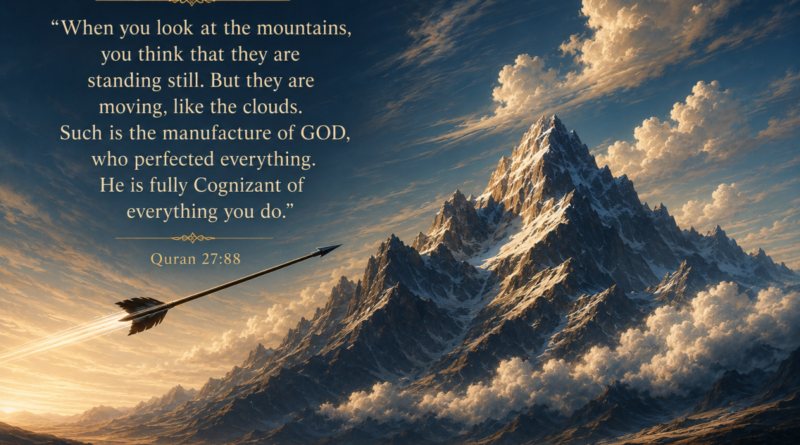
Sometime in the fifth century before Christ, in the Greek colony of Elea on the Italian coast, a philosopher named Zeno proposed a thought experiment that has never entirely gone away. Picture an arrow in flight. Now consider a single instant of that flight, a durationless slice of time. At that instant, the arrow occupies a region of space exactly equal to its own length. It is not moving into the space ahead of it, because at an instant there is no time in which to move. It is not moving out of the space behind it, for the same reason. At that instant, then, the arrow is at rest. But time, Zeno argued, is composed entirely of such instants. If the arrow is at rest at every instant of its flight, it is at rest throughout its flight. The arrow never moves. Motion is an illusion.
Zeno did not believe arrows fail to reach their targets. He was a student of Parmenides, the great metaphysician of stasis, who taught that true Being is one, unchanging, and eternal, and that the world of flux our senses report is a kind of cognitive error. Zeno’s paradoxes were weapons in that campaign: demonstrations that if you take change seriously and try to analyze it, you end in contradiction, and therefore change cannot be fundamentally real. Against Parmenides stood Heraclitus, for whom the opposite was true: reality just is flux, fire, the river you cannot step into twice, and it is stability that is the illusion, a temporary eddy in the stream. Western metaphysics has been oscillating between these two poles ever since.
The standard modern response to Zeno is mathematical. The calculus of Newton and Leibniz taught us to sum infinite series and to define velocity at an instant as a limit, and Bertrand Russell later formalized what philosophers call the “at-at” theory of motion: to move is simply to be at different places at different times, and there is nothing more to motion than this dense correspondence of positions to instants. The arrow moves because it occupies a continuous succession of locations across a continuous succession of moments. Problem solved, at least for the physics exam.
But Henri Bergson, writing at the turn of the twentieth century, saw that the mathematical answer concedes Zeno’s deepest premise even while refuting his conclusion. Both Zeno and Russell agree that time is built out of instants, that duration is an assembly of static snapshots. Bergson called this the cinematographic illusion of the intellect. The mind, he argued, works like a film camera: it takes stills of a moving reality and then runs them together fast enough to simulate motion. But the motion was never in the stills. You cannot reconstitute flow from any number of frozen frames, just as you cannot make water by piling up ice cubes. For Bergson, the true resolution of the paradox is to invert it. Motion is not the puzzle to be explained; the instant is. The durationless snapshot is an abstraction our minds perform upon a reality that is, in itself, pure passage. Zeno’s arrow is not proof that motion is illusory. It is proof that stillness is.
This inversion is worth sitting with, because it prepares us to hear something in the Quran that we might otherwise read past.
Things and Processes: A Distinction That Dissolves
Our language sorts the world into nouns and verbs, and our metaphysics tends to follow our grammar. Nouns name things: mountain, table, stone, planet. Verbs name happenings: flowing, burning, falling, dissolving. We treat these as two different kinds of reality. A mountain is an object, something that sits there and endures. A river is a process, something that happens. A flame is a borderline case that makes us slightly uncomfortable, because it holds a stable shape while being nothing but ongoing combustion, matter streaming through a pattern.
But examine the distinction closely, and it begins to dissolve. What makes the mountain a “thing” and the river a “process”? Not anything intrinsic to either. The difference is purely a matter of rate, and rate is only meaningful relative to a clock, and the clock we use is ourselves. Human perception samples the world within a narrow temporal window. We resolve events that unfold between roughly a tenth of a second and the span of a lifetime. Anything that changes faster than the bottom of that window blurs into invisibility: we do not see the hummingbird’s individual wingbeats, the flicker of a lightbulb, the oscillation of a plucked string. And anything that changes slower than the top of the window freezes into apparent permanence: we do not see the glacier advance, the continent drift, the mountain rise and erode.
The mountain is not still. It is a slow fountain. The Himalayas are surging upward at roughly the rate your fingernails grow, thrust by the Indian plate grinding into Asia, while rain, ice, and gravity tear them down at nearly the same pace. What we call the mountain is the momentary equilibrium of these opposing flows, the way a standing wave in a river holds its shape while the water composing it is replaced every second. Speed up the film, compress a hundred million years into a minute, and the mountains ripple across the landscape like weather. They pile up, migrate, and dissolve. They move, in the most literal sense, like clouds.
Run the film the other way and the reverse happens. Slow a cloud down, frame by frame, and it becomes an architecture, a sculpted solid hanging in the sky, as monumental and motionless as any alp. A mayfly, living a single day, would have every empirical reason to classify the cumulus overhead as a permanent fixture of the universe. A being whose thoughts unfolded over geological epochs would classify granite as vapor. Neither would be wrong about the data. Both would be wrong to mistake their sampling rate for an ontology.
There is a famous physical demonstration of this in a display case at the University of Queensland. In 1927 a professor poured heated pitch, a tar derivative that shatters like glass when struck with a hammer, into a sealed funnel and let it settle. Then he cut the funnel’s stem and waited. The pitch, which by every human test is a brittle solid, turned out to be a liquid roughly two hundred billion times more viscous than water. It flows. It has produced, in the century since, nine falling drops. No one has ever seen one fall. The experiment is a koan made of tar: a substance that is a solid at the timescale of a hammer blow and a liquid at the timescale of a decade. The question “but which is it really?” has no answer, because solidity was never a property of the pitch alone. It was a property of the relationship between the pitch and the clock of its observer.
Alfred North Whitehead, the twentieth century’s great process philosopher, drew the full conclusion: there are no things, only events of varying duration. What we call an object is simply a process slow enough, relative to us, to be named with a noun. A symphony is a fast event; a human life is a slower one; a mountain range is slower still; a star slower again. The universe is not furniture. It is music, played across tempos so disparate that the slower movements sound, to creatures like us, like silence.
The Verse
With all of this in mind, read the following verse, revealed in seventh-century Arabia:
[27:88] When you look at the mountains, you think that they are standing still. But they are moving, like the clouds. Such is the manufacture of GOD, who perfected everything. He is fully Cognizant of everything you do.
وَتَرَى ٱلْجِبَالَ تَحْسَبُهَا جَامِدَةً وَهِىَ تَمُرُّ مَرَّ ٱلسَّحَابِ صُنْعَ ٱللَّهِ ٱلَّذِىٓ أَتْقَنَ كُلَّ شَىْءٍ إِنَّهُۥ خَبِيرٌۢ بِمَا تَفْعَلُونَ
The precision of this verse is startling, and its precision is not primarily scientific but epistemological. Notice what it actually says. It does not say “the mountains are moving,” full stop, as a bare assertion of fact. It first describes an act of perception and diagnoses it: when you look at the mountains, you think they are standing still. The verse locates the stillness not in the mountains but in the looking. Stasis is presented as a judgment the observer forms, a hasib, a reckoning, an estimate, and the estimate is wrong. Then comes the correction, and the correction supplies exactly the comparison our thought experiment demanded: the mountains move like the clouds. The paradigm case of the static thing is identified with the paradigm case of the fleeting process. The noun is unmasked as a verb. The distinction between the enduring object and the passing event, the very distinction Parmenides and Heraclitus went to war over, is collapsed in a single image, and it is collapsed in the correct direction, Heraclitus’s direction, Bergson’s direction: the flow is real, and the fixity is the artifact of the observer.
And then the verse tells us why the world is like this. “Such is the manufacture of GOD, who perfected everything.” The Arabic is sunʿa Allahi alladhi atqana kulla shayʾ, God’s making, His craftsmanship, which has rendered every thing mutqan, perfected, brought to consummate precision. The word for making here, sunʿ, is not the vocabulary of a finished artifact sitting inert on a shelf. It is the vocabulary of workmanship, and the verse deploys it precisely at the moment it has revealed that the seemingly finished artifact, the mountain, is in fact still in motion, still in production. The mountain is not a completed noun that God made once. It is an ongoing act of making that we, at our timescale, mistake for a noun.
It is worth being honest about the interpretive landscape here. Many classical commentators, reading this verse in the context of the trumpet blast mentioned in the preceding verse, assigned the mountains’ movement to the Day of Resurrection, when the mountains will be scattered like carded wool. That reading is available. But it strains against the verse’s own grammar, which speaks of your looking and your thinking in the present, as a standing description of ordinary perception, and it strains even harder against the verse’s conclusion. A description of the world’s dissolution would be a strange occasion to praise the perfection of God’s craftsmanship; atqana kulla shayʾ describes a cosmos in consummate working order, not one being dismantled. The verse reads most naturally as a statement about the world as it is now: the mountains, right now, as you look at them, are moving, and your perception of their stillness is a limitation of your instrument.
That a seventh-century text should choose, of all objects, the mountain, the very thing it elsewhere calls a stabilizer, and declare its stillness a perceptual error, is remarkable. That it should then compare the mountain’s true motion to clouds, the exact image modern geology would reach for when time-lapsing tectonic drift, is more remarkable still. But the deepest layer is not the geology. It is the philosophy of perception: the Quran is teaching that stillness is observer-relative, that the appearance of static being is a function of the creature’s clock, and that reality, seen from the vantage of the One who is not bound by any clock, is process through and through.
The Stabilizers That Flow
There is an apparent tension here that turns out to be the whole point. The Quran repeatedly describes the mountains as rawasi, stabilizers, anchors:
[16:15] And He placed stabilizers (mountains) on earth, lest it tumbles with you, as well as rivers and roads, that you may be guided.
How can the mountains be both stabilizers and movers, both anchors and clouds? At a single timescale, this would be a contradiction. Across timescales, it is simply the truth, stated completely. At the timescale of human life and human civilization, the mountains stabilize: they are fixed landmarks, they anchor the crust, they shape climate and shelter valleys, and a man can navigate by them for all his days and his grandchildren after him. At the timescale of the earth itself, those same mountains are currents in a circulating rock mantle, waves passing through stone. The Quran uses both registers without embarrassment because both are accurate descriptions of the same process sampled at different rates.
Far from contradicting itself, the text is doing something more sophisticated: it is refusing to absolutize either frame. Stability is real, at the scale where creatures live. Flux is real, at the scale where God works. The error the verse corrects is not the perception of stability, which is functional and true within its window, but the metaphysical inference from that perception, the hasib, the conclusion that what looks still therefore is still, absolutely, in itself.
[32:5] All matters are controlled by Him from the heaven to the earth. To Him, the day is equivalent to one thousand of your years.
This is precisely where Zeno went wrong, and where his modern descendants go wrong. Zeno absolutized the instant, the frozen frame, and concluded that motion is impossible. The naive realist absolutizes the human frame and concludes that mountains are static things while clouds are passing processes. Both mistake a sampling artifact for the structure of reality. The Quran’s correction runs deeper than either: every frame is a creature’s frame, every clock is a created clock, and the reckonings we form within them, however useful, are estimates, not the final inventory of being.
If the mountain is not a finished object but an ongoing act, then creation itself must be reconsidered. The mountain moving like a cloud is what continuous creation looks like when the film is run at God’s speed rather than ours. The cosmos is a flame, not a stone: a pattern maintained by ceaseless expenditure, stable in form precisely because it is unceasing in process. What Bergson glimpsed philosophically, that duration is not an assembly of static instants but an indivisible flowing, the Quran asserts theologically: the flow is the sunʿ, the craftsmanship, and it never stops, because the Craftsman never withdraws.
[21:33] And He is the One who created the night and the day, and the sun and the moon; each floating in its own orbit.
Even the celestial bodies, the ancient world’s very emblems of changeless perfection, are given to us as swimmers, yasbahun, floating, coursing, in motion. There is no static tier of creation. There are only processes at different tempos, and a Sustainer whose relation to all of them is present tense.
The Moral Coda
The verse does not end where a philosophy paper would end. Having collapsed the mountain into the cloud and named the flow as God’s own craftsmanship, it closes with a turn that seems, at first, to change the subject entirely: “He is fully Cognizant of everything you do.”
But it is not a change of subject. It is the application. The verse has just taught you that your perception of stillness is unreliable, that beneath the apparent fixity of the world runs continuous, consequential motion invisible at your timescale. The closing clause turns that lesson from the mountains to the mirror. Your deeds are subject to the same illusion. A single act, a small dishonesty, a private kindness, a habit indulged or resisted, appears at the timescale of the day to be nothing, an instant, a frozen frame with no motion in it. Zeno’s paradox, applied to the moral life: at every instant, the soul seems to be standing still, so we conclude that nothing is really moving, that no trajectory is being traced. But characters drift like continents. Sum the imperceptible motions over years, and the coastlines of a life are redrawn, watersheds shift, ranges rise where there was plain. The man who looks at himself and thinks he is standing still is making the same hasib, the same erroneous reckoning, as the man who looks at the mountains.
[15:24] And we fully know those among you who advance, and we fully know those who regress.
And the verse names the observer for whom no motion is too slow and no instant too brief. He who perceives the mountains’ drift, to whom the Himalaya is a wave and the eon a day, perceives with the same resolution the tectonics of the heart. Nothing is lost in the sampling, because He does not sample. The One outside every timescale is the only one who sees any process whole, and every process, the verse insists, includes you.
Zeno froze the arrow and concluded that nothing moves. The Quran shows us the mountain flowing and concludes that everything does, that the stillness of the world is the artifact of our clocks, and that beneath the apparent fixity of stone and self alike runs the ceaseless, perfected workmanship of God. When you look at the mountains, you think that they are standing still. The verse is gentle with the perception and ruthless with the inference. Look again, it says. Everything is moving. Everything is being made. And everything you do is part of what is being watched, weighed, and, in the end, brought to its destination.
[96:2] To your Lord is the ultimate destiny.