Tehran hints at Hormuz talks with US as leaders gather at UN
By Samia Nakhoul and Parisa Hafezi
DUBAI, Sept 22 (Reuters) – A senior Iranian official told Reuters on Tuesday that Iran could reopen the Strait of Hormuz to Gulf shipping within days if the US lifts its blockade, describing a gathering at the UN as a “golden opportunity” to renew diplomacy with Washington.
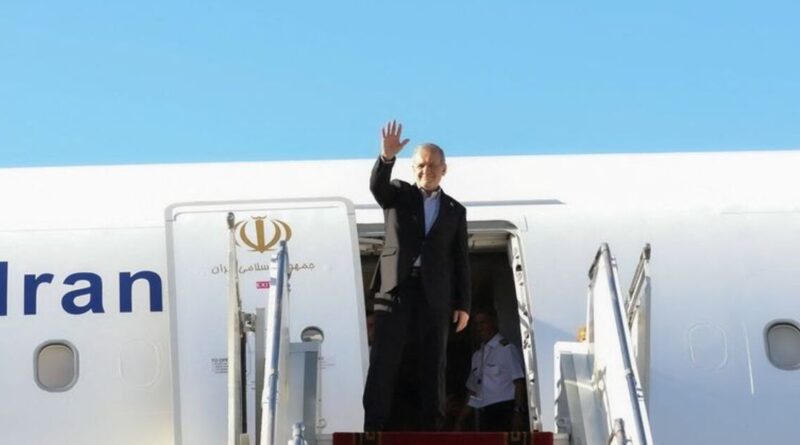
US President Donald Trump and Iranian President Masoud Pezeshkian are both due to attend the UN General Assembly in New York, the first time they will be at the same event since Trump launched “Operation Epic Fury” against Iran in February.
The Iranian official said Iran’s delegation had full authority to revive talks, although no direct meetings between the two presidents were planned.
No face-to-face meetings between Iran and the United States are known to have taken place since July, when an agreement on an interim deal to end the war collapsed just weeks after it was signed by Trump and Pezeshkian.
“The US needs to announce that it wants to resolve the issue diplomatically, make that official, and then agree on a timeline for how the process will move forward,” the Iranian official said.
“The UN General Assembly is a golden opportunity for the US to return to diplomacy,” the official said. He said Iran had sent its latest proposal to Washington via mediators on September 16.
US Secretary of State Marco Rubio told NBC’s “Today” show the US was open to speaking with the Iranians at the General Assembly, “especially if it has the prospects of leading to something positive and ultimately achieving the goal of what this is all about”.
SAUDI ARABIA INCREASINGLY EXPOSED TO EFFECTS OF WAR
Trump is due to meet on Tuesday with the leaders of the six Gulf Arab states: Bahrain, Kuwait, Qatar, Oman, Saudi Arabia and the United Arab Emirates.
The Gulf countries are keen to restore shipping through the Strait of Hormuz but wary of giving their longstanding rival Iran too much power.
All apart from Oman host huge US military bases that have come under repeated Iranian attack throughout the war, which has strained their decades-old security partnerships with Washington.
The biggest of them, Saudi Arabia, has been drawn deeper into the war this month, with Houthi fighters aligned to Iran advancing in Yemen, routing forces of a Saudi-backed government there and threatening Saudi oil exports through the Red Sea.
There was some relief on oil markets on Tuesday, after sources told Reuters that Saudi Arabia had restarted operations at its East-West Pipeline and could resume exports within hours, albeit at reduced volume, from the Red Sea port of Yanbu. [O/R]
The pipeline, Saudi Arabia’s main alternative route for exports to bypass wartime disruption in the Strait of Hormuz, was shut down after attacks on September 10 that Riyadh blamed on Iranian allies in Iraq. [O/R]
The Houthis have pushed back Saudi-supported government forces with the aim of controlling the Bab el-Mandeb Strait, the southern mouth of the Red Sea, and have attacked Saudi Arabia directly with missiles and drones.
The US, which bombed the Houthis for two months last year, has so far rebuffed repeated pleas from Saudi Arabia’s Crown Prince Mohammed bin Salman to rejoin the fight against the group. The New York Times reported that Trump called off US strikes against the Houthis on Sunday at the last minute, after troops had already begun loading bombs onto planes.
QATARI PROPOSAL ON THE TABLE
On the table at the Gulf states’ meeting with Trump is a Qatari proposal for a framework to bring Iran and the Arab Gulf states into a common security architecture, regional sources said.
Speaking at a Qatar Economic Forum in New York on Sunday, Qatari Prime Minister Sheikh Mohammed bin Abdulrahman Al Thani said any such arrangement would need to provide security guarantees for the Gulf states and expand economic interdependence with Iran.
“Lasting security cannot be built through repeated cycles of escalations and retaliation, or arrangements that leave any state permanently exposed to insecurity,” Sheikh Mohammed said.
Another source in the region told Reuters Iran was reviewing the proposal.
Houthi fighters in Yemen are pushing to seize the strategic heights of the Kahboub Mountains to cut off the Red Sea coast from remaining areas held by Saudi-backed forces.
The area of Kahboub overlooks the western coastline and Bab el-Mandeb, and would provide a commanding position from which the Houthis could seek to exert greater control over both. Its rugged landscape also makes it easier for Houthi fighters to remain concealed from drones and air strikes than on the coastal plain.
The fighting has already displaced more than 130,000 people this month and the UN refugee agency said on Tuesday that tens of thousands more people could be driven from their homes.
(Reporting by Reuters Gulf bureauxWriting by Samia Nakhoul and Kevin LiffeyEditing by Peter Graff)