Return of displaced Syrian Kurds to hometown suspended after violence
The return of displaced Syrian Kurds to their northeastern hometown of Ras al-Ain was suspended on Monday after a first group of returnees was attacked, prompting protests in other Kurdish-majority parts of Syria.
Hundreds of people had gone back to the town on Monday, months after a January agreement with the Syrian government on merging Kurdish forces and civil institutions into the state that included provisions for the return of displaced Kurds.
Jawan Isso, from a committee representing displaced people from Ras al-Ain, told AFP that a “first batch” of around 2,500 people were headed home but were later attacked by “armed groups”.
Mahmud Khalil Ali, deputy head of security forces in Syria’s Hasakeh province, said several of those involved in the attacks were arrested, but return trips were “temporarily suspended as a precautionary measure to ensure the safety of residents”.
“These trips will resume as soon as the situation stabilises and full protection is provided for the returnees.”
A second batch of Kurds was supposed to head to the town in the coming days, according to Isso.
Tens of thousands of Kurds were uprooted when Turkey and allied Syrian fighters seized an Arab-majority strip of territory along the Turkish border, including Ras al-Ain, from Kurdish control in 2019 during Syria’s civil war.
The attacks on Monday sparked a demonstration in nearby Kurdish-majority Qamishli, where an AFP correspondent saw angry protesters try to break into the security forces’ headquarters, with Syrian officers pushing them back.
In Kobane, a Kurdish-majority town in the north, Syrian state television said people attacked government offices and took down the Syrian flag in front of the local security forces headquarters.
Quoting a security source, state television then said authorities imposed a curfew on Kobane while looking for the perpetrators.
“We condemn the assault to which the displaced Kurdish families were subjected during their return,” Mazloum Abdi, leader of the Kurdish-led Syrian Democratic Forces who signed the January deal with Damascus, said on X.
“We understand the angry reactions in the Kurdish street in response to this assault, and at the same time, we call on our people to exercise self-restraint, refrain from being drawn into any irresponsible acts, and preserve our civil and security institutions,” he added.
Abdi said he was working with the relevant authorities “to ensure the protection of the returning displaced civilians”.
– ‘Waiting for this moment’ –
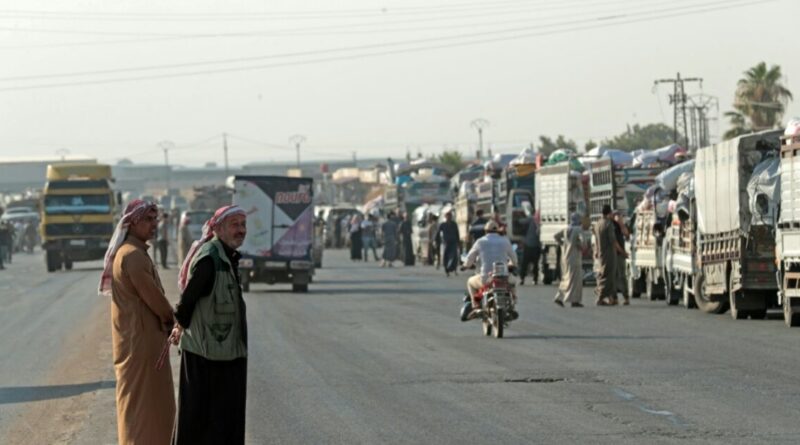
Earlier in the day, an AFP correspondent saw dozens of trucks loaded with furniture and other belongings waiting to set off from near the city of Hasakeh, with men, women and children eager to depart.
“I’ve been waiting for this moment… It’s like a dream for a person to return to their home,” said returnee Nora Khodor, 37.
Isso said that around 100,000 people from the Ras al-Ain area had applied to return.
Human rights groups say residents’ homes and belongings there were seized or looted after the offensive.
Some of the fighters subsequently settled in the area with their families, with some reportedly still living in the formerly ethnically mixed region, known as Sari Kani in Kurdish.
Turkey launched successive cross-border offensives against Kurdish-led forces in the country’s north before Syria’s new Islamist-led authorities ousted longtime ruler Bashar al-Assad in December 2024.
Since then, the authorities have been extending central government control across the country, including formerly Kurdish-held areas.
“We are very happy about returning,” said Rawda Mohammed, 39, before the violence erupted.
“I asked about my home. They told me it is totally destroyed, but we did not get pessimistic because we’re happy to return, and when we get there we’ll see what we can do.”
Some 5.5 million people remain internally displaced in Syria following the more than 13-year civil war, according to the United Nations.
str-lk/lg/nad/smw/sbk
AL-MONITOR All-Access gives you unlimited access to all our journalism, the full Daily Briefing, exclusive interviews, premium newsletters, and live events — for less than $2/week.