Regional Powers Cannot Substitute U.S. For Gulf’s Defense Against Iran
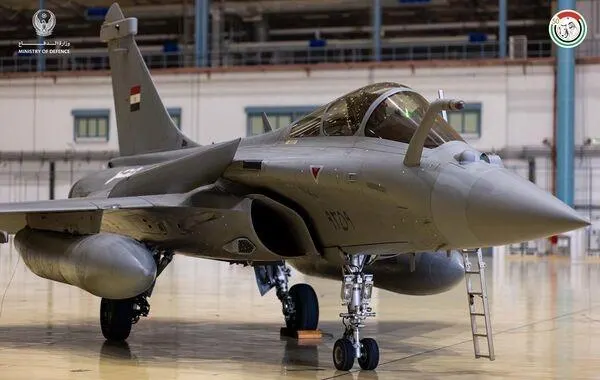
An Egyptian French-made Dassault Rafale fighter jet deployed to the United Arab Emirates. (UAE Ministry of Defense photo)
UAE Ministry of Defense
The U.S.-Israel war against Iran, launched on February 28, saw Tehran take the unprecedented step of repeatedly targeting all six Arab Gulf monarchical member states of the Gulf Cooperation Council with ballistic missile and explosive drones. After the April 8 ceasefire halted hostilities, some in the Gulf states began questioning why larger regional powers like Egypt didn’t do more to help defend them against Iran.
Iran and its regional militia proxies fired missiles and drones at the Gulf states throughout the war, with the United Arab Emirates enduring the brunt of these attacks. The UAE’s world-class air defense found itself under unprecedented strain, and the daily Iranian attacks undermined its carefully cultivated reputation for security and stability that Abu Dhabi strove to uphold for decades.
The Emirates and other GCC states provided grants and investments worth tens of billions of dollars to Egypt to prop up its economy since 2013. The war consequently left some Gulf Arabs wondering aloud why Egypt, which has the largest army of any Arab country, didn’t do more to assist them militarily.
In another unprecedented development of the war, Israel forward-deployed troops to operate Iron Dome anti-rocket and even the new Iron Beam laser defense system to help defend Emirati airspace from these constant attacks.
Tareq al-Otaiba, a former official in the Emirati national security council, wrote a scathing article for the Arab Gulf States Institute, charging that the Iran war exposed “the hollowness of Arab solidarity.”
“In the face of Iranian aggression, several states have stepped up to provide real assistance to the UAE,” he wrote. “Primarily, the United States and Israel have proved to be true allies by offering support through extensive military aid, intelligence sharing, and diplomatic backing.”
“The same support has not come from the Arab world.”
Al-Otaiba also correctly noted that the crisis was the worst the Gulf has seen since August 1990, when Saddam Hussein’s Iraq infamously invaded and annexed the GCC member state of Kuwait. On that occasion, the U.S. responded by assembling a multinational coalition that expelled the Iraqi Army in the ensuing 1991 Persian Gulf War.
Since then, the United States has remained the predominant military backer and arms supplier of the Gulf states, which host various American air and naval forces in large bases throughout the region that Iran bombarded during this latest war.
None of this necessarily means that other regional powers did nothing as the GCC faced its worst crisis since 1990.
Almost a month after the April 8 ceasefire, the UAE Ministry of Defense revealed that Egypt had deployed some of its French-made Dassault Rafale multirole fighter jets to the Gulf state. Egyptian President Abdel Fattah el-Sisi even visited and “conducted an inspection visit to the Egyptian fighter detachment stationed” there with his Emirati counterpart, Mohamed bin Zayed al-Nahyan. How many of these jets, where they are stationed, and whether they played an active role in helping the UAE shoot down drones during the conflict, remains unclear. Nevertheless, their deployment is a symbol of Egypt’s support for its Gulf ally’s defense and certainly isn’t nothing.
France deployed 12 Rafales to the UAE during the war which intercepted several drones. The French fighters expended at least 80 MICA air-to-air missiles, an expensive and unsustainable way of shooting down relatively inexpensive Iranian drones. France has already modified the Rafale’s cannon to intercept such drones more cost-effectivelysomething the UAE has probably taken note of, given the pending delivery of 80 Rafale F4s Abu Dhabi ordered in December 2021. In the meantime, Egyptian Rafales could conceivably augment their French counterparts if Iranian drone attacks resume in the near future.
The United Kingdom has also armed its Eurofighter Typhoons operating in the Middle East with the cost-effective Advanced Precision Kill Weapon System, which uses relatively inexpensive laser-guided rockets rather than conventional air-to-air missiles to intercept drones. The UAE and several other Gulf states have made large orders of thousands of APKWS rockets after their respective experiences in dealing with unrelenting Iranian drone barrages during the war.
The Wall Street Journal recently reported that Egypt also deployed ground-based air defenses to the UAE and other Gulf states during the war. The systems in question were reportedly the Skyguard Amoun, which integrates anti-aircraft guns and surface-to-air missiles, making it suitable for providing point defense for bases and critical infrastructure. As with the Rafales, it’s unclear if these intercepted anything.
Additionally, Reuters reported that Saudi Arabia’s longtime ally, Pakistan, had deployed 8,000 troops, along with JF-17 Thunder multirole fighter jets and long-range Chinese-made HQ-9 air defense missile systems to the kingdom. Islamabad has stationed troops on Saudi soil during past regional crises, including the Iran-Iraq War and the 1991 Persian Gulf War, to help bolster its defenses. The Iran war was no different. It’s also long been suspected that Pakistan and Saudi Arabia have an understanding in which the former would put its nuclear arsenal at the disposal of the latter if the kingdom faced an existential threat.
Today, Pakistan, Egypt, and Turkey, which also have troops and F-16 fighter jets stationed in GCC member Qatar, are earnestly pushing for negotiations aimed at ending hostilities with Iran. They have a vested interest in doing so: both for regional security and stability and, of course, to mitigate the risk that their troops and military hardware in the Gulf could come under Iranian fire if this regional war resumes.
The war wasn’t the first time the GCC had found its regional allies somewhat lacking in providing an alternative or parallel military support to the U.S. and other Western armed forces.
In the 1980s, leading GCC states supported Saddam Hussein’s Iraq during the Iran-Iraq War with the notable exception of Oman. Muscat has always had the closest ties to Tehran of any GCC state, but that still didn’t spare it from Iranian attacks this year. Back then, Oman shrewdly understood that “only Tehran could potentially act as a balance to an immensely powerful Baghdad,” which Saudi Arabia and Kuwait were financing and helping to become a predominant military power in the region with an enormous army. A mere two years after the Iran-Iraq War ended, Saddam Hussein infamously annexed Kuwait, sending shockwaves throughout the GCC states. In 2019, then-Iranian President Hassan Rouhani even argued that Saudi Arabia and the UAE only survived that crisis because Tehran didn’t cooperate with Saddam Hussein against them.
While the U.S.-led coalition liberated Kuwait and shielded the GCC, these states briefly explored a regional non-American solution for their defense. The subsequent March 1991 Damascus Declaration envisioned the GCC financing a long-term deployment of Egyptian and Syrian troops in Kuwait and Saudi Arabia to defend them against Iraq. Both Arab countries had provided sizable troop detachments to the U.S.-led coalition that fought the Gulf War.
However, grand plans for a permanent force of up to 100,000 Egyptian-Syrian troops were quickly reduced to a much more “symbolic” force of a mere 3,000 to 5,000. Even newly liberated Kuwait expressed its belief that there was “no substitute for Western might.”
Egyptian and Syrian troops left the Gulf by the summer of 1991, and talk of any Egypt-Syria force was abandoned by the end of the year or, in the words of one retrospective analysis“achieved the status of a footnote in history.”
Whether the current Egyptian and Pakistani deployments will become a similar footnote remains to be seen, though it’s already apparent that, at least as far as some in the GCC states are concerned, they cannot adequately substitute for American military might.