US and Iran move closer to extending ceasefire by 60 days, say mediators
Mediators believe they are edging closer to a deal to extend the US ceasefire with Iran by 60 days and lay the framework for discussions on the Islamic republic’s nuclear programme.
People briefed on the high-stakes talks said it would include a gradual reopening of the Strait of Hormuz and a commitment to discuss the diluting or handing over of Iran’s stockpile of highly enriched uranium.
The US would also ease its blockade of Iranian ports and, in phases, agree to sanctions relief and unfreezing Tehran’s assets held overseas.
Donald Trump told Axios on Saturday that he would meet his senior officials to discuss the proposal, but the US president added it was a “solid 50/50” whether he would be able to make a “good” deal or else “blow them to kingdom come”.
He held a call with the leaders of Saudi Arabia, Pakistan, Qatar, the United Arab Emirates, Egypt and Turkey on Saturday, an Arab official said. A diplomat said the call “was very positive”.
“Good progress is being made,” the diplomat said. “Regional leaders were supportive of the progress.”
Iran’s foreign ministry spokesman Esmael Baghaei said that Tehran was discussing a “memorandum of understanding” to end the war as the first phase of a deal, before moving on to thrash out the details of a broader agreement within 30 to 60 days.
“We are now finalising this memorandum of understanding,” he said.
Mediators hope that the terms of the agreement will dissuade Trump from resuming strikes on the Islamic republic, amid fears the US could strike in days if the diplomatic effort fails.
“The deal seems to be going in the right direction. It’s with the Americans now for review,” the diplomat briefed on the talks said. “Iranians are likely ready to give more on nuclear energy but won’t do it while the war is ongoing — this deal helps bridge the gap.”
US secretary of state Marco Rubio earlier said there had been “some progress made”.
“There is a chance that, whether it’s later today, tomorrow, in a couple of days, we may have something to say,” he told reporters while on a visit to India. “But this issue needs to be solved, as the president said, one way or another.”
He added that Trump’s preference was to deal with it diplomatically.
The tentative signs of progress came after Pakistani and Qatari negotiators held crunch talks with Iranian counterparts on Thursday and Friday.
After Field Marshal Asim Munir, Islamabad’s lead negotiator, left Tehran on Saturday, the Pakistani army said the talks “resulted in encouraging progress towards a final understanding” between the US and Iran.
The mediators were in regular contact with US envoy Steve Witkoff while talking to the Iranian delegation, which was led by Mohammad Bagher Ghalibaf, the parliamentary speaker, and foreign minister Abbas Araghchi.
Ghalibaf, one of Iran’s top wartime civilian leaders, told Munir that Tehran would not step back from its “rights”, especially when dealing with the US, which “has not been sincere and cannot be trusted”.
He added that Iran would use diplomacy to secure its “legitimate rights and interests”.
Ghalibaf also said Iran had rebuilt its military capabilities during the ceasefire, which began in early April, and was prepared to respond in a more “crushing” manner should the US commit the “folly” of restarting the war, according to Iranian media.
Underscoring the tenuous state of progress, Baghaei said the two sides were both “very far and very close” to an agreement.
“On one hand, we have the experience of the American side’s contradictory statements and shifting positions. They have put forth conflicting stances several times,” Baghaei said. “We cannot be completely certain that this approach will not change.
“On the other hand, the views [of the two sides] are getting closer, not in the sense that we have reached an agreement on such significant issues, but in the sense that we can reach a mutually satisfactory solution based on a set of parameters.”
One of the big stumbling blocks has been Trump’s insistence that Iran must hand over its stockpile of 440kg of uranium enriched close to weapons-grade levels and that the republic must never have the capacity to develop a nuclear weapon.
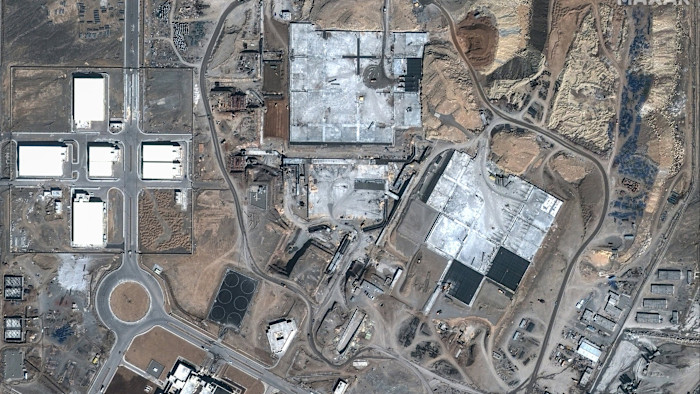
The US president has also demanded that Iran dismantle its three main nuclear sites — Natanz, Fordow and Isfahan — which the US bombed after joining Israel’s 12-day war against the republic last June.
The highly enriched uranium is believed to be beneath the rubble of those sites, mostly at Isfahan.
The intense push to get an agreement over the line and build on a fragile ceasefire agreed on April 8 comes amid fears that if no deal is reached Trump would resume strikes, escalating a war that has spread across the Middle East.
Trump on Monday said that the US held off from renewing attacks on Iran — which he said would have been launched the following day — while adding that “serious negotiations” with Tehran were taking place. He said Saudi Arabia, Qatar and the UAE had asked him to suspend the military assault.
Washington’s regional allies fear that a resumption of US-Israeli strikes would cause Iran to retaliate by striking Gulf states, which have borne the brunt of the Islamic republic’s attacks, and exacerbate the worst global energy crisis in decades.